



 PDF
 Citation
 Print


INTRODUCTION
The root canals are chemomechanically treated to eradicate pulp tissue fragments and related bacteria. Various sodium hypochlorite (NaOCl) concentrations, ranging from 0.5% to 5%, are implemented to eliminate the bacterial burden [1]. Mechanical instrumentation created a thin smear coating that obstructs the dentinal tubules. This layer could be removed using 17% ethylenediaminetetraacetic acid (EDTA), which dissolves inorganic particles, thereby softening dentin [2]. None of these irrigants could be described as optimum. However, from a mechanical standpoint, the gradual breakdown of organic content, particularly type 1 collagen fibrils, and inorganic dentin constituents may contribute to root fracture following treatment [3].
A secure coronal seal, provided by an adhesive restoration, is crucial to prevent bacterial re-entry into fully restored root canals. The chemical effects of endodontic irrigation solutions on the dentin lining the root canals may similarly influence coronal dentin when these substances are infused into it during endodontic therapy. These solutions may impair the bonding of the ultimately inserted adhesive restoration, either by altering the bonding technique or by altering the mechanical and structural properties of the dentin surface [4,5].
In endodontics, collagen cross-linking and dentin biomodifier compounds are used as intraradicular final irrigants to enhance the mechanical, chemical, and physical properties of the dentin substrate; thereby, they may improve sealer penetration depth. These compounds can induce biomodification of dentin, a process traditionally accomplished with artificially manufactured cross-linking agents, such as chlorhexidine (CHX), which produces a stable, long-lasting hybrid layer [6]. Among the limitations of the CHX is its incompatibility with the dentin surface [7]. Additionally, most synthetic cross-linking agents produce a rapid effect, resulting in the formation of a surface barrier over the dentin; hence, they prevent the collagenolytic action at greater dentin depths, in addition to the presence of non-reacted molecules that induce cytotoxicity [8,9]. Therefore, natural dentin biomodifiers could serve as feasible substitutes for synthetic ones, given their biosafety and minimal cytotoxicity. Bromelain is a naturally derived dentin biomodifier that is commercially extracted from the pineapple fruit or stem. Bromelain enzyme is a collection of sulfhydryl proteolytic enzymes that includes a variety of cysteine proteases. It was reported that bromelain promotes the dilation of dentinal tubules on the exposed dentin surface by diminishing collagen on the demineralized surface [10]. However, insufficient data had been documented to investigate the impact of 8% bromelain enzyme as an intraradicular final irrigant on both resin-bond strength to coronal dentin and sealer-penetration following chemo-mechanical root canal debridement, so this research was intended to evaluate the effect of 8% bromelain enzyme and CHX, as intraradicular final irrigant, on the dentin-collagen matrix integrity by assessing the resin-coronal dentin microtensile bond strength (µTBS), dentin-bond interfacial micromorphology, and sealer penetration depth to radicular dentin utilizing scanning electron microscopy (SEM). The null hypotheses are proposed as follows: (i) The different investigated dentin biomodifiers did not have a positive impact on either the resin composite µTBS to coronal dentin or the sealer penetration depth to radicular dentin. (ii) The proposed dentin biomodifiers would not affect the micromorphology of the dentin-bond interface.
METHODS
Sample size calculation
Based on earlier research [11,12], the sample size was quantified adopting G*Power ver. 3.1.9.7 (Heinrich-Heine-Universität Düsseldorf, Düsseldorf, Germany). To assess resin-coronal dentin µTBS and sealer penetration depth, a sample size of (n = 51) and (n = 42) was estimated. This calculation was performed using an alpha level of 0.05, a beta level of 0.10, and effect sizes (d) of 0.53 and 0.58.
Specimens’ selection and ethical approval
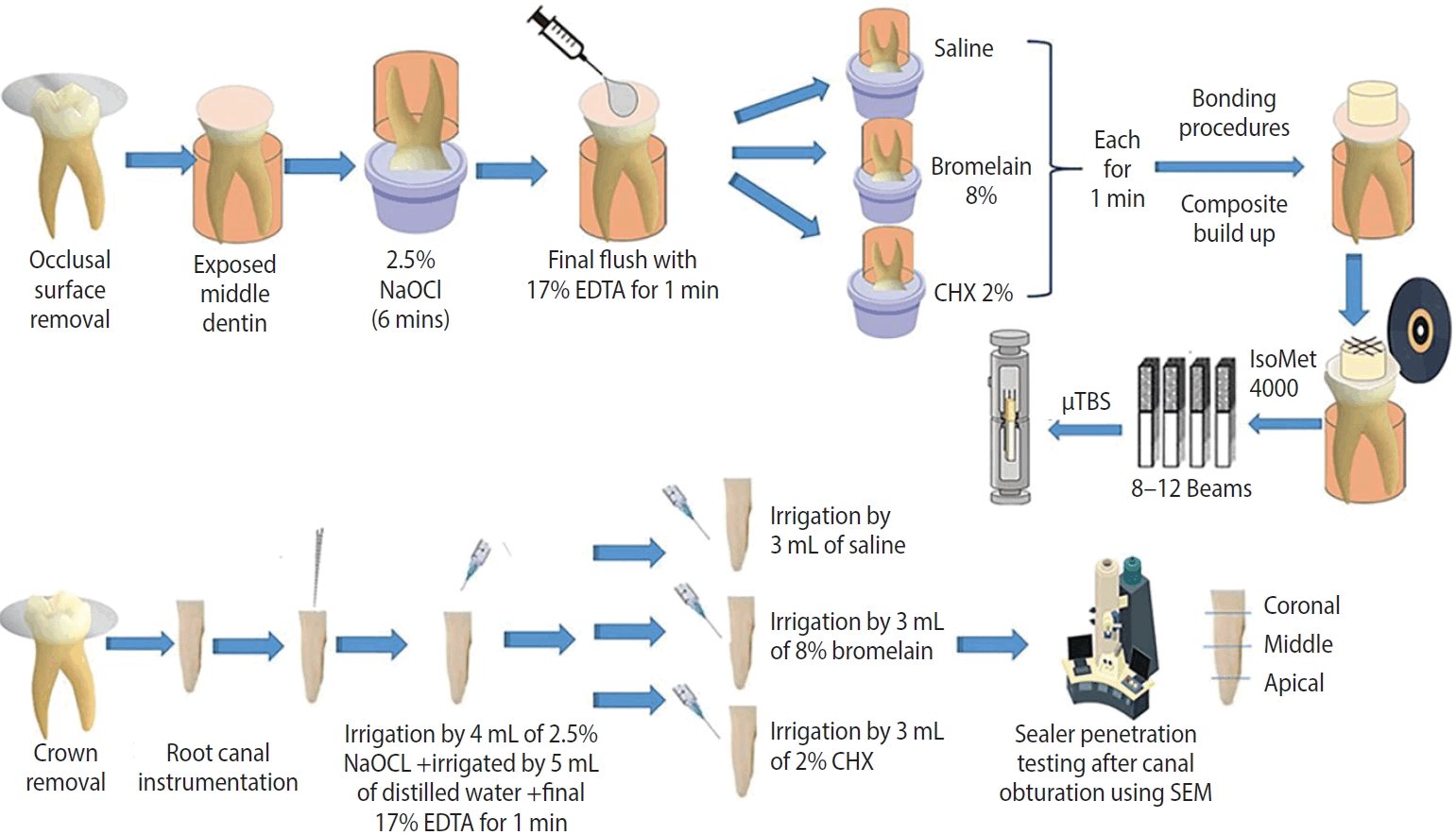
The research protocol was validated by the Ethical Research Committee of the Faculty of Dentistry, Cairo University, on July 24, 2019 (document number 59/7/24). A total of 51 and 42 anonymous caries-free human mandibular first molars were selected, ultrasonically cleaned, and maintained at 4°C in a saline solution supplemented with 0.02% sodium azide until future use. The entire experimental procedure is illustrated in Figure 1.
Coronal dentin specimens’ preparation
Fifty-one lower first molars were embedded in 2 cm diameter cylinder-shaped plastic molds pre-filled with soft acrylic resin. After complete resin polymerization, the occlusal tables of the molars were slit via a diamond saw (Isomet 4000; Buehler, Lake Bluff, IL, USA) along with water stream cooling to produce flat mid-dentin surfaces [13]. Each surface was smoothed using silicon carbide paper (600 grit) for 1 minute with water cooling, and then water flushed to construct a standardized smear layer [14]. For the entire specimens, dentin surfaces were immersed in 20 mL of 2.5% NaOCl (Golden Falcon, Dubai, UAE) for 6 minutes, washed under distilled water (DW) for 15 seconds, and finally flushed with 17% EDTA (3 mL; Root Dental Medical Devices Co., Ltd., Beijing, China) for 1 minute [15].
Bonding procedure and composite build-up
The samples were randomly assigned to three groups (n = 17) according to the dentin biomodification protocol, where each specimen was immersed for 1 minute in a plastic container containing equal amounts (3 mL) of the proposed dentin biomodifier. Group 1: Dentin surfaces biomodified with saline (control group) [12]. Group 2: Dentin surfaces biomodified with 8% bromelain solution, which was prepared by dissolving pure bromelain powder (8 g; Sigma Aldrich, Darmstadt, Germany) in DW (100 mL) [16,17]. Group 3: Dentin surfaces biomodified using 2% CHX (Consepsis; Ultradent Products, South Jordan, UT, USA) [13].
The specimens were subsequently washed out for approximately 15 seconds with DW and gently air-dried. Following the manufacturer’s instructions, a universal adhesive (All Bond Universal; BISCO Inc., Schaumburg, IL, USA) was utilized in self-etch mode and was coated on the dentin surfaces and light polymerized for 15 seconds utilizing a light-curing device (Woodpecker, Mini S Curing Light; RTA, Guilin, China) with a 1,000 mW/cm2 intensity and a 420 to 480 nm wavelength. The resin composite was then incrementally placed to form 4 mm-thick build-ups (Schütz CAPO Composite Universal; Schütz Dental GmbH, Rosbach vor der Höhe, Germany); each composite increment (2 mm) was continuously light polymerized for 40 seconds. The bonded samples were preserved in DW at 37°C for up to 24 hours.
Microtensile bond strength measurements
The bonded samples were cut longitudinally, at right angles to the bonded interfaces, into beams with 1 mm² of bonding area. They were obtained by placing the pretreated tooth in the gripping attachment and sequentially sectioned using a cutting machine (IsoMet 4000; Buehler, Esslingen am Neckar, Germany) under copious coolant. Exploiting a digital caliper (Absolute Digimatic; Mitutoyo, Tokyo, Japan), the proportions for all beams were validated. To test μTBS, 8 to 12 beams were chosen from the center of each tooth. Each beam was set up in a universal testing machine (Instron, Model 3345; Instron Corp, Norwood, MA, USA) and secured in the testing jig utilizing cyanoacrylate-based adhesive. The beams were stressed in tension at a crosshead rate of 0.5 mm/min till the sample’s bonding failure occurred. Finally, bond strength was measured in megapascal (MPa).
Failure mode examination
The failure modes were analyzed using a stereomicroscope (MA 100; Nikon, Tokyo, Japan) at 30× magnification. Three distinct categories of failure patterns were recognized: adhesive failure (in between resin and dentin), cohesive failure (dentin or resin), or mixed failure (both adhesive and cohesive failure).
Scanning electron microscopy
From each group, a randomly selected representative sample was examined using field-emission SEM (Quattro S; Thermo Fisher Scientific, Hillsboro, OR, USA) to investigate the resin-dentin interface. The specimens were prepared, attached to aluminum stubs, and then inspected on the SEM (field emission gun) at a magnification (14× up to 1,000,000), an accelerating voltage (30 kV), and a resolution for the Gun. 1n.
Specimens’ selection and preparation for the sealer penetration test
The crowns of 42 lower first molars were cut, and occlusal surfaces were smoothed to establish a point of reference for working length (WL) standardization. The roots were standardized to 17 mm in length. A closed canal system was formed, and the external surface of each root was covered with tray adhesive. The root apex was wrapped in flexible, hot adhesive, which was allowed to set before being embedded in a transparent polyvinyl silicone-filled Plexiglas tube. K-file ISO #10 was placed into the mesiolingual root canal to achieve a 0.1 mm apical diameter with a curvature range of 10°–20°, adhering to the Schneider technique [18]. This was performed to ensure apical clearance till its tip was apparent in the apical foramen. While the file was first observed, its length was reduced by 1 mm to obtain the WL, which was fixed at 16 mm [19].
Root canal instrumentation
The Edge File X5 rotary system (EdgeEndo, Albuquerque, NM, USA) was employed for mechanical root canals’ preparation through a crown-down method exploiting an endodontic electric motor (XSmart; Dentsply Maillefer, Ballaigues, Switzerland) rated at a modified torque (2 Ncm) at a rotation rate (300 rpm) following the manufacturer’s directions. A pecking motion of the rotary system was performed up to the full WL as follows: 20/6%, 20/4%, 30/6%, followed by 30/4% as the master apical file.
Irrigation protocol
The prepared canals were first washed out with a 2.5% NaOCl solution (2 mL) for 1 minute, followed by the same amount of this solution after the #10 K-file and the #15 K-file, each for 1 minute. During instrumentation, continuous irrigation was performed using 2.5% NaOCl (4 mL) for 1 minute via a plastic single-use syringe (Sung Shim Medical, Bucheon, Korea) with a 30-gauge side-vented needle inserted passively and positioned 2 mm from the WL. Finally, to counteract the NaOCl carryover effect, the canals were washed out with (5 mL) DW for 1 minute and finally washed utilizing 17% EDTA for 1 minute. After that, the root canals were randomly assigned across three groups (n = 14) with regard to the dentin biomodification protocol, which applied intra-radicularly as a final irrigant, whereby the root canals were finally irrigated passively with the same volume and duration of the proposed dentin biomodifiers that were applied in the coronal portion as a final irrigant. The entire quantity of irrigants applied in each canal was NaOCl (20 mL) for 6 minutes and DW (5 mL) for 1 minute. The canal patency was preserved via exploiting a K-file size #10. Each instrument was discarded after being used in five canals. All the prepared canals were rinsed with DW (5 mL) for 1 minute, thoroughly dried using absorbent sterile #30 paper points, and then obturated with a master apical gutta-percha point size 30/4% that was extended to the entire canal length. Using a master apical file, the MTA Bioseal bioceramic sealer (Itena Clinical Products, Paris, France) was blended and applied circumferentially. The lateral compaction technique was then used to plug the canals to ensure a tight, adequate seal [20].
Sealer penetration depth measurement
The specimens were maintained at 37°C with 100% humidity for 2 weeks. Thereafter, sealer penetration was measured using SEM (Quanta FEG 250; FEI Company, Eindhoven, the Netherlands). Each root section was split into four quadrants (mesial, distal, buccal, and lingual). Three measurements were carried out in each quadrant. The sealer penetration values were estimated by a single calibrated investigator as the mean of the measurements’ data. Images were taken for each quadrant at 500× magnification. The sealers penetrating the dentinal tubules were identified by energy dispersive X-ray analysis as containing a radiopaque constituent (zirconium oxide). Each quadrant was evaluated for the highest sealer penetration depth [21].
Statistical analysis
Data normality has been assessed by examining the distribution, calculating the mean and median, and using the Kolmogorov-Smirnov and Shapiro-Wilk tests. The data exhibited a parametric distribution; hence, they were displayed as mean and standard deviation values. The effects of the examined factors and their interactions were investigated using one- and two-way analyses of variance (ANOVAs). The main and simple effects were compared using pairwise t-tests with Bonferroni correction, and proportions across qualitative parameters were compared using the chi-square test of significance. The significance threshold limit was established at p ≤ 0.05. Statistical assessment was implemented with IBM SPSS for Windows, ver. 26.0 (IBM Corp, Armonk, NY, USA).
RESULTS
Microtensile bond strength
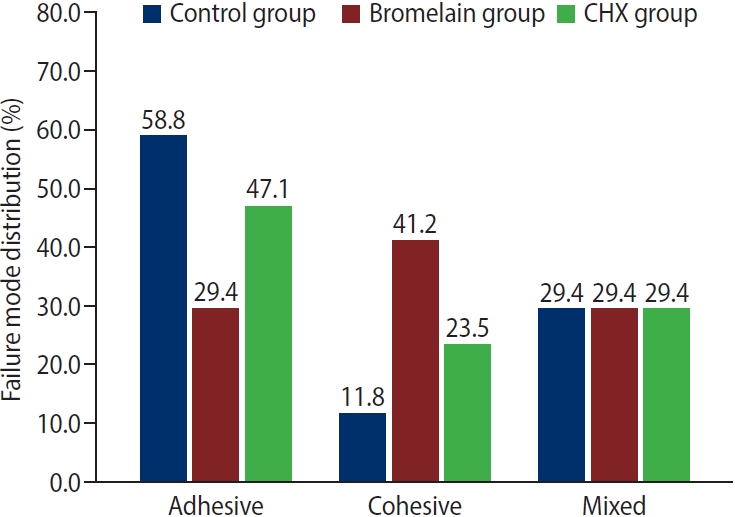
Table 1 demonstrated that the bromelain biomodified group exhibited the highest statistically significant values (46.38 ± 3.42), followed by CHX (39.26 ± 7.60), and the lowest values were recorded with the control specimens (32.41 ± 7.71) based on the ANOVA test (p = 0.001) and Bonferroni post hoc test. Regarding failure mode distribution, 41% of the bromelain-treated specimens showed cohesive failure, and 29% revealed adhesive failure. In the CHX-treated group, only 23% of the specimens revealed cohesive failures, and 47% showed adhesive failure. In the control group, 11% of the specimens showed cohesive failure, and 58% showed adhesive failure. The mixed failure pattern was equally distributed among all tested groups (Figure 2).
Scanning electron microscope
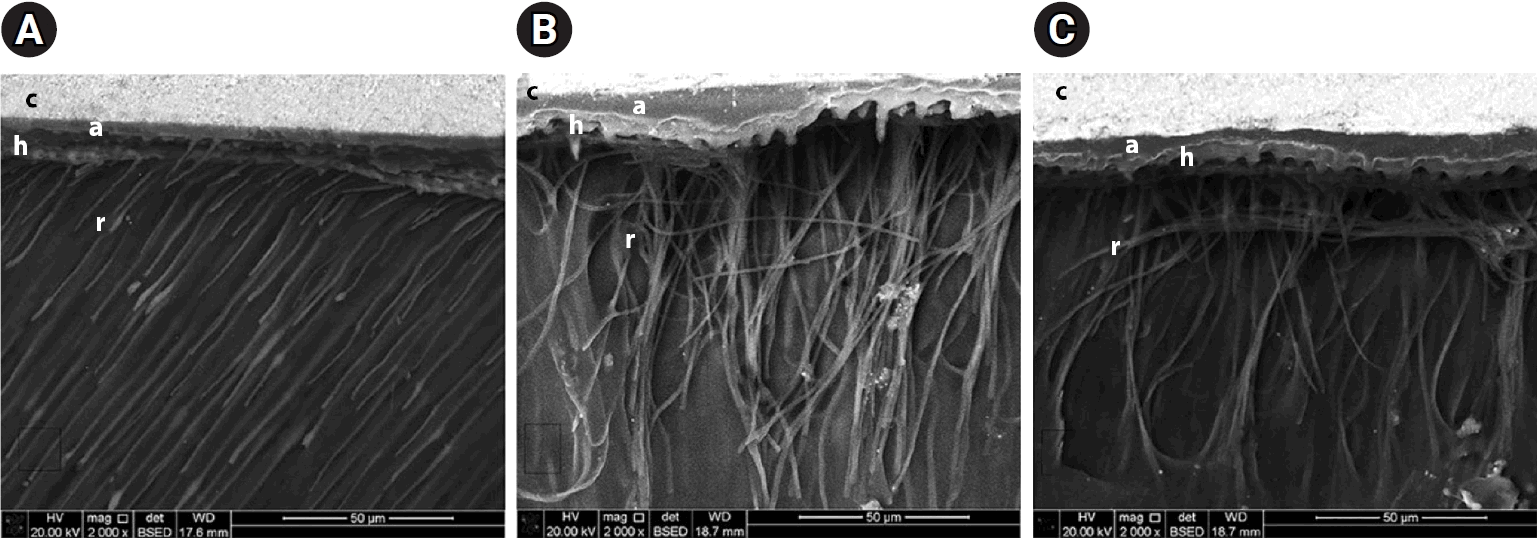
Representative SEM micrographs of the resin-dentin bond interface for each group are shown in Figure 3. The control specimens demonstrated a thin hybrid layer exhibiting short extending resin tags. In bromelain-treated specimens, resin tags were more numerous, elongated, and exhibited lateral branching and obvious entanglement. Meanwhile, in the CHX group, resin tags were fewer than in the bromelain-treated specimens.
Sealer penetration
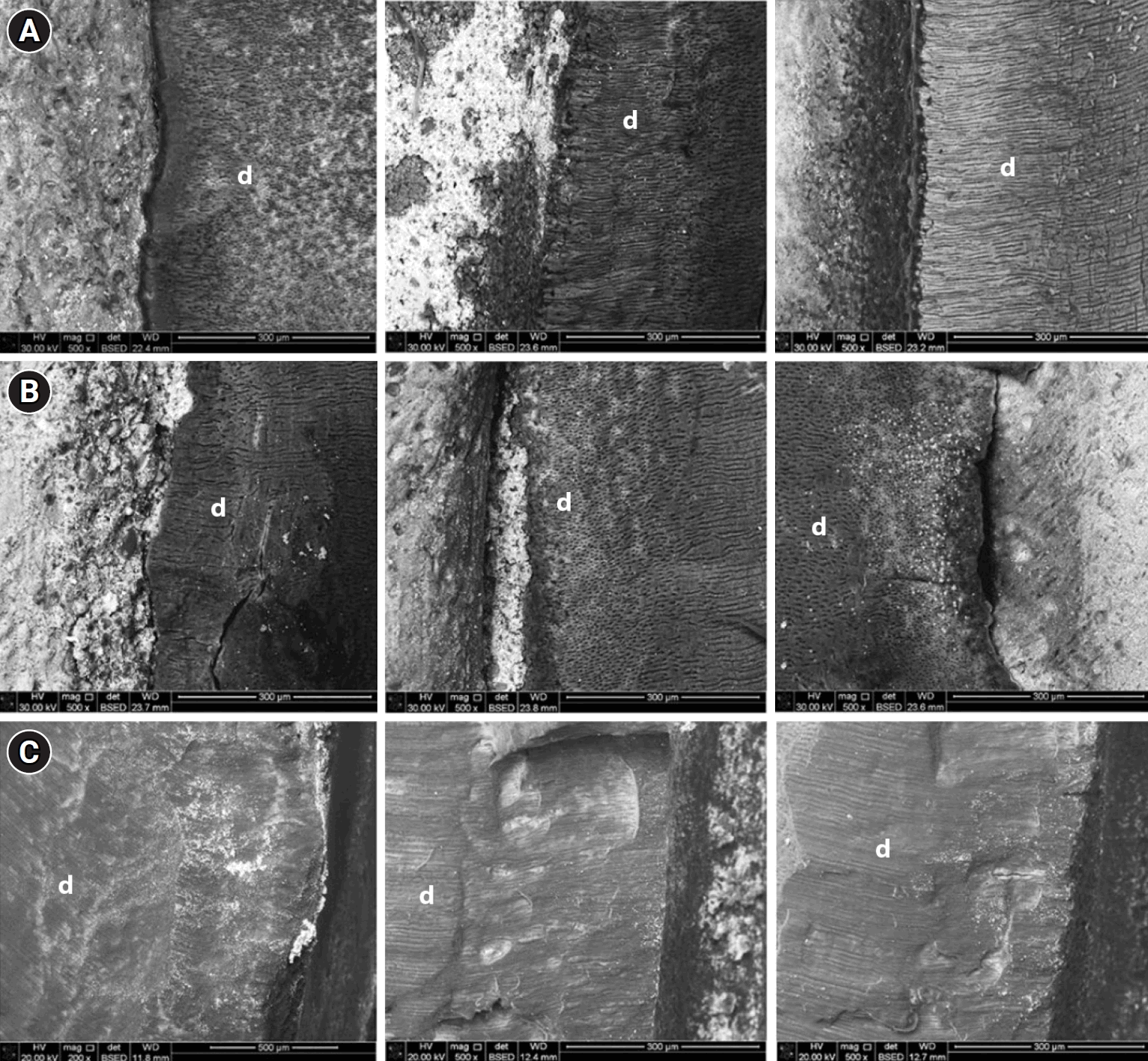
A highly statistically significant difference was identified between the groups and across all canal levels (p = 0.001). At the coronal level, the sealer penetration quantity showed the highest significant values, followed by the middle portion, and the lowest values were recorded apically. According to the post hoc test, the amount of sealer penetration for bromelain was greatest at both the middle and apical levels (242.84 ± 36.68 and 192.69 ± 23.76, respectively), followed by CHX (218.66 ± 9.01 and 114.76 ± 38.04, respectively). The control group demonstrated the lowest recorded values (194.24 ± 26.75 and 108.73 ± 4.91). The sealer penetration quantity of the CHX group was significantly the highest value coronally (301.46 ± 51.46), followed by the bromelain and control groups (282.90 ± 31.90 and 240.46 ± 6.44, respectively; p = 0.001) (Table 2, Figure 4).
DISCUSSION
Considering the current study’s findings, the null hypotheses tested were rejected, as the bromelain enzyme, CHX, influenced both the µTBS in coronal dentin and the sealer penetration depth into radicular dentin, with a remarkable difference compared to the unmodified group.
The primary objectives of endodontic therapy were to effectively clean, shape, and create a fluid-tight seal at both the apical and coronal levels [22]. The irrigants used during biomechanical preparation may influence the bonding of the subsequently applied resinous restorations [5]. Despite the bioceramic sealer’s bioactivity, its elevated alkalinity may weaken type I collagen fibrils, forming nearly all of the radicular dentin [23]. In the current study, an 8% concentration of bromelain enzyme was selected, as it may enhance proteolytic activity, which helps dissolve organic debris without causing dentinal erosion or adverse side effects. So, this research was intended to evaluate the effect of 8%bromelain enzyme, CHX, as an intraradicular final irrigant, on the dentin-collagen matrix integrity by assessing the resin-coronal dentin µTBS, dentin-bond interfacial micromorphology, and sealer penetration depth to radicular dentin utilizing SEM. Regarding the resin-dentin µTBS and sealer penetration results in the middle and apical portions of radicular dentin, bromelain biomodification revealed the highest significant values, followed by CHX. This could be explained by the fact that bromelain deproteinizes dentin by removing the weak, unsupported collagen fibers that may be present following smear layer removal, thereby exposing more dentinal tubules and increasing dentin permeability owing to the elevated surface energy of hydroxyapatite and altered dentin hydrophilic features [10,17]. This result was consistent with previous studies [20,24].
On the other hand, this finding contradicts a previous study that reported that NaOCl, CHX, and Boswellic acid solutions remarkably reduced microbial levels (p < 0.05), with no significant differences among them. This controversy might be explained by differences in methodology [25]. CHX dentin biomodification enhanced the resin-dentin bond strength due to its cationic and antibacterial properties. CHX at 0.2% and 2% concentrations inhibited matrix metalloproteinases and cysteine cathepsins, thereby hampering collagen degradation and enhancing bond durability [26,27]. Moreover, its easy binding to phosphate groups and its capacity to raise the dentin’s free surface energy would support the notion that using CHX following dentin demineralization could enhance dentin adhesion [28]. These findings were in line with other studies [6]. While inconsistent with a previous study [12], which concluded that lesser collagen degradation was observed in the proanthocyanin-treated group rather than the CHX group. This disparity may be related to the different techniques applied.
At the coronal level, the quantity of sealer penetration for CHX was the highest, followed by bromelain and the control groups. It could be clarified by the substantivity effect of CHX and the enlarged diameter of dentinal tubules coronally [29]. These results were inconsistent with an earlier investigation [30], which found that applying 17% EDTA after CHX gel (2%) for smear film elimination might be recommended, thereby enhancing AH Plus sealer (Dentsply DeTrey GmbH, Konstanz, Germany) penetration. The differences in the results might be related to variations in the evaluation methods or the types of roots used in the study.
The control group showed the least significant values for µTBS and sealer penetration. These findings could be related to the progressive demineralization of the coronal dentin surface [3]. These findings were consistent with another study [31], which found that EDTA, as a final irrigant, could dissolve dentin’s inorganic constituents, thereby uncovering the collagen fibrils. Furthermore, it had detrimental impacts on the integrity of the dentin-collagen matrix. Additionally, the chelation of calcium by EDTA could disturb the hydration process of the calcium silicate. The calcium decline at the dentin-sealer interface or degradation of the calcium-silicate sealer’s ingredients might hinder the establishment of the mineral-infiltration region, which could finally end in a weaker infiltration of the sealer into the wall of the root canal [32]. These findings were in line with other investigations [33] but conflicted with a previous study that reported that EDTA improved sealer infiltration into dentinal tubules and facilitated the elimination of the smear film [34]. This may be due to the use of a different type of endodontic sealer.
In the current study, sealer penetration depth was greatest coronally, relative to the middle and apical levels. This may be related to reduced tubular density, the presence of sclerotic dentin, and lower apical irrigant efficiency, resulting in less smear layer clearance [35]. The limitations of the current study include the risk of tearing gutta-percha and sealer during SEM specimen preparation of the filled root. Regarding the coronal dentin assessment, bond strength was evaluated only immediately; therefore, bond durability in the pretreated coronal dentin requires further investigation. Further clinical trials are required to investigate the long-term influences of these biomodifiers.
 XML Download