



 PDF
 Citation
 Print


Introduction
Cadaveric dissection affords a three-dimensional understanding of human anatomy, tactile familiarity with tissue planes, and professional formation that virtual alternatives only partly replicate [1]. Shortages of donated bodies interrupt anatomy pedagogy and limit exposure to clinically relevant variation [2, 3]. In India, these shortages are often attributed to low public awareness, opaque consent pathways, and anxieties around religious or cultural rites [2, 4].
Prior studies from student populations and general community samples suggest that education can improve attitudes toward voluntary body donation (VBD) and that pro-donation norms can diffuse through peer networks [5, 6]. Moreover, willingness to donate is rarely an individual decision in isolation; household structures and family norms strongly shape post-mortem choices [7, 8]. Yet cross-sectional surveys frequently stop at bivariate associations, limiting causal inferences about what truly drives willingness. We therefore set out to (1) profile awareness and attitudes toward VBD among adults attending a tertiary-care out patient department (OPD) in North-East India and (2) estimate the independent determinants of willingness using multivariable modelling, with explicit checks for discrimination and collinearity.
Materials and Methods
Study design and setting
We conducted a descriptive cross-sectional survey at the outpatient department of All India Institute of Medical Sciences (AIIMS), Guwahati over a three-month period (between March–May 2025). The setting draws a heterogeneous mix of urban and rural attendees across age, education, and socio-economic strata—useful for exploring attitudinal diversity but susceptible to health-seeking selection, a limitation we acknowledge.
Participants and eligibility
We approached consecutive adult patients and accompanying attendants. Exclusion criteria were inability to read English or Assamese and prior formal pledge for VBD (to focus on pre-pledge determinants of willingness). All participants provided written informed consent; the protocol had prior approval from the Institutional Ethics Committee of the All India Institute of Medical Sciences (Ref. No. AIIMSG/IEC/M2/P3/2023).
Instrument development and measures
We used a self-administered bilingual questionnaire (English/Assamese) that was piloted for clarity and face validity (Supplementary Material 1). It captured demographics (age, sex, education, occupation [skilled/other], residence [urban/rural], and self-reported morbidity); awareness and information sources, including exposure to electronic media; knowledge items covering the perceived importance of body donation, where donation can be made, and who can legally consent; comfort discussing VBD (a single item on ease of conversation); anticipated family agreement (whether close family members would support donation); and advocacy (whether the respondent encourages others to donate). The primary outcome was willingness to donate one’s body after death, recorded as a binary response. Few variables were dichotomised for analysis. If source of information was internet, television or social media, it was categorised as electronic source of information, and if source was family or friends or printed newspapers or similar, they were categorised as non-electronic sources of information. For the purpose of this study, knowledge about donation was considered correct if the participants knew that donation of body could be done and such bodies would be used for anatomical study and medical research. However, if participants answered in terms of organ donation, transplant, cremation, identification of unknown bodies etc., it was taken as an incorrect response.
The tool did not include a full psychometric validation; we therefore treat items as pragmatic indicators rather than latent scales.
Sample size and power
A conventional cross-sectional calculation assuming 50% prevalence, 5% absolute precision, and Z=1.96 suggested n=384. Operational constraints yielded 309 completed questionnaires. For regression, the complete-case dataset (n=233) balanced parsimony and coverage of prespecified predictors; we report events-per-variable considerations in the limitations.
Statistical analysis
We summarized demographics and key attitudes using descriptive statistics. To identify independent determinants of willingness, we fitted a multivariable logistic regression with the following predictors entered simultaneously (conceptually guided by a directed acyclic model of knowledge → attitudes → social context → willingness): age, male sex, urban residence, education, skilled occupation, morbidity, comfort to talk, information source (electronic), knows correctly about importance, knows where to donate, knows who can consent, family agreement, and encourages others.
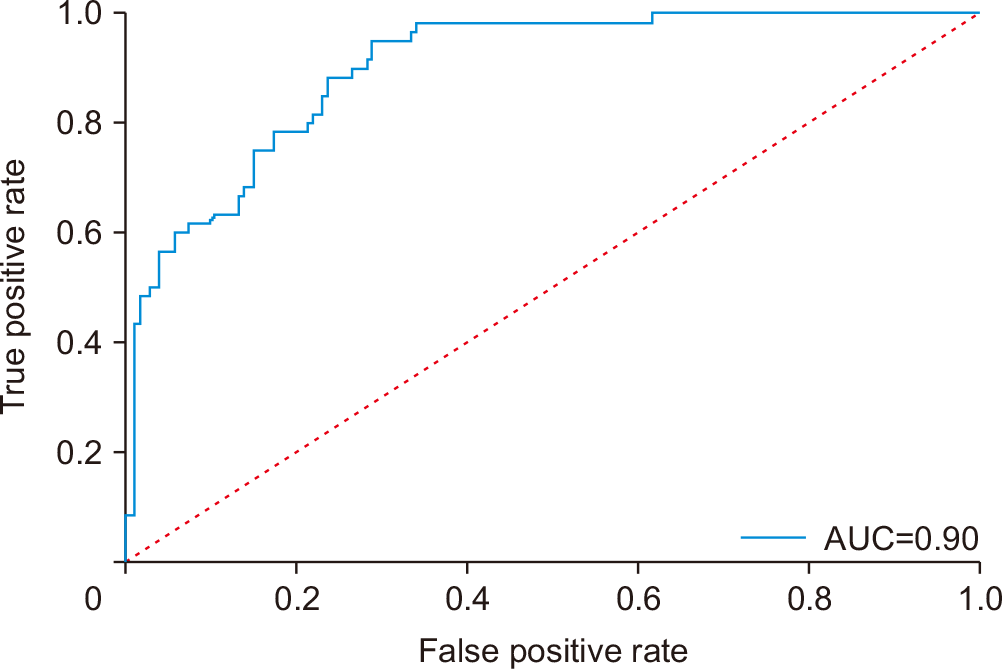
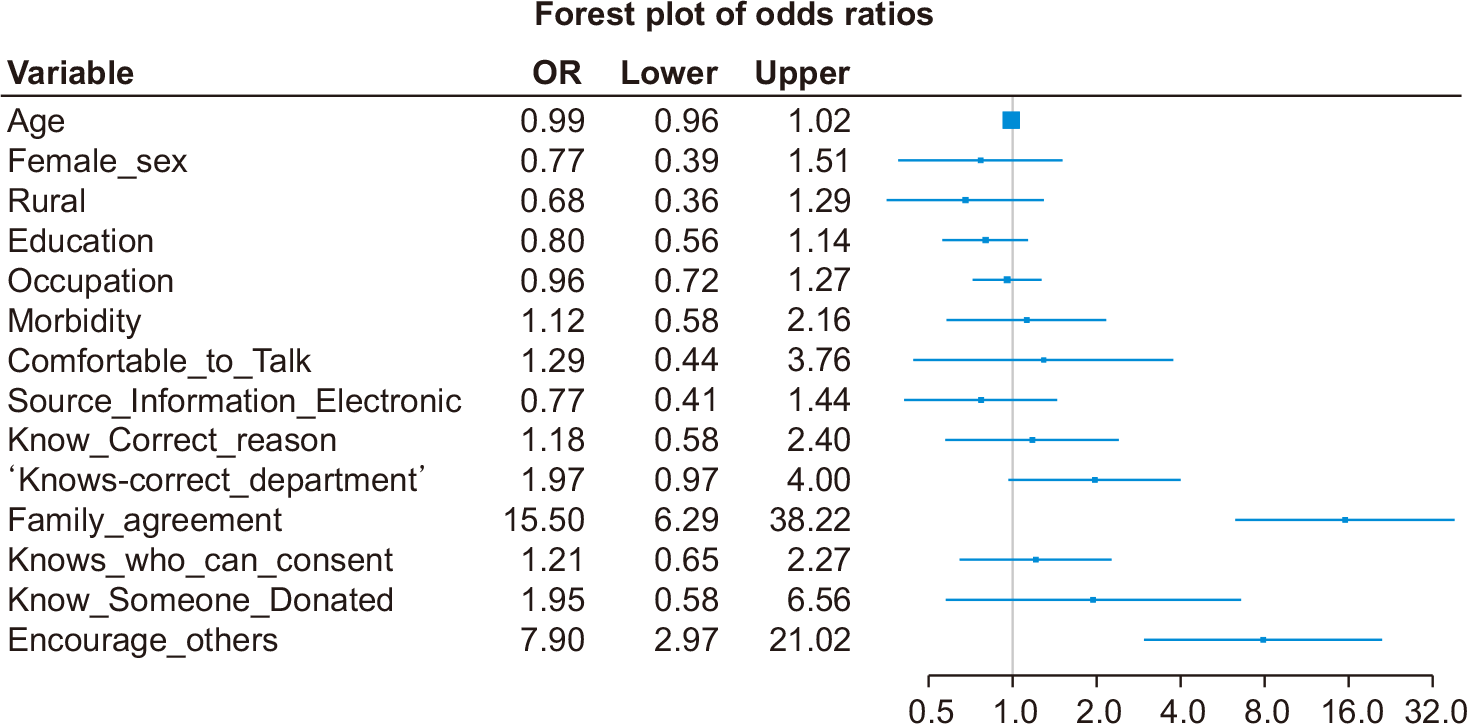
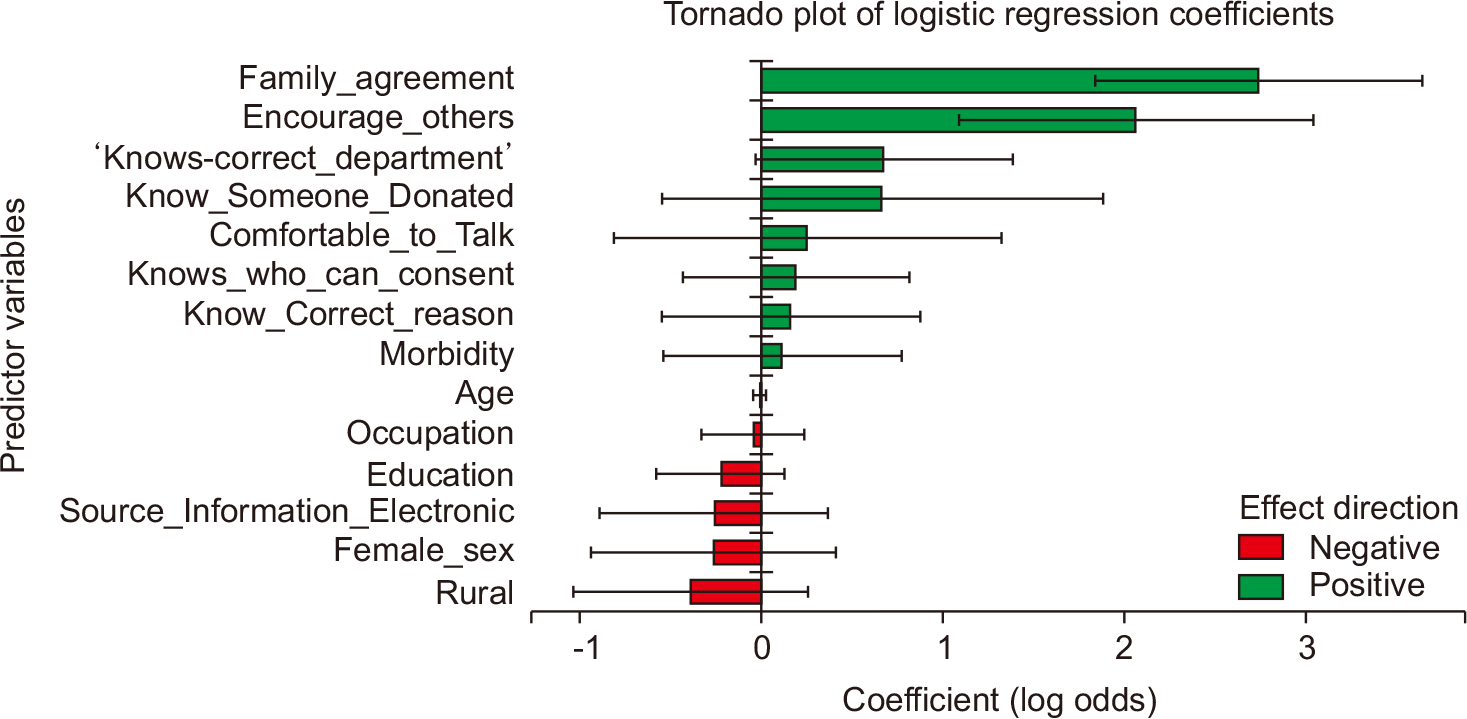
We report adjusted odds ratios (aORs) with 95% confidence intervals (CIs) and P-values. Discrimination was quantified by receiver operating characteristic curve (ROC) area under the curve (AUC) (Fig. 1). We examined multicollinearity using variance inflation factors (VIFs) (Table 1); all were <1.55, indicating negligible redundancy. A forest plot (Fig. 2) displays effect sizes and precision; a tornado plot (Fig. 3) ranks standardized coefficients to convey relative influence. Complete-case analysis was used; we discuss implications of missingness below. Analyses were performed in R software (version 4.4.0; R Foundation for Statistical Computing). The following packages were used: readxl, ggplot2, forestplot, summarytools, dplyr, along with the stats package inbuilt in base R. Model diagnostics (null/residual deviance, Akaike information criterion [AIC]) are reported with the regression.
Results
Participant profile and unadjusted attitudes
We enrolled 309 adults (mean age 35.3±10.5 years; 64.1% male). Out of 309, 93 (30.1%) expressed willingness to donate and 216 (69.9%) were unwilling to donate. Many participants had at least heard of VBD but expressed discomfort initiating conversations about it. The most frequent stated barrier among those reluctant to donate was the wish to fulfil religious rites after death (52.3%). Willing respondents commonly expressed pro-social dispositions, including a readiness to recommend donation to others.
Multivariable determinants of willingness
The complete-case regression used n=233 observations (null deviance 265.8 on 232 df; residual deviance 156.8 on 219 df; AIC 184.8). Discrimination was excellent (ROC AUC =0.90; Fig. 1), indicating strong separation of willing vs. unwilling responses. Multicollinearity was negligible (all VIFs <1.55; Table 1).
Family agreement was strongly associated with willingness (aOR 15.50; 95% CI: 6.29–38.22). The magnitude suggests near-deterministic separation for many respondents—if they anticipated family support, their own willingness rose dramatically. ‘Encourages others to donate’ independently predicted willingness (aOR 7.90; 95% CI: 2.97–21.02). This variable likely captures internalized pro-donation norms and confidence to advocate within one’s social circle.
Two additional variables displayed positive, non-significant trends: urban residence (aOR 0.68; 95% CI: 0.36–1.29) and knowing where to donate (aOR 1.97; 95% CI: 0.97–4.00). The direction of effect is consistent with a modest advantage in access/logistics among urban participants and with the value of practical knowledge; however, CIs are wide and cross unity.
By contrast, age (aOR 0.99; 95% CI: 0.96–1.02), sex (aOR 1.71; 95% CI: 0.39–1.51), education (aOR 0.80; 95% CI: 0.56–1.14), occupation (aOR 0.96; 95% CI: 0.72–1.27), morbidity (aOR 1.12; 95% CI: 0.58–2.16), comfortable to talk (aOR 1.29; 95% CI: 0.44–3.76), electronic information sources (aOR 0.77; 95% CI: 0.41–1.44), correct knowledge of importance (aOR 1.18; 95% CI: 0.58–2.40), and knowing who can consent (aOR 1.21; 95% CI: 0.65–2.27) were not independently associated after adjustment (Figs. 2, 3).
Discussion
In a tertiary-care OPD cohort in North-East India, anticipated family agreement emerged as the fulcrum of willingness for VBD, overshadowing demographic and knowledge variables. A secondary, independent lever was peer advocacy—those who already encourage others to donate are more likely themselves to be willing. Urban residence and practical knowledge of donation logistics may matter at the margin, but the evidence is suggestive rather than conclusive in this sample.
Our multivariable approach moves beyond bivariate narratives that conflate awareness with intention. After adjustment, generic knowledge and even comfort discussing VBD were not decisive. This aligns with broader behavioural science that information alone rarely shifts behaviour. Social permission and anticipated approval from significant others often play a bigger role.
The magnitude of the family agreement effect (aOR 15.5) is large for social predictors. It could be such because post-mortem decisions are collective, guided by elders or spouses. This maps to prior evidence that family endorsement is pivotal for organ and body donation [7, 8]. Our data sharpen that insight: even when people “know” why donation matters, they may refrain unless they believe their family will stand with them.
The analytic sample was reduced by missing items, which may introduce selection bias if missingness depended on unobserved factors (missing not at random) or on measured variables not fully captured by our missingness checks. While the events-per-variable ratio suggested adequate data for model fitting, reduced sample size can still inflate uncertainty and widen confidence intervals, particularly for weaker associations.
Several predictors represent attitudinal or normative constructs measured using single items. This pragmatic approach improves feasibility in community surveys but limits psychometric interpretability; measurement error may attenuate effect estimates, and the regression should be interpreted as identifying associations with these indicators rather than fully validated latent constructs.
A population-based Libyan study revealed widespread refusal of deceased donation, driven by inadequate awareness, religious doubts, and discomfort with body manipulation, underscoring the need for targeted public education. The study shows Otago body donors remain mostly older, altruistic individuals, with increased motivation to support medical teaching and research, improved awareness of body use, and strong familial influence on donation decisions [9, 10].
Within the sociocultural context of Northeast India, family agreement, quantified through multivariable modelling, emerged as the dominant determinant, independent of knowledge and demographic factors. Unlike prior studies that emphasize awareness deficits, our findings shift the focus toward family-centred decision-making and identify peer advocacy as an additional, actionable lever. Policy implications have also been expanded to reflect these context-specific insights [11, 12].
The independent signal on advocacy supports the idea of norm entrepreneurs. Individuals whose willingness is both cause and consequence of encouraging others. Identifying and equipping such “donation champions” could be a high-leverage tactic within clinics and communities.
In mainland China, nationwide survey shows moderate-to-high acceptance of body donation, driven by education, urban residence, and health literacy, yet cadaver shortages persist for medical education [13]. In the United Arab Emirates, most university members support body donation for education, yet few are willing to donate due to religious, psychological, and family concerns, underscoring awareness gaps [14]. In Australia, anatomy students strongly support organ donation but show low willingness for body donation, influenced by religion, culture, and increased exposure to cadaveric dissection [15]. Globally, body donation practices vary widely; countries with strong willed-donation programs report effective donor-based surgical training, while reliance on unclaimed bodies limits educational innovation capacity [16].
Implications for practice and policy
Making the family the unit of intervention may be the most effective and pragmatic path to increase body donation. Counselling should directly engage spouses, parents, and key decision-makers. Tools could include guided family discussion checklists, consent navigation scripts, and written materials that answer common family-level questions (e.g., funeral rites, timelines, body handling, memorialization options). Training willing patients, attendants, medical volunteers, and community health workers as pro-donation ambassadors also appears a viable intervention strategy. Visible recognition (certificates, wall-of-honour, remembrance ceremonies) can normalize donation and honour families. Although “knowing where to donate” was not significant at P<0.05, the trend and qualitative salience argue for transparent, step-wise instructions (whom to call, paperwork, transport, timing, what happens afterward, how remains are returned if applicable).
The leading stated barrier was the wish to fulfil religious rites. Partnerships with faith leaders can surface ritual accommodations (e.g., timelines for last rites, dignified handling) without diluting donation’s purpose. Citing respected local authorities may build legitimacy. The urban trend suggests access and information asymmetries. Outreach that leverages primary care, mobile health units, and community events can close the gap.
Strengths and limitations
Strengths include bilingual materials; recruitment in a public tertiary setting capturing diverse attendees; and multivariable estimation with good discrimination and negligible collinearity. The analysis seeks to find factors associated with willingness to donate. The OPD sampling frame risks health-seeking and male over-representation. Single-centre also limits external validity. The regression used complete-case analysis (233/309), which can bias estimates if missingness is informative. Several CIs are wide (e.g., advocacy), reflecting sparse positive responses in some strata. Finally, we did not perform a full psychometric validation of the instrument. Knowledge and attitude items are single indicators rather than validated scales.
Earlier Indian studies emphasize low awareness and cultural barriers, proposing education as remedy [2, 3, 11]. Our results do not strongly support this notion. Education alone is unlikely to convert intention into willingness absent family endorsement. International work calls for transparent consent processes and standardization of information provided to potential donors and families [4]; our findings reinforce the need to communicate dignity, body handling, and memorialization—matters families care about deeply. Evidence from students shows attitudinal gains with education [5, 6, 12] but translation into family-backed decisions likely requires structured household dialogues and social proof.
In conclusion, improving VBD uptake will not be achieved by information campaigns alone. Our adjusted analysis indicates that the decisive step is to secure family agreement, with peer advocacy as a powerful companion lever. Initiatives that reframe donation as a family-affirmed, dignified contribution to medical science—paired with practical, trustworthy logistics—stand the best chance of narrowing India’s cadaver gap in anatomy education.
 XML Download