



 PDF
 Citation
 Print


Introduction
Three-dimensional (3D) bioprinting represents a paradigm shift in drug delivery and regenerative medicine, offering micrometer-scale control over the spatial organization of cells, biomaterials, and bioactive molecules. Initially conceived for replicating tissue and organ architectures, this technology has rapidly evolved into a versatile platform for the fabrication of programmable drug delivery systems. These constructs enable the localized, sustained, and multimodal release of therapeutic agents, overcoming the limitations associated with systemic administration, such as poor bioavailability, poorly controlled pharmacodynamic responses, and unpredictable plasma clearance profiles. Thus, the convergence of 3D bioprinting with advanced material engineering and pharmaceutical microfabrication is driving the next generation of precision therapeutics tailored to both patient-specific anatomy and pathophysiology.
Conventional drug delivery systems are frequently hindered by their suboptimal pharmacokinetic profiles, including rapid burst release, systemic toxicity, limited bioavailability, and insufficient site-specific accumulation. These drawbacks often result from the inadequate control of drug distribution and release kinetics in vivo. In contrast, 3D bioprinting enables the fabrication of architecturally defined constructs that not only recapitulate native tissue microenvironments but also allow for precise modulation of drug-release parameters. By leveraging bioinks composed of hydrogels, naturally derived or synthetic polymers, and drug-encapsulating nanosystems, recent studies have demonstrated enhanced spatiotemporal control over therapeutic payload distribution governed by tunable diffusion dynamics and matrix degradation behavior [1,2].
A broad spectrum of therapeutic agents, including low-molecular-weight chemotherapeutics, antimicrobial compounds, and high-molecular-weight biologics such as growth factors (GFs), peptides, and monoclonal antibodies, have been successfully integrated into 3D bioprinted matrices. These systems support anatomically localized delivery and enable precisely modulated multiphase release kinetics, which are essential for maintaining therapeutic efficacy in the management of chronic pathologies, persistent infections, and neoplastic diseases [3–5]. Furthermore, 3D bioprinting allows for the spatially segregated or colocalized incorporation of multiple pharmacological agents within a single construct, facilitating synergistic interactions and mitigating the emergence of therapeutic resistance, particularly in heterogeneous and treatment-refractory conditions such as solid tumors [6].
Recent advancements in stimuli-responsive biomaterials have enabled the development of “smart” drug delivery systems that are activated by endogenous physiological signals, such as pH gradients, local temperature changes, or enzyme overexpression. These materials facilitate spatiotemporally controlled and on-demand drug release in response to disease-specific microenvironmental cues, thereby enhancing therapeutic selectivity and minimizing off-target effects [7]. Concurrently, the integration of computer-aided design tools with imaging-guided anatomical modeling has allowed for the fabrication of patient-specific drug delivery constructs, aligning drug-release profiles with individualized anatomical and pathological parameters, which is a critical step toward the clinical realization of precision medicine [8].
However, despite these advances, several key challenges remain. Achieving optimal drug loading without compromising the rheological and structural properties required for bioprinting remains challenging. In addition, preserving the bioactivity of sensitive therapeutic agents during printing, particularly under conditions involving shear stress, heat, or photoinitiation, is a significant technical constraint. Material biocompatibility, immunogenicity, and degradation kinetics must also be rigorously optimized to ensure safety and efficacy in vivo. Furthermore, the clinical translation of bioprinted drug delivery systems is hindered by scalability issues and the complex regulatory landscape, particularly concerning the classification and approval of biofabricated combination products that incorporate both device and pharmaceutical components [9].
This review presents a comprehensive synthesis of the current advancements in drug-releasing systems engineered using 3D bioprinting technologies. We examine the full spectrum of bioinks and biomaterials employed for drug incorporation and strategies for achieving controlled and responsive release. Particular emphasis is placed on the underlying mechanisms of drug release as well as translational applications, including infectious disease management, wound healing, oncological therapy, and regenerative medicine. By critically analyzing both technological innovations and persistent limitations within the field, this review seeks to delineate future trajectories and facilitate the rational design of next-generation bioprinted drug delivery platforms.
Bioinks for drug incorporation: composition, functionality, and drug compatibility
Bioinks serve as the foundational material for 3D bioprinting, providing not only the structural matrix for cell encapsulation, but also the vehicle for drug incorporation and release. Bioink material selection has a significant influence on physicochemical interactions with the drugs, their release kinetics, and the viability of co-printed cells.
Natural bioinks
Natural bioinks such as alginate, gelatin, collagen, hyaluronic acid (HA), and fibrin are widely used because of their intrinsic biocompatibility and extracellular matrix (ECM)-mimetic properties [10]. Alginate forms ionic crosslinks in the presence of divalent cations (e.g., Ca2+), which can entrap drugs via electrostatic or diffusion-based mechanisms. However, alginate lacks cell-adhesive motifs and has a high uncontrolled degradation rate, which limits tissue integration and temporal control of drug release. The gelatin methacryloyl derivative (GelMA) supports drug–protein conjugation through amine or carboxyl groups and enables photocrosslinking, enhancing structural fidelity and sustained drug retention [10].
Synthetic polymers
Synthetic polymers such as poly(ethylene glycol) diacrylate (PEGDA), polycaprolactone (PCL), and polylactic-co-glycolic acid (PLGA) offer customizable mechanical properties and degradation profiles through molecular weight and copolymer ratio adjustments. PEGDA provides a hydrophilic, non-fouling matrix suitable for the diffusive release of hydrophilic drugs, yet lacks intrinsic bioactivity. PCL, on the other hand, facilitates slow-release applications owing to its hydrophobicity and enzymatically driven degradation, making it favorable for the sustained delivery of hydrophobic agents such as paclitaxel or curcumin [11].
Functionalized hydrogels
Functionalized hydrogels, including GelMA, HA derivatives, and thiol-modified chitosan, allow chemical conjugation or physical encapsulation of drugs via Michael addition, Schiff bases, or host–guest interactions. These chemical modifications provide spatiotemporal control over drug release and protect labile agents from shear and thermal degradation during extrusion and inkjet bioprinting. For example, GelMA matrices incorporating nanocarriers such as liposomes or polymeric micelles can preserve the bioactivity of chemotherapeutics during printing and modulate release kinetics via degradation or temperature stimuli [2,12].
Drug–bioink compatibility
Drug–bioink compatibility is significantly influenced by the chosen bioprinting modality (Table 1). Extrusion-based bioprinting subjects bioinks to high shear stress, potentially compromising the stability of sensitive therapeutic agents. Inkjet-assisted and laser-assisted bioprinting methods can expose bioinks to elevated temperatures, which may affect the integrity of biologics. Therefore, pre-printing assessments of viscosity, shear-thinning behavior, and drug–bioink interactions using analytical techniques such as Fourier-transform infrared spectroscopy, differential scanning calorimetry, or high-performance liquid chromatography (HPLC) are essential to ensure that the pharmacological function is retained post-fabrication [1,13,14].
Mechanisms of drug release: controlling the spatiotemporal profile
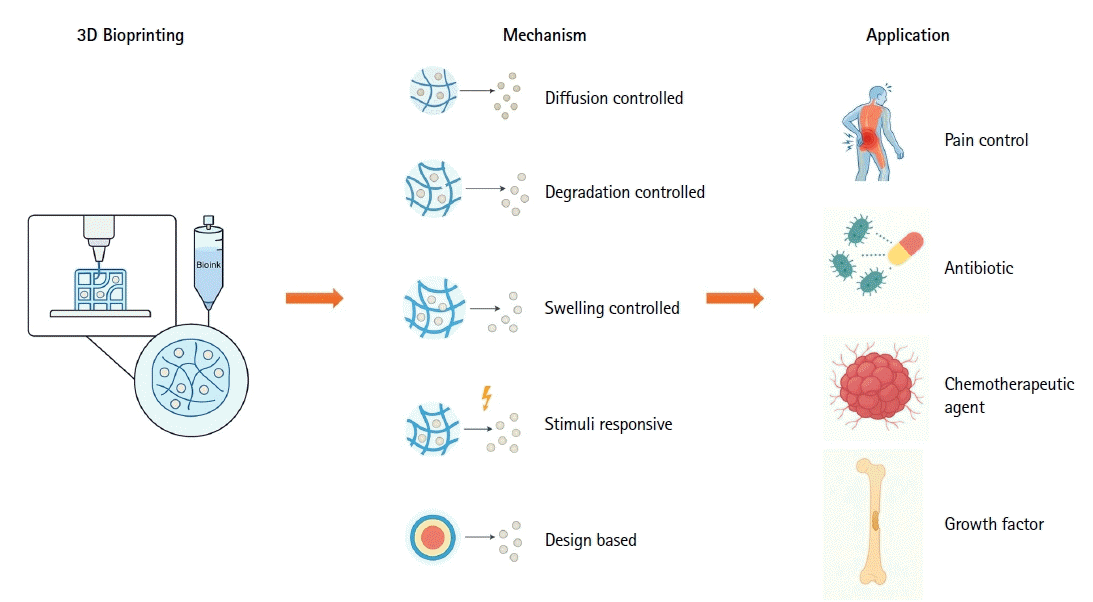
The release of therapeutic agents from 3D-bioprinted constructs is governed by complex physicochemical and structural factors intrinsic to both the bioink formulation and printing architecture. Achieving spatiotemporally controlled release is essential for matching the pharmacokinetic needs of target tissues, reducing systemic toxicity, and improving therapeutic efficacy (Fig. 1).
Diffusion-controlled release
Diffusion-controlled release is the most fundamental mechanism, relying on the passive movement of drug molecules through hydrogel networks. Fickian transport mechanisms are typically observed under conditions of limited crosslink density and high equilibrium water content, wherein solute movement follows concentration-dependent passive diffusion, such as in alginate or PEGDA matrices, and can be tuned by altering the mesh size, crosslinking density, and molecular weight of the incorporated drug [15,16]. The diffusion coefficient can be modeled using the Stokes–Einstein equation and validated experimentally using release assays and fluorescence imaging.
Degradation-mediated release
Degradation-mediated release involves the breakdown of scaffold materials, allowing for sustained and often zero-order kinetics. Natural polymers (e.g., gelatin, collagen) undergo enzymatic degradation via matrix metalloproteinases (MMPs), whereas synthetic polymers such as PLGA degrade hydrolytically, offering control over long-term release profiles based on their lactic/glycolic acid ratio [17]. In these systems, the drug-release rate is influenced not only by the degradation rate, but also by the polymer–drug interaction strength (e.g., hydrogen bonding, hydrophobic interactions).
Stimuli-responsive biomaterials
Stimuli-responsive biomaterials have emerged as a critical advancement in bioprinted drug delivery systems, offering spatiotemporally controlled release in response to specific environmental or external triggers. These smart hydrogels or composites are engineered to undergo structural or physicochemical changes that facilitate drug release under defined stimuli, thereby enhancing site-specific therapeutic precision while minimizing systemic exposure.
pH-responsive systems
pH-responsive systems utilize polymers that swell or degrade in response to acidic environments such as tumors or inflamed tissues to enable site-specific drug release. pH-sensitive hydrogels exploit the differential acidity of pathological environments such as the slightly acidic extracellular milieu of solid tumors (pH ~6.5) and inflamed or infected wounds. Polymers such as chitosan, polyacrylic acid, and their derivatives possess ionizable groups that swell in response to low pH, enhancing hydrogel porosity and the diffusion rate. For instance, chitosan exhibits protonation of amine groups under acidic conditions, leading to network expansion facilitating drug release [18].
Thermoresponsive systems
Thermoresponsive systems employ materials that undergo sol–gel transitions near body temperature, enabling temperature-triggered drug release after implantation or injection. Thermosensitive materials, particularly poly(N-isopropylacrylamide) (PNIPAAm), exhibit lower critical solution temperature behavior. PNIPAAm remains soluble below ~32°C but collapses into a hydrophobic gel above this threshold, often near physiological temperatures (37°C). This thermogelling behavior is used to design injectables or printed scaffolds that release drugs upon an in vivo temperature shift, especially for controlled release post-implantation [19].
Enzyme-responsive systems
Enzyme-responsive systems release drugs via scaffold degradation triggered by disease-associated enzymes, thereby enabling cell-mediated and site-specific delivery. Enzyme-degradable matrices are tailored to respond to MMPs or other tissue-specific enzymes overexpressed in diseased tissues. For example, GelMA hydrogels crosslinked with MMP-cleavable peptide linkers selectively degrade in tumor or wound environments rich in MMP-2/9. This strategy enables cell-mediated, localized release, which is ideal for delivering GFs or cytotoxins directly at the site of remodeling or invasion [20].
Photo- and magneto-responsive systems
Photo- and magneto-responsive systems are externally controlled release platforms that utilize physical triggers such as light or magnetic fields. Gold nanorods, with tunable surface plasmon resonance, can convert near-infrared (NIR) light into localized heat, disrupting the surrounding matrix and releasing cargo on demand. Similarly, superparamagnetic iron oxide nanoparticles (Fe3O4) embedded within hydrogels respond to alternating magnetic fields, inducing hyperthermia or mechanical disruption that triggers drug release. These systems are particularly suitable for on/off control in tumor ablation and targeted chemotherapy applications [21].
Spatiotemporal control
Spatiotemporal control can also be achieved through printing-design strategies. In addition to material-based modulation, advanced 3D bioprinting strategies enable precise spatiotemporal control of drug release through deliberate spatial arrangement and temporal programming during scaffold fabrication. These architectural strategies allow for the tailoring of drug kinetics to meet complex therapeutic demands (Table 2).
Multimaterial or coaxial printing
Multimaterial printing employs multiple printheads or bioinks to simultaneously deposit drug-loaded and drug-free compartments within a single construct. This technique facilitates the creation of physical barriers, enabling differential release kinetics between regions. A notable example includes core–shell architectures formed via coaxial extrusion, wherein a drug-loaded core is enveloped by a protective shell layer, delaying exposure to the external environment and prolonging release duration. Such configurations are especially useful for sequential drug delivery or protecting sensitive agents from premature degradation.
Zonal patterning and gradient fabrication
Zonal patterning involves the spatial modulation of drug concentration, bioink stiffness, or degradation behavior across distinct regions of the printed scaffold. By integrating continuous or stepwise gradients into these properties, it is possible to mimic native tissue interfaces, such as osteochondral or tumor–stromal boundaries. For example, a gradient in GF concentration can guide cell differentiation along the scaffold, whereas a degradation gradient can ensure time-staggered release suitable for multiphase wound healing or tumor inhibition [22]. Gradient bioprinting is often achieved by using microfluidic printheads or digitally controlled mixing during extrusion.
Layer-by-layer temporal release programming
The temporal control of drug delivery can be implemented through vertical stratification, in which short- and long-acting therapeutics are deposited in discrete layers. This layered deposition strategy enables controlled pharmacokinetic profiles, simulating bolus–maintenance dosing schemes within a single implantable device. For instance, a rapidly dissolving top layer can deliver an initial burst of anti-inflammatory drugs, followed by the sustained release of chemotherapeutics in the deeper layers [23]. This strategy is particularly beneficial in multimodal therapies such as post-surgical cancer treatment or infection-prone wound management.
Applications by drug type
The adaptability of 3D bioprinting technologies offers an unprecedented platform for the spatially defined and compositionally tunable incorporation of pharmacological agents, ranging from low-molecular-weight chemotherapeutics to complex biologics, such as GFs, cytokines, and monoclonal antibodies. Each drug class has unique physicochemical properties, including solubility, stability, molecular size, and charge, which necessitate tailored approaches for bioink selection, structural design, and release modulation. Bioprinted constructs can be engineered to support highly customized and multifunctional drug delivery strategies by leveraging precise control over the spatial deposition, material heterogeneity, and layer-by-layer fabrication. This allows for the recreation of complex tissue environments, spatiotemporally regulated therapeutic exposure, and the integration of combinatorial regimens within a single construct, marking a significant advancement over traditional delivery platforms.
Chemotherapeutic agents
3D bioprinting has opened new frontiers in cancer therapy by enabling site-specific and sustained delivery of chemotherapeutic agents, thereby offering an effective strategy to enhance tumor targeting while minimizing systemic toxicity. Traditional systemic chemotherapy is limited by nonspecific biodistribution, systemic side effects, and therapeutic resistance resulting from suboptimal drug concentrations at the tumor site. Bioprinting addresses these challenges by providing localized, controlled-release platforms that can be customized to match tumor geometry and pathophysiology.
Commonly used chemotherapeutics, such as doxorubicin, paclitaxel, and cisplatin, have been incorporated into various biocompatible matrices, including GelMA, PCL, and PLGA. These drugs are introduced either as free molecules or encapsulated within microspheres, liposomes, or polymeric nanoparticles to protect their bioactivity and modulate their release kinetics [2]. The choice of matrix plays a critical role in regulating the drug-release profile. For example, hydrogel-based systems allow diffusion-dominated release, whereas biodegradable polymers enable erosion-mediated sustained release over extended periods. These platforms allow for passive diffusion, polymer degradation, or stimuli-triggered release depending on the matrix composition and physicochemical properties of the drug [12,24,25].
This approach is particularly beneficial for the treatment of solid tumors that require targeted therapy at the resection margin or peritumoral regions, where local recurrence and residual disease are common clinical concerns. Bioprinted scaffolds can be fabricated to conform precisely to irregular post-resection cavities, acting as localized depot systems that deliver therapeutic payloads directly to residual cancer cells. This minimizes systemic exposure and supports an elevated peritumoral pharmacological index with reduced systemic bioavailability-associated toxicity, thereby improving the likelihood of complete tumor eradication [26–28].
Moreover, 3D bioprinting allows for the integration of multiple therapeutic agents within spatially distinct compartments of a single construct, facilitating combination therapies such as chemotherapeutic with antiangiogenic or chemotherapeutic with immunomodulatory regimens. These multi-agent delivery systems enable coordinated, spatiotemporally controlled release, which can better mimic standard-of-care multi-drug regimens in a single, implantable format, thereby improving patient compliance and therapeutic efficacy [29].
An illustrative study conducted by Hao et al. [30] developed a 3D-printed drug-loaded prosthesis containing paclitaxel and doxorubicin for post-surgical implantation in breast-conserving surgery. The device demonstrated sustained local drug release, effective suppression of tumor regrowth, and the potential for personalized anatomical conformity, highlighting the clinical promise of such constructs. Furthermore, these bioprinted systems are increasingly utilized in tumor-on-a-chip platforms for preclinical screening. By enabling the co-culture of cancer and stromal cells, integration of drug gradients, and real-time imaging, these models support the development of personalized image-guided therapies and offer a bridge between in vitro testing and in vivo validation [31].
In summary, 3D-bioprinted chemotherapeutic delivery systems represent a convergence of spatial precision, sustained pharmacokinetics, multi-agent compatibility, and patient-specific adaptability, marking a paradigm shift toward more localized and programmable cancer therapies.
Antibiotics
Postoperative infections, biofilm formation on implants, and chronic wound contamination remain major clinical challenges in the fields of surgery, orthopedics, and dentistry. Systemic antibiotic therapy is often inadequate because of poor perfusion at the infection site, potential systemic toxicity, and emergence of antibiotic resistance. 3D-bioprinted antibiotic delivery systems have emerged as a promising strategy for localized and sustained antimicrobial therapy, enabling site-specific targeting and controlled-release profiles to maintain therapeutic drug concentrations over clinically relevant timeframes.
Antibiotics such as vancomycin, gentamicin, and ciprofloxacin have been incorporated into bioprinted constructs using hydrogel matrices (e.g., alginate, GelMA, HA) and biodegradable polymers (e.g., PCL, PLGA), either as free drugs or encapsulated within microparticles, nanogels, or mesoporous silica nanoparticles. These carriers protect the drug from premature degradation and modulate release duration depending on the material porosity, degradation rate, and crosslinking density [4].
A unique advantage of 3D bioprinting is its ability to produce layered or zonally patterned architectures, thus enabling the staged release of antibiotics. For instance, surface layers may deliver an initial burst to rapidly suppress planktonic bacteria, while inner cores provide sustained release to prevent biofilm resurgence and support long-term infection control [32]. This temporally programmed release strategy addresses the critical need to maintain sub-minimal inhibitory concentrations of suppressive drugs over extended periods, which is a key factor in preventing the emergence of antimicrobial resistance. In addition, stimuli-responsive bioinks can be engineered to respond to infection-specific cues such as acidic pH, bacterial enzymes, or oxidative stress, allowing for the on-demand release of antibiotics only when pathogenic activity is detected. This not only improves therapeutic efficiency but also minimizes drug exposure to the surrounding healthy tissues [33].
From a pharmacokinetic perspective, the sustained local release of antibiotics via bioprinted scaffolds has been shown to maintain therapeutic concentrations in situ without systemic administration. This eliminates the peaks and troughs associated with bolus injections and reduces the risk of dose-related toxicity. For example, vancomycin-loaded GelMA scaffolds or ciprofloxacin-releasing PCL constructs have demonstrated stable release profiles exceeding one week, which is sufficient to manage both acute and chronic infection models [34].
Beyond bacterial eradication, bioprinted constructs can be engineered for dual-functional applications by incorporating both antibiotics and GFs, such as vascular endothelial growth factor (VEGF) or platelet-derived growth factor (PDGF), to simultaneously combat infection and stimulate tissue regeneration, which is a key objective in the treatment of complex wounds and bone defects. Clinically, these multifunctional systems show promise in addressing conditions such as osteomyelitis and infected nonunion bone defects, peri-implantitis and prosthetic joint infections, chronic skin ulcers (e.g., diabetic foot wounds), and periodontal or maxillofacial reconstructions. By enabling spatially precise delivery, customizable pharmacokinetics, and the co-loading of multiple therapeutic agents, 3D-bioprinted antibiotic delivery platforms represent a next-generation approach to overcoming the limitations of conventional antimicrobial therapies.
Growth factors
In regenerative medicine, GFs such as VEGF, fibroblast growth factor (FGF), and bone morphogenetic proteins (BMPs) are essential signaling molecules that regulate cell proliferation, migration, differentiation, and tissue morphogenesis. Despite their therapeutic potential, the clinical translation of GF therapies remains limited owing to their short in vivo half-life, proteolytic degradation, and the risk of ectopic or fibrotic outcomes if the concentration and duration are not precisely spatiotemporally controlled. 3D bioprinting provides a powerful platform to overcome these limitations by enabling the customized deposition and sustained release of GFs within bioengineered constructs. By selecting appropriate bioinks, including GelMA, alginate, HA derivatives, and collagen, researchers can fabricate biocompatible matrices that stabilize GFs, protect their bioactivity, and facilitate localized tunable release kinetics aligned with regenerative processes [20].
To address the challenge of achieving precise temporal and spatial GF delivery, several strategies have been integrated into bioprinted scaffolds, including physical entrapment of GFs within hydrogel networks to enable passive diffusion-based release; nanoparticle-mediated encapsulation using carriers such as PLGA, silica, or liposomes to ensure sustained release while protecting GFs from enzymatic degradation; affinity-based immobilization through heparin-mimetic domains or aptamers that mimic extracellular matrix sequestration and allow for on-demand release; and enzyme-responsive systems in which GFs are tethered via protease-sensitive linkers and released in response to local matrix remodeling [20,35–37].
Such control mechanisms allow for the fabrication of gradient structures that mimic native tissue complexity. For example, VEGF and BMP-2 have been co-printed into zonally compartmentalized constructs to sequentially promote angiogenesis and osteogenesis at different spatial regions, which is particularly relevant for osteochondral interface regeneration [22].
Additionally, the temporal layering of GFs during printing enables the sequential release of early-phase (e.g., FGF-2 for proliferation) and late-phase (e.g., BMP-2 for differentiation) signals, recapitulating the dynamic signaling cascade of natural healing. This level of control is difficult to achieve using conventional GF delivery methods that often rely on surface coatings or bolus injections.
Notably, bioprinted GF-loaded scaffolds can be synergistically integrated with antibiotics or anti-inflammatory agents within a single construct, enabling the development of multifunctional devices capable of simultaneously achieving infection control, inflammation suppression, and tissue regeneration within patient-specific anatomical architectures.
In summary, 3D bioprinting facilitates the fabrication of precision-guided, biologically active architectures capable of delivering GFs in alignment with cellular-level and tissue-level demands, thereby bridging the gap between biologically effective dosing and structural fidelity in regenerative medicine.
Pain control agents
Effective pain management is the cornerstone of both acute post-surgical recovery and chronic disease control, with significant implications for patient comfort, rehabilitation, and quality of life. Despite advancements in pharmacotherapy, conventional pain control strategies, particularly those that rely on the systemic administration of opioids, nonsteroidal anti-inflammatory drugs (NSAIDs), or anticonvulsants, continue to have major limitations. These include nonspecific biodistribution; subtherapeutic local drug concentrations; rapid systemic clearance; and undesirable side effects, such as sedation, gastrointestinal toxicity, nephrotoxicity, and the risk of tolerance and dependency, especially in the case of opioids [38]. Inadequate local analgesia is particularly problematic in orthopedic surgery, oncologic resection, and nerve trauma, where effective pain control is not only essential for patient comfort, but also directly influences functional recovery, wound healing, and immune modulation. Moreover, current systemic regimens often fail to account for anatomical complexity, localized nociceptive signaling, and inflammatory microenvironments, resulting in inconsistent therapeutic efficacy. In this context, 3D bioprinting has emerged as a transformative tool for developing localized, controlled-release pain management systems that align with the principles of precision medicine. By enabling anatomically shaped, patient-specific constructs, bioprinting allows for site-specific delivery of analgesics at clinically relevant doses tailored to the surgical field or pathological lesion. Furthermore, the ability to engineer sustained or staged drug-release profiles using hydrogel matrices, polymeric scaffolds, or embedded nanoparticles helps to overcome the pharmacokinetic drawbacks associated with bolus dosing, such as plasma level fluctuations and off-target exposure [39]. These advantages underscore the potential of 3D-bioprinted analgesic delivery systems in clinical scenarios that require sustained local pain control while minimizing systemic drug exposure. Such systems are particularly beneficial for patients with complex medication regimens (polypharmacy), impaired renal or hepatic function, or increased susceptibility to central nervous system-active agents.
Local anesthetics, such as lidocaine, bupivacaine, and ropivacaine, have been incorporated into bioprinted hydrogel matrices (e.g., gelatin, alginate, chitosan) and degradable polymeric scaffolds (e.g., PCL, PLGA) to achieve controlled release at the target site. These drugs can be embedded as free molecules or encapsulated within microparticles or liposomes to fine-tune the release kinetics and prolong their action [40].
Bioprinted systems allow for layered or gradient-loaded architectures that enable sequential or staged analgesia. For example, the outer layers may provide an immediate release of lidocaine for rapid onset, while the inner cores may release bupivacaine or ropivacaine over several days to maintain a prolonged nerve block [41]. This dual-release model mimics conventional bolus-plus-maintenance therapy in a single implantable system.
In addition to short-term pain relief, 3D-bioprinted scaffolds have been explored for neuropathic pain modulation, in which agents such as gabapentin or pregabalin are embedded within biodegradable constructs placed near the affected nerves. This approach offers localized modulation of nerve excitability, potentially avoiding cognitive side effects and tolerance issues associated with oral administration [42].
An additional advantage is the potential to co-deliver analgesics with anti-inflammatory or regenerative agents. For example, dexamethasone or interleukin-10 (IL-10) may be included alongside anesthetics in a single construct to provide multimodal pain control, while simultaneously addressing nociceptive, inflammatory, and neurogenic pain mechanisms.
Clinical applications of bioprinted pain control systems include postoperative site-specific analgesia such as after tumor resection or joint replacement, peripheral nerve block scaffolds designed for prolonged sensory suppression, chronic pain implants for conditions such as diabetic neuropathy or spinal disc degeneration, and integrated constructs that combine with orthopedic implants or wound dressings to serve dual therapeutic purposes. As surgical techniques continue to evolve toward minimally invasive approaches, localized and programmable pain control systems enabled by 3D bioprinting have become essential components of modern perioperative and chronic pain management strategies.
Application of bioprinting for pain control: by route
Building on these mechanistic foundations, recent studies have investigated the application of bioprinting through distinct delivery routes. Four major approaches have been explored for pain control: oral, implantable, transdermal, and perineural, each offering unique opportunities and challenges for optimizing analgesic therapy.
Oral bioprinting for pain control
Oral delivery remains one of the most convenient and patient-preferred routes for analgesia. However, conventional dosage forms are limited by variable absorption, gastrointestinal degradation, and first-pass metabolism [43]. 3D bioprinting offers the ability to create personalized dosage forms with programmable release kinetics, thereby addressing certain pharmacokinetic hurdles [44]. Recent advances include the development of a dual-extrusion core–shell ketamine hydrochloride (HCl) floating tablet capable of providing 12-h controlled release, as well as selective laser sintering-fabricated mini-printlets co-loaded with paracetamol and ibuprofen, which enable both immediate and sustained-release profiles [45,46]. Although these examples remain largely preclinical, they underscore the translational promise of oral bioprinting for the tailoring of multimodal pain therapies.
Implantable bioprinting for pain control
Implantable systems are the most extensively studied applications of bioprinting for pain management, offering sustained and localized analgesia directly at the surgical or trauma site [47]. Moving beyond preclinical hydrogel formulations, translational efforts have evaluated reservoir-type implants containing ketorolac or diclofenac and thermoresponsive depots such as PF72 and poloxamer 407 hydrogels, which demonstrate prolonged postoperative analgesia and improved recovery compared to systemic regimens [48–51]. These approaches align with enhanced recovery after surgery protocols by reducing the systemic analgesic requirements [52]. Despite encouraging results, routine clinical adoption remains constrained because of issues of biocompatibility, degradation byproducts, immune responses, and regulatory challenges; however, implantable constructs continue to exemplify the strong potential of bioprinting for personalized and long-acting pain control.
Transdermal bioprinting for pain control
Transdermal strategies exploit the skin as a delivery route, providing a noninvasive and patient-friendly alternative to injections or implants. Bioprinted microneedle arrays loaded with lidocaine or diclofenac have achieved effective skin penetration, rapid onset, and sustained release [53,54]. Similarly, NSAID-loaded hydrogel patches fabricated via extrusion or inkjet bioprinting have delivered steady diffusion for several hours, offering relief from musculoskeletal pain while avoiding the plasma fluctuations associated with oral dosing [55]. Although advanced fabrication strategies could enable multilayered or gradient structures for more precise release modulation, most translational studies have focused on microneedles and patches because of their clinical practicality [56,57]. Although challenges remain, such as variable skin permeability, dose limitations, and local irritation, transdermal bioprinting has a strong potential to offer safe, sustained, and compliant pain management [58,59].
Perineural bioprinting for local anesthetics
Recent advances in local anesthetic research have pursued two major directions: the development of novel molecular agents and the refinement of drug delivery systems. The latter has already demonstrated clinical impact, exemplified by the adoption of liposomal bupivacaine for prolonged analgesia. Building on this framework, recent preclinical studies have highlighted diverse hydrogel-based strategies for local anesthetic delivery. Thermoresponsive systems, such as poly(N-isopropylacrylamide) hydrogels loaded with bupivacaine and Pluronic F127 depots containing lidocaine, have prolonged sensory and motor blockade from several hours to four days [52,60]. Stimuli-responsive platforms, including pH-sensitive methylcellulose hydrogels and enzyme-degradable polydopamine matrices with lidocaine, have enabled on-demand release and extended analgesia for days to weeks [61,62]. Multifunctional designs, such as ropivacaine combined with dexmedetomidine in sequential-release hydrogels, have improved block duration and promoted wound healing [63]. More advanced self-healing sodium deoxycholate hydrogels with ropivacaine or gelatin–PEG crosslinked matrices containing bupivacaine have further improved depot stability, reduced neurotoxicity, and ensured biocompatibility [64–66]. Collectively, these findings highlight the versatility of hydrogel systems in overcoming the short duration, burst release, and systemic toxicity of conventional local anesthetics.
Clinical studies have begun to validate the translational potential of hydrogel-based local anesthetic delivery systems. Thermoresponsive formulations such as PF72 hydrogels have demonstrated significant analgesic benefits: in orthognathic surgery, they have reduced pain scores at 24 and 72 hours and decreased rescue analgesic requirements, while in laparoscopic abdominal surgery, they have lowered cumulative numeric rating scale scores without adverse events [67,68]. Similarly, poloxamer 407 hydrogels have provided effective pain relief in colorectal and thoracic procedures, offering comparable analgesia to continuous infusion systems but with the advantages of simplified administration, shorter hospital stays, and reduced systemic toxicity risks [69,70]. Beyond major surgery, hydrogel applications have been extended to dentistry, where poloxamer–polyelectrolyte complexes have achieved rapid onset and prolonged socket anesthesia, and liposomal lidocaine–prilocaine hydrogels have delivered reliable palatal anesthesia with greater duration than non-liposomal formulations [71,72]. Collectively, these early clinical trials underscore the feasibility, safety, and patient-friendly profile of hydrogel depots as alternatives or adjuncts to conventional anesthetic techniques [40].
Clinical translation and regulatory challenges
Despite the remarkable progress in 3D bioprinting for drug delivery applications, the clinical translation of bioprinted constructs is hindered by a series of scientific, manufacturing, and regulatory bottlenecks. These constructs often integrate active pharmaceutical ingredients (APIs), biomaterials, and occasionally living cells, classifying them as combination products under most global regulatory frameworks [9]. Their hybrid nature introduces unique challenges that traditional drug or device approval pathways are not fully equipped to address.
Regulatory classification and framework gaps
Current regulatory structures have not fully standardized a path for evaluating bioprinted drug–device combinations. These products may fall into one or more of the following categories: medical devices, drugs, biologics, or combination products, each triggering different approval routes, preclinical data requirements, and manufacturing standards [73]. The absence of a unified classification scheme has led to ambiguity and inefficiency in early stage development and regulatory planning [74].
In addition, many 3D-bioprinted products exhibit patient-specific or on-demand fabrication characteristics, making it difficult to fit them into traditional centralized batch-based good manufacturing practice (GMP) paradigms. Scholars emphasize that adaptive regulatory frameworks informed by risk-based categorization and product-specific guidance are urgently required to address this gap [75].
Manufacturing, reproducibility, and scalability
A fundamental barrier to the clinical translation of 3D-bioprinted drug delivery systems is the standardization and scalability of the manufacturing processes. Unlike traditional pharmaceuticals, these constructs are often customized for individual patients and feature complex geometries, heterogeneous material compositions, and variable drug-release profiles. This customization complicates efforts to achieve consistent and reproducible production at scale.
Moreover, the reproducibility of bioprinted products across different manufacturing sites remains a concern. A multicenter study involving 12 academic laboratories highlighted the significant variability in extrusion-based bioprinting outcomes, even when standardized protocols were employed. The factors contributing to this variability included differences in equipment calibration, operator expertise, and environmental conditions. This study underscores the need for automated quality control measures and standardized assessment methodologies to enhance reproducibility [76,77].
The scalability of bioprinting processes is further hindered by the lack of robust high-throughput manufacturing platforms. Current bioprinters are primarily designed for research and prototyping purposes, with a limited capacity for large-scale production. Advancements in bioprinter design, including multi-nozzle systems and integrated real-time monitoring, are essential to meet the demands of clinical and commercial manufacturing [77].
Addressing these manufacturing challenges is critical for the successful clinical translation of 3D-bioprinted drug delivery systems. Collaborative efforts among researchers, industry stakeholders, and regulatory bodies are necessary to develop standardized protocols, validate scalable manufacturing processes, and establish comprehensive quality control frameworks.
Biocompatibility and risk assessment
Bioprinted constructs often incorporate novel materials, such as stimuli-responsive polymers, nanocarriers, or custom-modified hydrogels, for which in vivo degradation, systemic clearance, immunogenicity, or toxicology are not yet fully understood. Standard ISO 10993-based biocompatibility tests may not be sufficient for assessing such multifunctional and responsive materials [4]. Importantly, drug-release kinetics, especially in systems designed for on-demand or multiphase release, must be validated under clinically relevant dynamic conditions. Regulatory reviewers have increasingly emphasized the need for standardized in vitro-in vivo correlation (IVIVC) methods for such smart delivery constructs [78].
Ethical, economic, and logistic considerations
Many bioprinted drug delivery systems are being developed for high-cost and high-precision indications, such as oncology, orthopedic regeneration, and neurological repair, where customization is central. This raises pivotal issues concerning health economics, decentralized fabrication logistics, equitable therapeutic access, and jurisdictional regulatory alignment. Furthermore, ethical concerns may arise in systems that integrate genetically engineered components, long-acting implants, or autologous cell therapies, particularly when therapeutic decisions are made in real time during treatment. Regulatory bodies have begun to explore bioethical review extensions and adaptive licensing models to address these realities [79,80].
Discussion
3D bioprinting-based drug delivery systems represent a convergence of precision fabrication, materials science, and pharmaceutical engineering, offering previously unattainable capabilities for local, sustained, and responsive therapeutic delivery. These systems allow for anatomical tailoring of constructs, multi-drug incorporation, and spatiotemporal control over release kinetics, which are particularly valuable in settings such as cancer therapy, wound healing, nerve modulation, and postoperative pain management. Their potential to replace or augment systemic pharmacotherapy with site-specific programmable solutions align directly with the paradigm of precision medicine.
Nevertheless, transitioning these systems from the bench to bedside remains a formidable challenge. The biological fidelity of bioprinted constructs, particularly for maintaining drug bioactivity throughout the printing process and ensuring compatibility with native tissues, is still under active investigation. Parameters such as thermal stress, crosslinking density, and shear forces can compromise the function of encapsulated therapeutics, particularly for sensitive agents such as proteins or GFs. Moreover, robust IVIVC methods have yet to be established for many bioprinted release platforms, especially those involving stimuli-responsive or multiphase drug kinetics, making preclinical validation and regulatory approval difficult.
Manufacturing scalability and reproducibility also pose significant obstacles. Bioprinted products are often personalized or produced in small batches, introducing variability in print fidelity, drug loading, and mechanical behavior. Sterilization methods suitable for living cell-loaded or drug-infused bioinks remain limited, and long-term storage stability is often untested. These technical limitations intersect with underdeveloped regulatory frameworks, as bioprinted drug delivery systems typically straddle the boundaries between medical devices, drugs, and biological classifications, triggering complex, sometimes conflicting, approval pathways. Additionally, the rise of point-of-care manufacturing poses challenges for traditional centralized oversight and raises concerns about quality control, access equity, and ethical governance, especially when constructs involve gene editing, autologous cells, or intraoperative decision making.
Despite these hurdles, the regulatory and translational landscapes are evolving. Recent efforts including adaptive licensing models, risk-based classifications, and the Food and Drug Administration’s exploration of point-of-care 3D printing policies indicate that regulatory science is beginning to catch up with the pace of innovation. To capitalize on this momentum, future research should focus on standardizing bioprinting protocols, validating long-term safety and release behaviors, and integrating monitoring and feedback systems into biofabricated constructs. Interdisciplinary collaboration between engineers, biologists, clinicians, and policymakers is critical for building the ecosystem necessary for clinical deployment.
In conclusion, 3D bioprinting offers not only a new modality of drug delivery, but also a new way of conceptualizing how therapeutics can be spatially and temporally orchestrated within the body. Although substantial technical and regulatory challenges remain, the trajectory of the field strongly suggests that bioprinted drug delivery systems will be central to the next generation of precision therapeutics.

 XML Download