



 PDF
 Citation
 Print


Introduction
To assess the anesthetic effects of regional anesthesia, several measures have been commonly used. Most of them evaluate patients’ subjective responses to mechanical [1,2], thermal [1–5], electrical [1], chemical [5,6], or ischemic stimuli [5]. However, these modalities that rely on patients’ subjective responses have inherent disadvantages, including the need for time-consuming education on the measurements and subsequent collection of patients’ responses to the test stimuli. Furthermore, these methods have limited applicability for uncooperative or sedated patients [7].
To overcome the limitations of subjective measurements, various objective tools, such as those based on the pulse wave transit time (PWTT) [8–10], perfusion index [11], temperature [12], and blood flow [12] measured in limbs affected by regional anesthesia, have been developed. However, measuring the perfusion index, temperature, and blood flow typically requires special monitors or measurement tools that are not routinely available in the operating room [11–13]. In contrast, the PWTT that reflects arterial vascular tone can be calculated from waveforms obtained via photoplethysmography (PPG) and electrocardiography (ECG) that are standard monitoring methods for patients under regional anesthesia. The regional anesthesia-induced sympathectomy-like effects theoretically lead to a reduction in arterial vascular tone, resulting in an increase in the PWTT. The usefulness of the PWTT in assessing the anesthetic effects of axillary brachial plexus block and epidural anesthesia has already been demonstrated, as it was shown to increase with successful blockade [8–10]. However, to our knowledge, its usefulness has not yet been assessed in patients undergoing an interscalene brachial plexus block (ISBPB). Considering that the PWTT oscillates due to the complex interaction between the autonomic nervous system and the cardiovascular system, it is worth investigating the information hidden within this oscillation, particularly the low-frequency power (LF) of PWTT variability (PWTTV) that is closely related to the LF of systolic blood pressure variability [14–16] representing sympathetic vasomotor activity [17].
In this study, we measured the PWTT and LF of the PWTTV in patients receiving an ISBPB to test the hypothesis that ISBPB placement increases the PWTT and reduces the LF of PWTTV.
Materials and Methods
Study design
The protocol of this prospective observational study was approved by the Institutional Review Board of Daegu Catholic University Medical Center (CR-23-074) and registered with a clinical trials registry (NCT05944497, http://ClinicalTrials.gov) on July 13, 2023, before patient enrollment that began on July 31, 2023. Written informed consent was obtained from all patients before surgery. The study adhered to the Good Clinical Practice Guidelines and the principles of the Declaration of Helsinki (2013).
Inclusion and exclusion criteria
Patients aged between 20 and 60 years with an American Society of Anesthesiologists physical status of 1 who were scheduled to receive an ISBPB for arthroscopic shoulder surgery were recruited for this prospective observational study.
We excluded patients with contraindications to ISBPB (coagulopathy, skin infection in the area for ISBPB, peripheral neuropathy or neurologic sequelae in the upper extremity ipsilateral to ISBPB, contralateral vocal cord palsy or pneumo/hemothorax, hemidiaphragmatic paresis/paralysis, allergy to ropivacaine, or history of allergic shock), cardiac conduction disturbances, a history of using medication that affects the cardiac conduction system, arrhythmias, hypertension, diabetes mellitus, ischemic heart disease, thyroid dysfunction, or other medical conditions affecting the autonomic nervous system.
Patient monitoring and acclimatization
Patients abstained from products containing alcohol or caffeine for at least 24 hours before surgery and received no premedication. They fasted beginning midnight before the day of the surgery. One hour before surgery, infusion of 1 L of PlasmaLyte was begun at a rate of 2 ml/kg/h via an intravenous catheter inserted into the lumen of the cephalic or basilic vein contralateral to the site of the ISBPB. The fluid was not warmed to near body temperature, as the infusion rate and total volume were not expected to significantly affect body temperature [18]. Before arrival in the operating room, the patients’ core temperature was measured at the tympanic membrane. Upon arrival in the operating room, where the ambient temperature was maintained at 20°C using a heating, ventilation, and air conditioning system, ECG, pulse oximetry, and noninvasive blood pressure monitoring were initiated with the patient in the supine position that was maintained throughout the study period. The ECG electrodes were attached to the bilateral infraclavicular fossae and left anterior axillary line between the iliac crest and the 12th rib. A pulse oximeter sensor (TruSignalTM, SpO2 Finger Sensor, TS-F-D, GE Healthcare Finland Oy) was placed on the thumb ipsilateral to the site of the ISBPB. This area is innervated by the sixth cervical (C6) nerve root that is the origin of the suprascapular and axillary nerves [19] that supply the glenohumeral joint [20] where arthroscopic shoulder surgery primarily occurs. A noninvasive blood pressure cuff was placed tightly around the arm contralateral to the site of the ISBPB, ensuring that there was no empty space between the cuff and arm. A nasal cannula connected to a capnometer that was used to measure the respiratory rate was placed in both nostrils to administer oxygen at a rate of 2 L/min that is not expected to affect vascular tone [21,22]. Once artifact-free ECG, PPG, and capnometry waveforms as well as baseline blood pressure were displayed on the patient monitor (CARESCAPETM Monitor B650, GE Healthcare Finland Oy), the patients were acclimatized for 15 min to ambient temperature under quiet conditions to achieve stable hemodynamics and autonomic nervous activity. For the final 5 min of the acclimatization period, after which data collection commenced, stabilization of physiological parameters was confirmed, with heart rate and peripheral oxygen saturation (SpO2) remaining within a clinically acceptable range and within 10% of baseline values. Blood pressure was not regularly measured during the acclimatization period to avoid patient discomfort and/or anxiety caused by arm compression during cuff inflation. At the end of the acclimatization period, blood pressure was measured at five-minute intervals to ensure patient safety during and after ISBPB placement. Throughout the entire study period, a calm and quiet environment was maintained to minimize anxiety. The patients were instructed to remain still without talking and to breathe regularly at a rate between 9 and 24 breaths/min (0.15–0.4 Hz) unless an event requiring immediate medical attention occurred.
After the baseline pupil sizes were measured at the end of the acclimatization period, a total of 26 ml of 0.75% ropivacaine was administered via a block needle around the fifth to eighth cervical (C5-to-C8) nerve roots under ultrasound guidance [23]. Twenty minutes after the block needle was introduced, the pupil size was measured bilaterally using a portable infrared pupillometer, followed by the assessment of sensory and motor blockade.
ISBPB for surgical anesthesia
The patient’s head was slightly rotated contralateral to the ISBPB. The skin area between the ipsilateral jaw and infraclavicular fossa was prepared with povidone and covered with a fenestrated drape. Using a linear ultrasound probe (UST-5413, Hitachi Aloka Medical, Ltd.) attached to an ultrasound machine (ProSound α6, Hitachi Aloka Medical, Ltd.), the upper, middle, and lower trunks of the brachial plexus lying on the first rib were visualized lateral to the pulsating subclavian artery. The probe was moved cephalad to identify the C5-to-C8 nerve roots located within the interscalene groove. A block needle (SonoPlex STIM, Pajunk® GmbH) was inserted toward a nerve root parallel to the ultrasound beam in a lateral-to-medial direction (in-plane approach). The needle trajectory was adjusted such that 0.75% ropivacaine was administered around each nerve root. The nerve roots were blocked in order from the C8 to the C5 nerve root, as per our routine practice [23]. The supraclavicular nerves were subsequently blocked by administering ropivacaine between the sternocleidomastoid and scalene muscles [24]. Blocking the C7 and C8 nerve roots, in addition to the C5 and C6 nerve roots that are typically targeted by conventional ISBPB, as well as the supraclavicular nerves, alleviates pain in the posterior shoulder area where a posterior portal is generally placed to visualize the glenohumeral joint. This approach minimizes the need for supplemental analgesics and/or sedatives due to inadequate surgical anesthesia [23]. A total of 26 ml of 0.75% ropivacaine was used for the ISBPB (6 ml per cervical nerve root and 2 ml for the supraclavicular nerves) to minimize the risk of hypotensive bradycardic events [25] that can occur in seated patients undergoing surgery under ISBPB placement [26]. When the local anesthetic injection resulted in significant resistance and/or elicited pain in the upper limb, we withdrew the needle and adjusted its trajectory due to the suspicion of intrafascicular injection.
Calculation of the PWTT from the ECG and PPG waveforms
Between 5 min before the end of the acclimatization period and 20 min after block needle introduction, the ECG and PPG waveforms displayed on the patient monitor (CARESCAPETM Monitor B650) were recorded at 300 Hz using Vital Recorder (version no. 1.9.11.0, https://vitaldb.net) that was installed on a desktop computer connected to the patient monitor via an RS232 cable, null modem, and USB-to-serial converter.
On the WinDaq Waveform Browser (DATAQ Instruments, Inc.), where the two waveforms were loaded, the second-derivative PPG waveform was generated using Advanced CODAS analysis software (DATAQ Instruments Inc.). The R peaks of the ECG waveform and the corresponding peaks of the second-derivative PPG waveform were identified using Advanced CODAS analysis software.
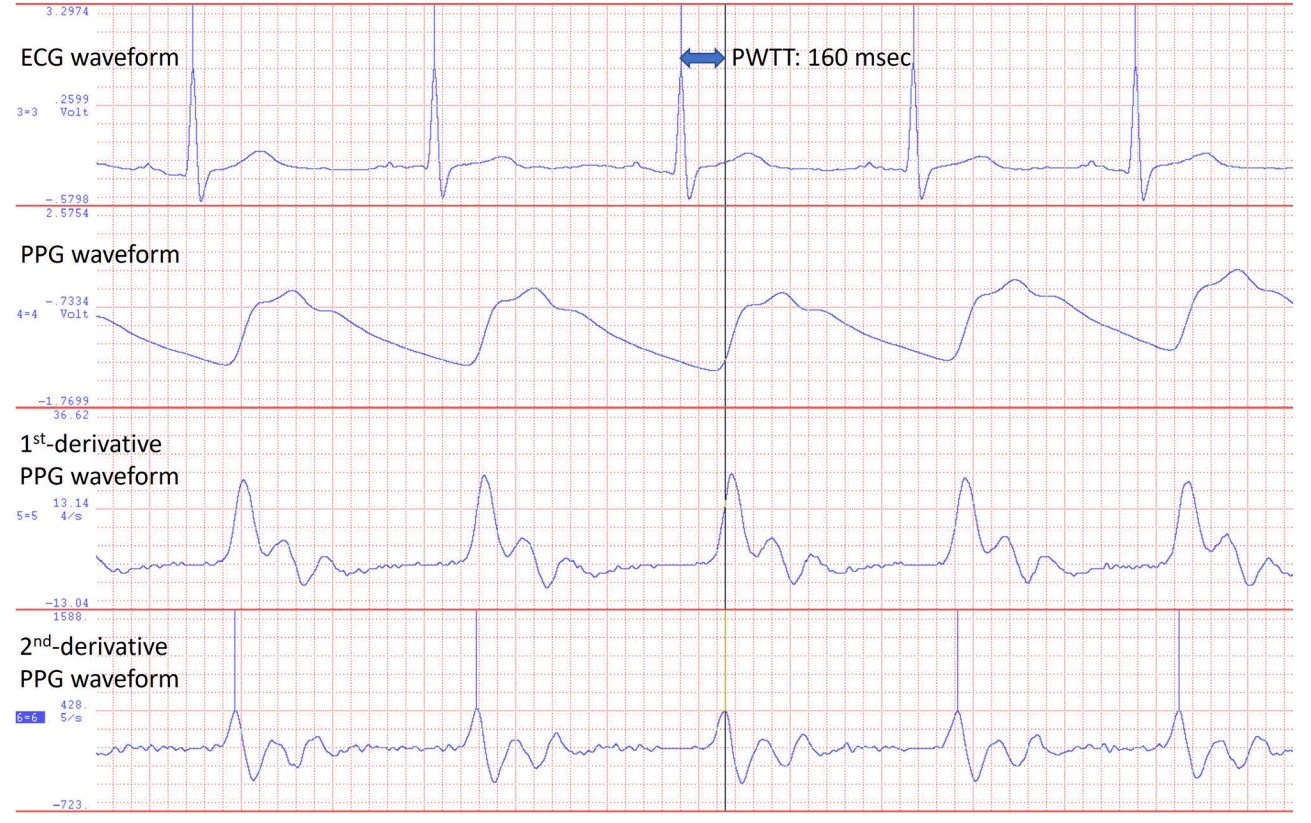
We manually replaced undetected peaks with correct ones or deleted erroneously detected peaks. The PWTT was defined as the difference in milliseconds (ms) between the R peak of the ECG waveform and the peak of the second-derivative PPG waveform (Fig. 1) [27]. A PWTT longer or shorter by 20% than the previous or next PWTT that was regarded as one from an ectopic beat was replaced with an adjacent normal PWTT.
Analysis of the PWTTV
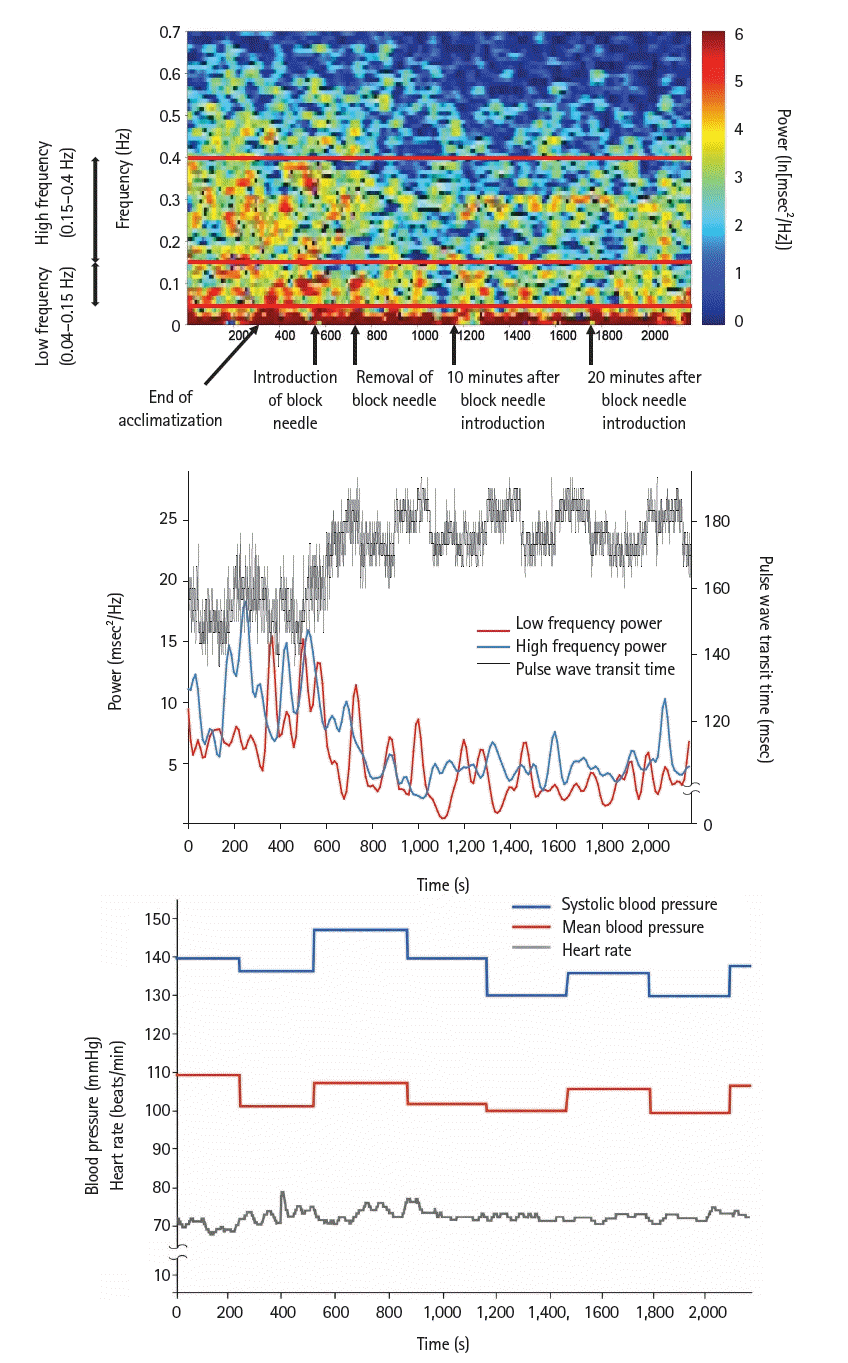
The data points from the XY plot, in which the X and Y axes represent the time from 5 min before the end of acclimatization to 20 min after block needle introduction (study time) and the PWTT from each heartbeat, were linearly interpolated. A new dataset consisting of equidistant data points was generated by resampling the data at 4 Hz from the linearly interpolated lines. The resampled data were detrended by creating a residual plot of a simple linear regression model, where the time corresponding to the resampled PWTTs served as an independent variable and the resampled PWTTs served as a dependent variable. The detrended data were divided into 100-second-long segments with adjacent segments overlapping by 90% (90 s). Each segment was Hamming windowed to prevent spectral leakage [28], and then a fast Fourier transform was applied to produce a power spectrum. The frequency resolution was 0.01 Hz, and the maximum frequency was 2 Hz (Nyquist frequency). By integrating the power between 0.04 and 0.15 Hz and between 0.15 and 0.4 Hz, the LF and high-frequency power (HF) were calculated. The LF and HF values from 20 segments corresponding to each five-minute-long study time point were averaged. The study time points were as follows: 1) during the 5 min before the end of the acclimatization period (baseline); 2) between 5 and 10 min after the introduction of the block needle (5–10 min post-needle insertion); and 3) between 15 and 20 min after the introduction of the block needle (15–20 min post-needle insertion). Since the PWTT increases within a few minutes of the local anesthetic being injected through the block needle, the time of needle insertion was set as the reference time point. Due to their right-skewed distributions, the LF and HF for each time point were natural log (ln)-transformed. To visualize the longitudinal changes in LF and HF throughout the entire study period, a spectrogram was generated (Fig. 2).
Assessment of sensory and motor blockade
To assess sensory blockade, an alcohol swab was applied to the dermatomal areas innervated by the five nerve roots from the brachial plexus (C5-to-first thoracic [T1] nerve roots). Coldness was rated via a three-point scoring system, where 0, 1, and 2 represent no cold sensation, reduced cold sensation, and normal cold sensation, respectively. Motor blockade was assessed by rating the power of movement corresponding to each terminal nerve of the brachial plexus as 0 (complete block), 1 (partial block), or 2 (no block). The movements and their controlling nerves are as follows: shoulder abduction (axillary nerve), elbow flexion (musculocutaneous nerve), forearm pronation (median nerve), forearm supination (radial nerve), wrist flexion (median nerve), wrist extension (radial nerve), thumb adduction (ulnar nerve), thumb abduction (radial nerve), thumb opposition (median nerve), and finger abduction (ulnar nerve) [23].
Measurement of pupil size
Pupil size was measured bilaterally using a portable infrared pupillometer (PLRTM-3000, NeurOptics, Inc.). Before the measurement, patients were given 2 min to adapt to the low-mesopic conditions [29] achieved by turning off all the lights in the operating room. The patients were instructed to open their eyes widely facing forward without blinking with their head in a neutral position during the entire measurement period. The eye cup of the pupillometer was positioned at a right angle to the vision axis, minimizing tilting of the pupillometer during the measurement. During the two-second measurement, the pupil diameter was captured at 30 Hz. The mean and standard deviation (SD) were automatically calculated from 60 pupil diameter measurements. Measurements with an SD > 0.1 mm were discarded, and new measurements were made. The diameter of the pupil ipsilateral to the site of the ISBPB was measured following the measurement of the contralateral pupil diameter [30].
Study outcome variables
The primary outcome variable was the lnLF at 15–20 min post-needle insertion. The secondary outcome variables were as follows: 1) the lnLF at baseline and 5–10 min post-needle insertion; 2) the PWTT and lnHF at the three study time points; 3) sensory and motor block scores assessed 20 min after block needle introduction; 4) bilateral pupil diameters measured at baseline and 20 min after block needle introduction; and 5) the incidence of side effects related to ISBPB (Horner’s syndrome, subjective dyspnea, and hoarseness).
The change in pupil size following ISBPB placement was calculated, accounting for the physiological discrepancy in the baseline pupil diameter between the bilateral eyes. The pupil size change adjusted for the baseline difference between both eyes (baseline-adjusted pupil size change) was defined as follows:
Patients were considered to have developed Horner’s syndrome if the baseline-adjusted pupil size change was < –0.5 mm [31].
Sample size calculation
In the pilot study involving 10 patients, the lnLF decreased from an average of 1.395 to 1.223 ln(ms2/Hz) at 15–20 min post-needle insertion. The mean and SD of the paired difference were –0.172 and 0.380, respectively. To achieve 90% power to detect a mean paired difference of –0.172 at a significance level of 0.05 using a two-sided paired t test, 53 patients were needed. Considering a dropout rate of 10%, a total of 59 patients were needed for this study. The sample size was calculated using PASS 15 software (2017) (NCSS, LLC.).
Statistical analysis
The normality of the data was assessed using the Shapiro‒Wilk test. Normally distributed data are presented as the means ± SDs, whereas non-normally distributed data are presented as the medians (Q1, Q3). Repeated-measures analysis of variance was used to evaluate the within-subject effect of changes in the PWTT, lnLF, and lnHF, as well as the interaction effect between the side of the eyes and the time point of pupil size measurement. Post hoc multiple comparisons were conducted using paired t tests, and the P values were adjusted with Bonferroni’s correction. The Friedman test was performed to test whether there were significant differences in the distribution of block scores among the C5-to-T1 dermatomes and movements corresponding to each terminal nerve. We grouped the dermatomes and movements that were not significantly different from each other (P > 0.05) [32]. Linear regression analysis was used to assess the linear relationship between baseline-adjusted pupil size changes and changes in PWTT parameters (differences in the PWTT, lnLF, and lnHF between baseline and 15–20 min post-needle insertion). The coefficient of determination (R2) from the linear regression models was used to determine the degree of correlation between the independent and dependent variables [33]. Because the sensory block score was determined using a three-point Likert scale, Spearman’s correlation analysis was employed to investigate the correlation between the sensory block scores of the C6 dermatome and changes in PWTT parameters. A two-sided P < 0.05 was considered to indicate statistical significance. All the statistical analyses were performed using IBM® SPSS® Statistics for Windows (version 20.0.0, IBM® Corp.).
Results
Patient characteristics
Among the 59 enrolled patients, three patients were excluded from the study; two patients had unexpected arrhythmia despite having a normal preoperative ECG, and one patient was excluded due to study protocol violation. No patients underwent general anesthesia due to intolerable pain caused by ISBPB failure. The characteristics of the 56 analyzed patients are presented in Table 1.
ISBPB data
Significant differences were found in the distributions of sensory and motor block scores among the C5-to-T1 dermatomes (P < 0.001) and movements specific to each motor nerve (P < 0.001), respectively. In the shoulder region and region distal to the shoulder, the C8 dermatome showed the least blockade of cold sensation among the five dermatomes (Table 2). Thumb opposition innervated by the median nerve was less markedly impaired by the ISBPB than the other movements.
ISBPB-induced changes in the PWTT and PWTTV
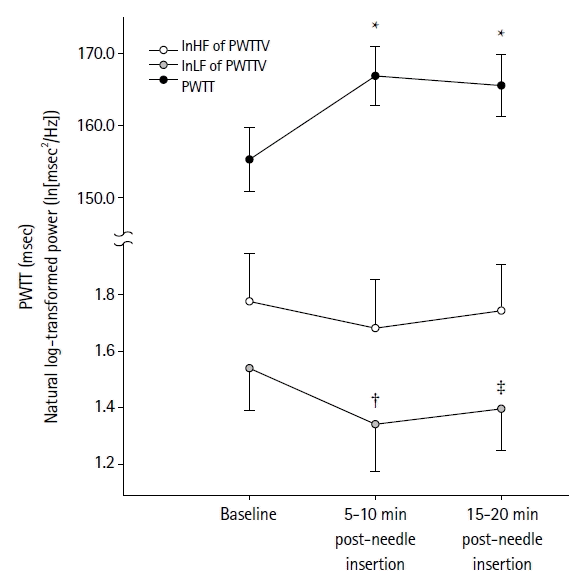
The PWTT significantly increased (P < 0.001) from baseline (mean [SD]: 155.3 [16.7] ms) to 5–10 min post-needle insertion (166.9 [15.4] ms) (mean difference of 11.6 ms, 95% CI [9.2–14.0], P < 0.001) and 15–20 min post-needle insertion (165.6 [16.1] ms) (mean difference of 10.3 ms, 95% CI [7.3–13.2], P < 0.001). The lnLF significantly decreased (P < 0.01) from baseline (1.539 [0.560] ln[ms2/Hz]) to 5–10 min post-needle insertion (1.341 [0.617] ln[ms2/Hz]) (mean difference of –0.198 ln[ms2/Hz], 95% CI [–0.356 to –0.040], P < 0.01) and 15–20 min post-needle insertion (1.396 [0.548] ln[ms2/Hz]) (mean difference of –0.144 ln[ms2/Hz], 95% CI [–0.274 to –0.013], P = 0.03) (Fig. 3). However, no significant changes in the lnHF were observed.
ISBPB-induced changes in bilateral pupil sizes
There was a significant interaction between the side of the eye and the time point of pupil size measurement (P < 0.001) (Table 3). Horner’s syndrome developed in 51 out of 56 patients (91.1%).
Linear relationships between PWTT parameters and pupil size changes
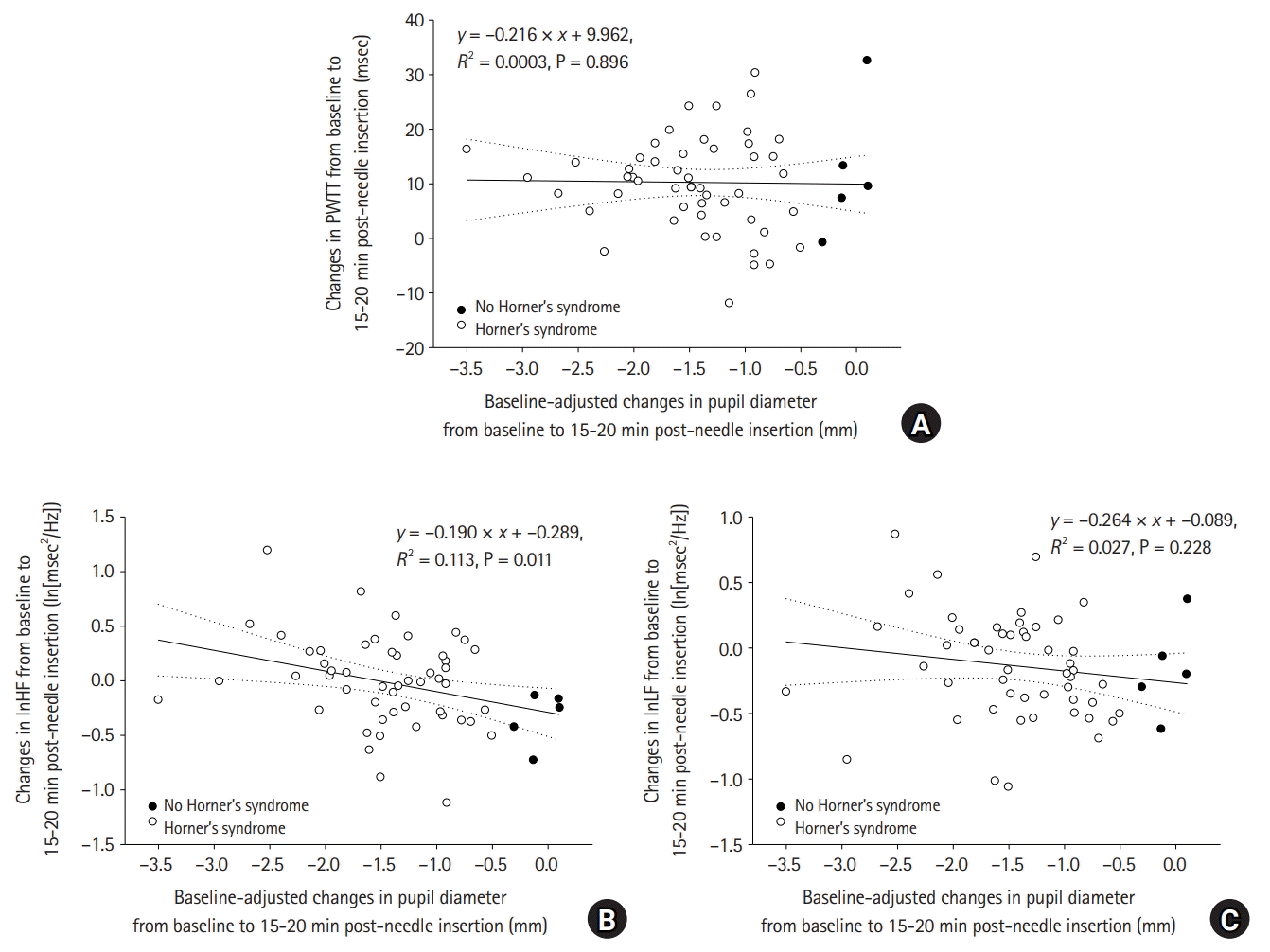
As all the R2 values determined from the linear regression models were less than 0.16, the degree of correlations between baseline-adjusted pupil size changes and changes in PWTT parameters was determined to be negligible or weak (Fig. 4) [33]. Furthermore, no significant correlations were found between the sensory block scores of the C6 dermatome and changes in PWTT parameters.
Side effects of ISBPB placement
Following ISBPB placement, three patients (5.4%) reported subjective dyspnea, although no patients reported hoarseness. Local anesthetic infiltration was applied at the site of the posterior portal to relieve pain upon posterior portal placement in four patients. Eight patients developed hypotensive bradycardic events [26] and were treated with ephedrine (10 mg for four patients, 20 mg for one patient, and 30 mg for three patients).
Discussion
In our study, we observed that the PWTT and lnLF measured using PPG waveforms obtained from the thumb that is innervated by the C6 nerve root increased and decreased, respectively, 5 min after block needle introduction. These changes were maintained until the end of the study period (20 min after block needle introduction). However, we did not find any correlation between these changes and the extent of C6 dermatomal block. In addition, the block of the cervical sympathetic trunk accompanying the ISBPB did not affect these changes.
Various methods exist for assessing sensory blockade under regional anesthesia [7]. These methods include measuring patients’ responses to mechanical stimuli (e.g., touch [2], pinprick [1,2], pressure [1]), thermal stimuli (e.g., wet alcohol sponges [2], cold gel bags [1], ice water [4,5], heat [3], and lasers [3]), electrical stimuli (e.g., transcutaneous [1]), chemical stimuli (e.g., capsaicin [6] and mustard oil [5]), and ischemic stimuli (e.g., tourniquets [5]). However, these approaches rely on subjective patient responses, are time consuming, and cannot be used for sedated or uncooperative patients [7]. Consequently, several objective measures have been introduced to assess the effects of regional anesthesia on the basis of changes in autonomic nervous activity (sympathectomy) [34], such as the PWTT [8–10], perfusion index [11], temperature [12], and blood flow [12] of the limb under regional anesthesia. However, measuring the perfusion index, temperature, and blood flow requires specialized equipment that is not readily available or is inconvenient for routine use in the operating room (e.g., pulse oximeters capable of measuring the perfusion index [11], thermometers [12] or infrared thermography cameras [13], and ultrasound machines capable of calculating the time‒velocity integral [12]). In contrast, the PWTT can be calculated using PPG and ECG waveforms that are always available in the operating room through standard monitoring of patients under regional anesthesia. Owing to their clinical feasibility, we chose to use the PWTT and its derived parameters (lnLF and lnHF) to assess the effects of ISBPB placement.
Previous studies have demonstrated the usefulness of the PWTT in determining the success of epidural and axillary brachial plexus blocks [8–10]. However, to our knowledge, its application has not been investigated in patients receiving an ISBPB for surgical anesthesia. When a high volume of highly concentrated local anesthetic is administered in the interscalene groove, the local anesthetic is very likely to spread along the prevertebral fascia to the cervical sympathetic trunk [30], including the middle cervical, vertebral, inferior cervical, and T1 ganglia [35]. These structures provide sympathetic innervation to the ipsilateral upper limb through gray rami communicantes of the C5-to-T1 nerve roots. Therefore, evaluating the effects of ISBPB placement for surgical anesthesia on the PWTT presents inherent challenges, as the assessment of this effect is confounded by the block of the cervical sympathetic trunk, which leads to sympathetic blockade and subsequent changes in the PWTT [36] in the ipsilateral upper limb, similar to what can be expected with ISBPB placement. Accordingly, in our study, a high incidence of Horner’s syndrome (91.1%), attributed to block of the cervical sympathetic trunk, was found, which is consistent with the findings of a previous study (97.6%) [30]. The high incidences of Horner’s syndrome in these studies were detected by employing pupillometry to objectively measure the severity of the condition (i.e., block of the cervical sympathetic trunk), whereas low incidences of Horner’s syndrome were reported in previous studies that relied on subjective observations by researchers for diagnosis (33.3% [37], 9.3% [38], and 21% [39]). Despite the high incidence of Horner’s syndrome, the confounding effects of the block of the cervical sympathetic trunk on PWTT parameters appear to be insignificant in this study, considering the weak or negligible correlations observed between changes in pupil size and PWTT parameters. We speculate that the relatively low contribution of the middle cervical, vertebral, inferior cervical, and T1 ganglia to the innervation C6 nerve root [35] that innervates the thumb where PWTT parameters were measured, may have contributed to the insignificant confounding effects of the cervical sympathetic trunk.
Given the assumed nonsignificant confounding effects of the block of the cervical sympathetic trunk secondary to ISBPB, we observed significant changes in the PWTT and lnLF following ISBPB placement. The brachial plexus contains sympathetic efferent postganglionic fibers, and its blockade leads to sympathetic blockade of the upper limb, resulting in a reduction in arterial vascular tone. This reduction is represented by an increase in the PWTT [40]. Accordingly, we observed an increase in the PWTT after ISBPB placement, which is consistent with the findings of previous studies on axillary brachial plexus blocks [9,10]. The PWTT that reflects arterial vascular tone [40] oscillates under dynamic and complex interactions between the autonomic nervous system and the cardiovascular system [14–16,41]. Therefore, it would be valuable to investigate how ISBPB placement affects PWTT oscillation patterns (the PWTTV). Although the physiological phenomena represented by the power spectral parameters of the PWTTV remain unclear, their close relationships with those of systolic blood pressure variability can be helpful in interpreting changes in the PWTTV following ISBPB placement. At rest, there is significant coherence (> 0.5) between the LF and HF of the PWTTV and those of systolic blood pressure variability [14]; furthermore, their changes after exercise are similar [15,16]. In our study, we observed a reduction in the lnLF after ISBPB placement. Given that the LF of systolic blood pressure variability reflects sympathetic vasomotor activity [17] and is coherent with the LF of the PWTTV [14–16], the decrease in lnLF indicates a reduction in sympathetic vasomotor activity resulting from ISBPB-induced sympathectomy. Similarly, the HF of systolic blood pressure variability represents the mechanical interaction between systolic blood pressure and respiration [17] and is coherent with the HF of the PWTTV [14–16]. Therefore, the nonsignificant changes in the lnHF suggest that ISBPB placement does not affect the mechanical interaction between the PWTT and respiration.
Study limitations
This study has several limitations that should be considered. First, no patients in our study underwent general anesthesia due to ISBPB failure that prevented us from performing receiver operating characteristic analysis to assess the performance of the PWTT parameters and their cutoff values in determining ISBPB success or failure. Second, since we placed the pulse oximetry sensor on the ipsilateral thumb innervated by the C6 nerve root, PWTT parameters were able to be evaluated for only the C6 dermatome. Therefore, further evaluation of other dermatomes is necessary. Third, the quality of PPG and ECG waveforms can be easily compromised by patient movements, and focused efforts are needed to acquire artifact-free waveforms. Otherwise, additional techniques such as filtering or imputation, which may result in data loss, introduce additional errors into the data, and prolong the time taken to process the data, should be used. Fourth, in addition to waveform collection, obtaining the lnLF and lnHF requires complex calculations and specialized equipment equipped with dedicated software, limiting their availability for use in typical clinical settings. Since these parameters have not yet been fully validated, the development of commercial devices for real-time monitoring is not yet feasible. However, once validated for clinical use, such devices could be developed to calculate and provide these parameters in near real time for clinicians, similar to the Analgesia Nociception Index calculated by the Root® monitor (Masimo Corp.) at two- and four-minute intervals using ECG waveforms [42]. Fifth, it is important to note that the PWTT and lnLF primarily indicate the activity of unmyelinated C fibers that constitute the sympathetic postganglionic fibers in the thumb [43]. In addition, cold stimulation with an alcohol swab that was applied to different areas of the upper limb according to the dermatome activates Aβ fibers [44,45]. In contrast, highly intense noxious stimulation during surgery leads to the activation and sensitization of both peripheral and central nociceptive neurons [46]. Therefore, the PWTT, lnLF, and cold stimulation have inherent limitations in the assessment of ISBPB success or failure that is ultimately determined by patients’ responses to noxious surgical stimulation [47]. These methods are based on different physiological mechanisms and are thus not interchangeable. Accordingly, our method should be considered complementary to existing methods rather than a replacement. However, given that sympathetic nerve fibers are more sensitive to local anesthetics than are the sensory fibers responsible for perceiving cold sensations [13], PWTT parameters may detect the onset of ISBPB earlier than traditional sensory tests, underscoring their potential usefulness for earlier estimation of block success. Sixth, in this study, we did not find a significant correlation between the sensory block scores of the C6 dermatome and PWTT parameters. The use of ultrasound guidance that enables accurate localization of the brachial plexus and precise administration of local anesthetics around the brachial plexus may have led to skewed distributions of both the sensory block scores and PWTT parameters, which were populated with extreme values representing the maximum physiologic effects of the ISBPB. As our study was not powered to detect minor differences within the narrow ranges of values, nonsignificant results were obtained. In addition, we speculate that the inconsistency between sensory and sympathetic dermatomes [48] might also have contributed to our negative findings. Finally, the use of a total of 26 ml of 0.75% ropivacaine, which aimed to achieve surgical anesthesia while minimizing the need for supplemental analgesics or sedatives and reducing the risk for hypotensive bradycardic events, could have produced systemic vascular effects. However, on the basis of previous studies using volumes of 25 ml or more, which demonstrated that perfusion index changes following brachial plexus block were confined to the blocked limb and did not extend to the contralateral limb [11,49,50], we believe that the local anesthetic did not have systemic effects in our study.
In conclusion, our study demonstrated a reduction in the lnLF and an increase in the PWTT after ISBPB placement, which may be attributable to ISBPB-induced sympathectomy.

 XML Download