



 PDF
 Citation
 Print


INTRODUCTION
Dysphagia requires prompt diagnosis and intervention to prevent complications such as malnutrition, dehydration, and aspiration pneumonia [1,2]. In the pediatric population, dysphagia can lead to chronic health issues, affecting physical growth and overall development, underscoring the need for early detection and timely intervention [3]. Children with central nervous system or neuromuscular disorders are at high risk of progressive dysphagia [2,4,5]. As such, accurate screening tools can be critical to detecting dysphagia at an early stage and improving clinical outcomes [6].
Videofluoroscopic swallowing study (VFSS) and fiberoptic endoscopic evaluation of swallowing (FEES) remain the most popular diagnostic tools for pediatric dysphagia [7]. Although accurate, they are invasive, with VFSS involving dangerous radiation exposure for younger children and FEES triggering discomfort, pain, and intranasal bleeding [8,9]. Therefore, non-invasive, reliable, and child-friendly screening tools, such as caregiver-administered questionnaires, are increasingly being recognized as both practical and efficient in identifying those at risk and helping minimize the reliance on invasive, traditional procedures [10].
A well-established tool for non-invasive screening of dysphagia is the Pediatric Eating Assessment Tool-10 (Pedi-EAT-10), adapted from the adult version [11], which has been validated and extensively used to assess dysphagia severity in adults with various conditions, such as stroke, dementia, amyotrophic lateral sclerosis, chronic obstructive pulmonary disease, and head and neck cancers [12-14]. The Pedi-EAT-10, comprising a 10-item caregiver-administered questionnaire, has also demonstrated strong validity and reliability in pediatric populations [15-17]. Validation studies for Pedi-EAT-10 in Arabic, Spanish, and Italian populations have further confirmed its internal consistency, test-retest reliability, and effectiveness in multiple languages to identify dysphagia in children with neurological and genetic disorders [18-20].
Although the Pedi-EAT-10 has been widely validated in several languages [18-20], no studies have been conducted in Asian populations. This study aimed to translate, culturally adapt, and validate the Korean version of Pedi-EAT-10 (K-Pedi-EAT-10), in accordance with the International Society for Pharmacoeconomics and Outcomes Research (ISPOR) guidelines to ensure methodological rigor in the cross-cultural adaptation process [21,22]. We hypothesized that the K-Pedi-EAT-10 would demonstrate strong reliability and validity and serve as a non-invasive, caregiver-administered screening tool for early detection of pediatric dysphagia and aspiration risk, thereby facilitating preliminary clinical triage and guiding the appropriate use of confirmatory instrumental evaluations such as VFSS or FEES when indicated.
METHODS
Study design
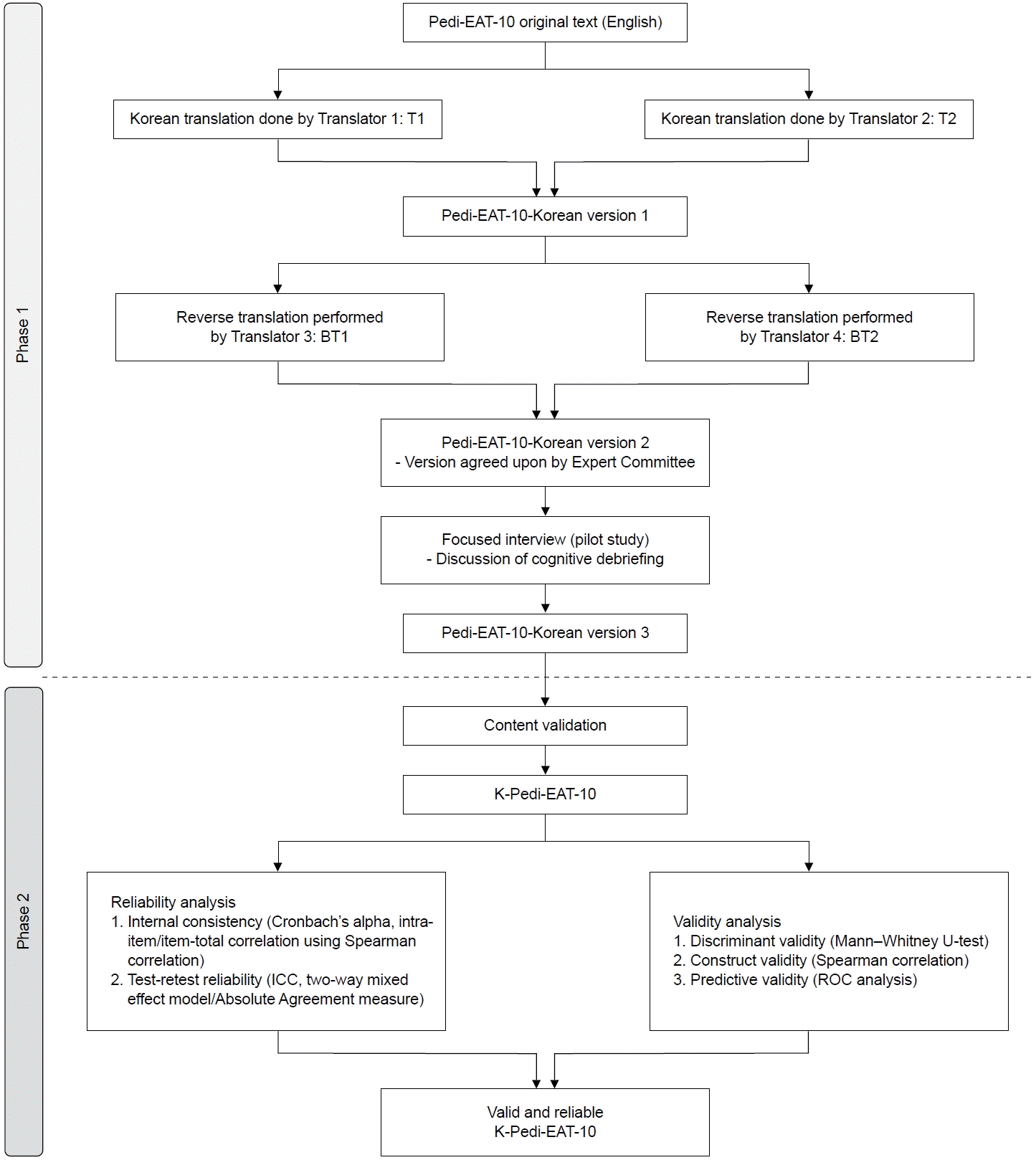
This prospective, cross-sectional pilot study was conducted in two phases: (1) translation and cultural adaptation of the Pedi-EAT-10 into Korean, and (2) psychometric validation of the K-Pedi-EAT-10 in children with dysphagia and typically developing controls (Fig. 1). The study followed the ISPOR Task Force guidelines for the translation and cultural adaptation of patient-reported outcome measures (Supplementary Table S1) [22].
A multidisciplinary expert committee composed of seven physiatrists (four with expertise in adult dysphagia and three in pediatric rehabilitation) and three pediatric swallowing therapists, all possessing more than five years of clinical experience regarding dysphagia, reviewed the two forward translations (BT1, BT2) and the original Pedi-EAT-10 to ensure semantic, experiential, and conceptual equivalence. Cognitive debriefing was subsequently conducted through focused interviews with five caregivers of children diagnosed with dysphagia confirmed by VFSS (Penetration-Aspiration Scale, PAS≥3) within the preceding three months. Caregivers evaluated the clarity, relevance, and comprehensibility of each item and response option, and their feedback was systematically analyzed in conjunction with the content validity assessment results. Based on the integrated analysis of cognitive debriefing outcomes and expert consensus discussions, the committee refined linguistic precision and cultural appropriateness, leading to the development of the finalized Pedi-EAT-10_Korean Version 3 (K-Pedi-EAT-10) for psychometric evaluation (Fig. 1).
Children aged 3 to <18 years were enrolled. The clinical group included children with dysphagia who had undergone VFSS within the preceding three months. The control group consisted of typically developing children without swallowing or neurological disorders. Children were excluded if they were totally tube-fed, medically unstable, or unable to complete the assessment due to poor cooperation or lack of caregiver support. Demographic and clinical data—including age, sex, and Functional Oral Intake Scale (FOIS) level [23] (Supplementary Table S2)—were collected from medical records or caregiver reports.
The study was approved by the Institutional Review Board of Seoul National University Hospital (IRB No. H-2308-140-1459). Written informed consent was obtained from legal guardians, and assent was also obtained from participants aged 7 years or older.
VFSS analysis
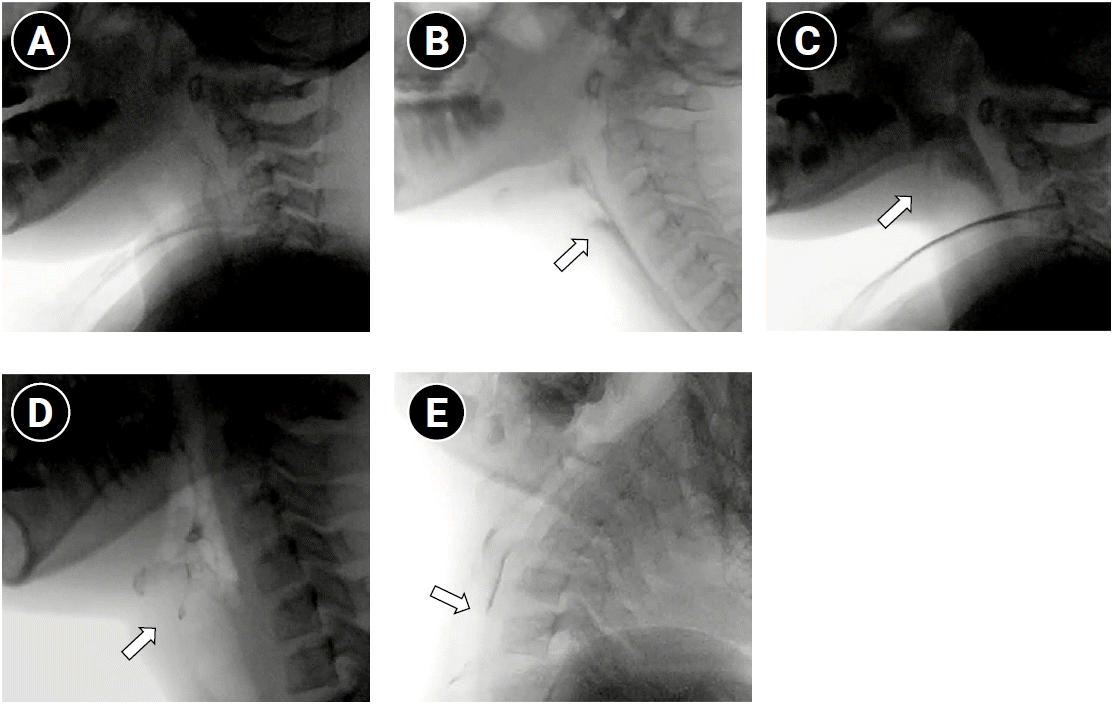
VFSS was performed with children seated upright in a chair or feeder seat, depending on clinical status. Standardized boluses were administered, and the primary analysis focused on 2 mL liquid barium and yogurt trials, which were feasible for most participants. Outcome parameters included the PAS, pharyngeal residue, oral transit time (OTT), and pharyngeal transit time (PTT). Detailed bolus types, scoring methods for PAS and residue, and definitions of OTT and PTT are provided in Supplementary Tables S3, S4, and Fig. 2 [24-27]. VFSS data were retrospectively collected within three months of the K-Pedi-EAT-10 responses.
Sample size determination
We calculated the required sample size based on a previous study reporting the relationship between Pedi-EAT-10 and PAS, in which the PAS≥6 group had a mean Pedi-EAT-10 score of 33.3±5.12 and the PAS≤5 group had a mean score of 22.0±5.26 [18]. To detect differences in Pedi-EAT-10 scores between the clinical and normal groups, with a significance level of 0.05 and a power of 0.9, a sample size of 12 participants per group was required. Considering a potential dropout rate of 10%, we recruited 13 participants for the clinical group and 13 age-matched healthy participants for the normal group.
Statistical analysis
Internal consistency of the K-Pedi-EAT-10 was assessed with Cronbach’s α, with values >0.8 indicating excellent reliability [28]. Item-to-item and item-to-total correlations were evaluated using Spearman correlation. Test–retest reliability was examined by re-administering the questionnaire 4–7 days later to caregivers in both groups, excluding participants who underwent therapeutic or medical changes between tests. Intraclass correlation coefficients (ICCs) were calculated, with ICC>0.80 reflecting excellent agreement.
Content validity was assessed using the item-level content validity index (I-CVI) and the scale-level content validity index based on the average method (S-CVI/Ave). Discriminant validity was examined by comparing K-Pedi-EAT-10 scores between clinical and control groups with the Mann–Whitney U-test (α=0.05). Construct validity was evaluated in the clinical group using Spearman correlations between K-Pedi-EAT-10 scores and VFSS parameters, including PAS, vallecular and pyriform sinus residue, OTT, and PTT during Yoplait and small fluid trials. Because the sample size was limited and the data were not normally distributed, nonparametric analyses were applied. Validity was interpreted using correlation strength: excellent (0.90–1.00), good (0.70–0.89), moderate (0.50–0.69), weak (0.30–0.49), and poor (<0.30) [29,30]. Predictive validity was analyzed by assessing the ability of K-Pedi-EAT-10 to detect aspiration (PAS≥6). Diagnostic accuracy was evaluated by receiver operating characteristic (ROC) curve analysis, with sensitivity and specificity calculated to identify optimal cutoff values.
RESULTS
Translation and cultural adaptation
The process of translation and cultural adaptation of the Pedi-EAT-10 into Korean was successfully completed through iterative revisions including feedback from focused interviews and expert committee reviews. During this process, semantic and conceptual clarifications were made to prevent confusion between similar terms such as “eating” and “swallowing,” “gags” and “vomiting,” and “pain” and “discomfort.” In addition, for Q3 and Q4 stating that “swallowing liquids or solids takes extra effort,” specific examples were added in parentheses to clarify the meaning of “extra effort.”
During the focused group interviews conducted with the Pedi-EAT-10-Korean version 2, the average response time to complete answering 10 questions was 75.4±19.0 seconds. Four respondents reported that all the questions were clear and easy to understand, while one respondent answered that Q2 and Q8 were “somewhat difficult to understand,” scoring 3 on a 4-point Likert scale. Consequently, further revisions were made on Q2 and Q8 to complete the Pedi-EAT-10-Korean version 3. Additional revisions were implemented to improve both relevance and clarity following the content validity evaluation of Q2, Q3, Q4, Q6, Q8, and Q10 by the expert committee discussions (Fig. 1). The final version of the K-Pedi-EAT-10 after completing the translation, cultural adaptation, and refinement process is presented in Supplementary Table S5.
Participants
For Phase 2, 13 patients in the clinical group (7 male; mean age: 10.2±4.2 years; median age: 11 years [range: 3–17 years]) and 13 individuals in the age-matched control group (7 male; mean age=9.5±5.0 years; median age: 10 years [range: 3–17 years]) were enrolled (Table 1). Patients in the clinical group were diagnosed with central nervous system lesions (n=7, 53.8%), including glioblastoma, West syndrome, and Lennox-Gastaut syndrome and neuromuscular diseases (n=6, 46.2%), such as nemaline rod myopathy, spinal muscular atrophy type 1, and chronic inflammatory demyelinating polyneuropathy. In the clinical group, four patients (30.8%) were classified as FOIS level 4, one patient (7.7%) as FOIS level 5, three patients (23.1%) as FOIS level 6, and five patients (38.5%) as FOIS level 7. In contrast, all participants in the normal group were classified as FOIS level 7.
Reliability
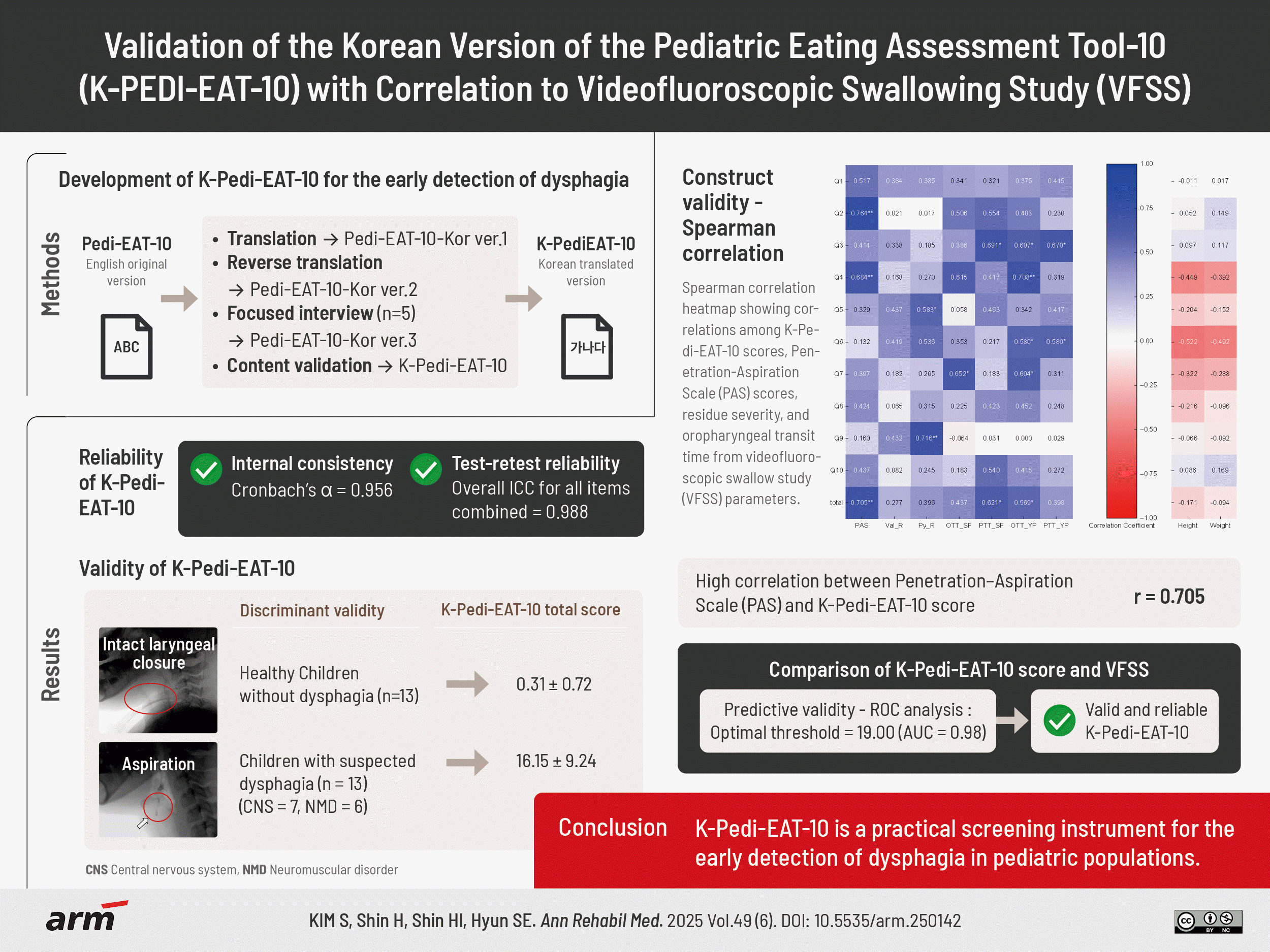
The internal consistency presented as inter-item analysis was excellent (Cronbach’s α=0.956). The item-to-item and item-to-total score correlations were also significant, with all items demonstrating strong correlations (Table 2). For the test-retest reliability, four participants in the clinical group failed to answer the re-test within 7 days after the first answer, owing to dietary changes (n=1), aggravation of the medical condition (n=2), and non-compliance (n=1). In the normal group, one participant was excluded due to non-compliance. The test-retest reliability showed ICC values of 0.836–0.990 for individual items, indicating good to excellent reliability (Table 2). The overall ICC for all items combined was 0.988 (95% confidence interval [CI], 0.971–0.995), demonstrating excellent test-retest reliability.
Validity
The I-CVI for both relevance and clarity were above 0.8 for all items (Table 3), and the S-CVI/Ave was 0.92 for relevance and 0.88 for clarity, indicating excellent content validity. The discriminant validity was confirmed through the comparison of mean total scores of the K-Pedi-EAT-10: clinical group, mean±standard deviation (SD): 16.15±9.24, median: 19 (range: 0–32); normal group, mean±SD: 0.31±0.72, median: 0 (range: 0–2). The Mann–Whitney U-test yielded a U-value of 9.5, with a corresponding Z-value of -4.053 (p<0.001), indicating a significant difference between the groups and demonstrating the ability of K-Pedi-EAT-10 to differentiate between children with dysphagia and healthy children. The comparison of K-Pedi-EAT-10 scores between the groups stratified by age and diagnosis is detailed in Table 4. Furthermore, the Mann–Whitney U-test comparing item-specific and total K-Pedi-EAT-10 scores between the aspiration (PAS≥6) and non-aspiration (PAS≤5) subgroups within the clinical group revealed significant differences in Q1 (U=5.5, p=0.022), Q2 (U=3.5, p=0.009), Q4 (U=4.0, p=0.013), Q5 (U=7.0, p=0.036), Q8 (U=7.0, p=0.034), and the total score (U=1.0, p=0.004), with higher scores consistently observed in the aspiration group (Table 5).
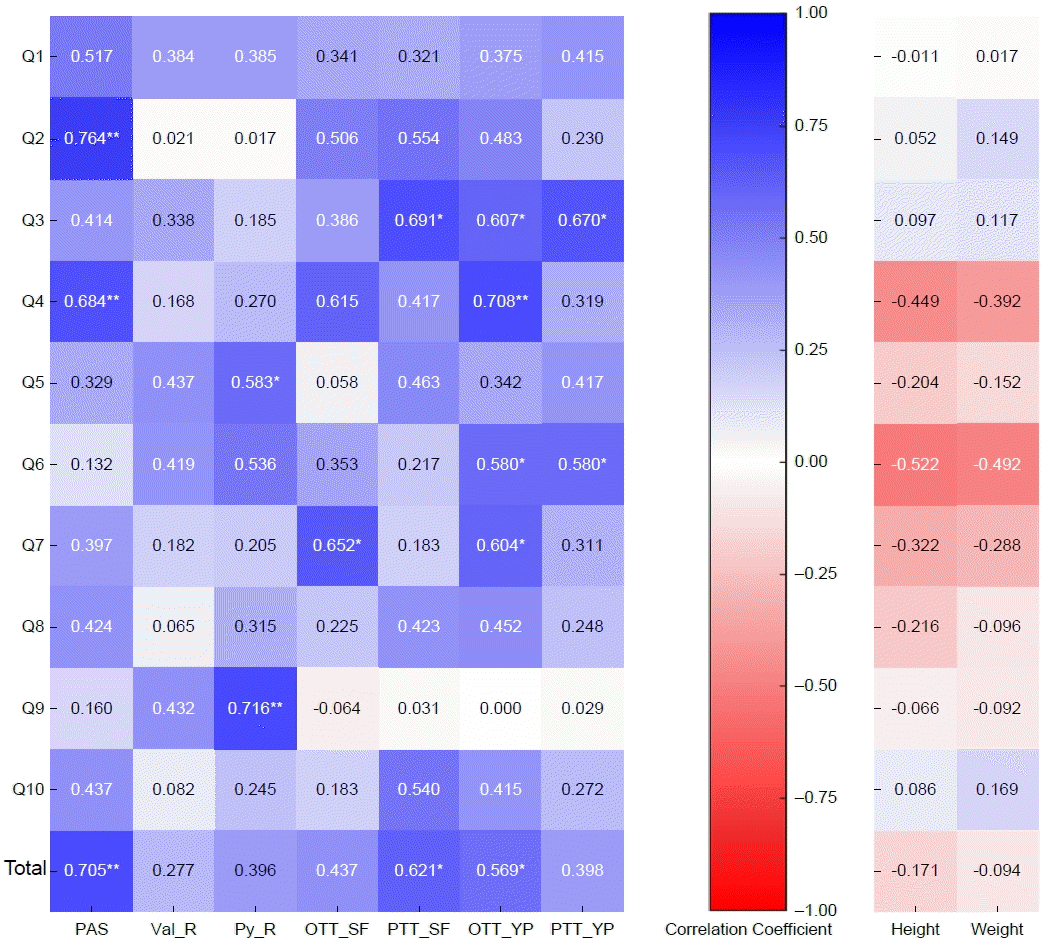
The K-Pedi-EAT-10 total score and PAS scores were significantly correlated (r=0.705, p=0.007), whereas vallecular or pyriform sinus residue levels were not correlated (Fig. 3). When analyzing the correlations between individual K-Pedi-EAT-10 item scores and PAS scores, significant correlations were observed for Q2 (r=0.764, p=0.002) and Q4 (r=0.684, p=0.010). No significant correlations were observed between individual K-Pedi-EAT-10 item scores and vallecular residue levels. However, significant positive correlations were found between pyriform sinus residue levels and Q5 (r=0.583, p=0.036), as well as Q9 (r=0.716, p=0.006) (Fig. 3). During the small fluid trials, significant correlations were only found between OTT and Q7 (r=0.652, p=0.041). For PTT, significant correlations were observed with Q3 (r=0.691, p=0.019) and total score (r=0.621, p=0.042). During the Yoplait trials, OTT showed a significant correlation with Q3 (r=0.607, p=0.028), Q4 (r=0.708, p=0.007), Q6 (r=0.580, p=0.038), Q7 (r=0.604, p=0.029), and the total score (r=0.569, p=0.042), whereas PTT was significantly correlated with Q3 (r=0.607, p=0.012) and Q6 (r=0.580, p=0.038). However, no significant correlations were found between height or weight and either individual K-Pedi-EAT-10 item scores or the total score.
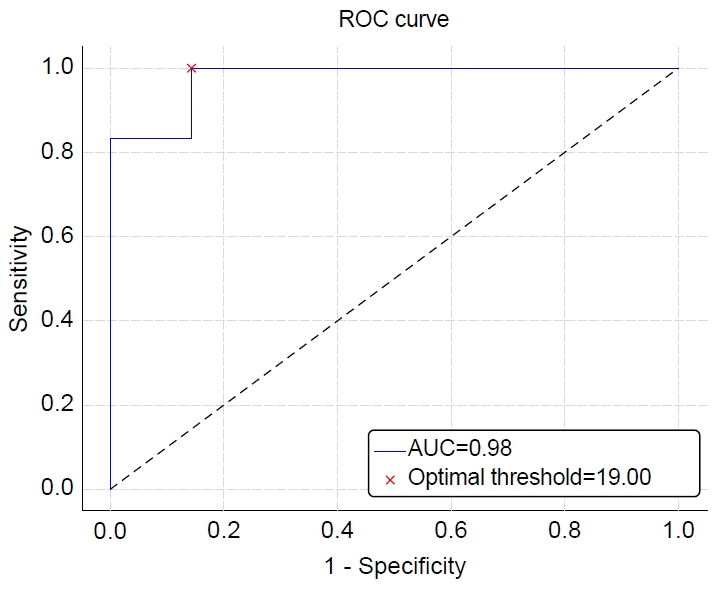
The ROC curve analysis for the diagnostic performance of the K-Pedi-EAT-10 demonstrated an area under the curve (AUC) of 0.98 (95% CI, 0.95–1.00; p<0.001) (Fig. 4). A cut-off score of 19 was identified as optimal for detecting aspiration risk (PAS≥6), yielding a sensitivity of 100% and specificity of 85.7%. Furthermore, the positive predictive value (PPV) and negative predictive value (NPV) were calculated as 85.7% and 100%, respectively, confirming the tool’s reliability in identifying children at risk of aspiration.
DISCUSSION
This study successfully translated, culturally adapted, and validated the K-Pedi-EAT-10 to ensure methodological equivalence with the original instrument. The K-Pedi-EAT-10 demonstrated excellent internal consistency (Cronbach’s α=0.956) and strong test-retest reliability (ICC=0.988), confirming its stability and reliability as a useful caregiver-administered screening tool. Discriminant validity was supported by markedly higher K-Pedi-EAT-10 total scores in children with dysphagia than in age-matched healthy controls (U=9.5, Z=-4.053, p<0.001). Construct validity was further established through significant correlations between K-Pedi-EAT-10 scores and objective VFSS parameters, particularly PAS scores (r=0.705, p=0.007). In addition, ROC curve analysis demonstrated excellent predictive validity, identifying a total score of 19 as the optimal threshold for detecting aspiration risk (AUC=0.98, 98% CI 0.95-1.00). Collectively, these results confirm that the K-Pedi-EAT-10 is a reliable, valid, and clinically feasible screening tool for early identification of dysphagia and aspiration risk in children.
During the process of translation and cultural adaptation including focused group interviews and expert committee reviews, minor modifications were made to enhance conceptual equivalence at each step. For example, “while eating” in Q8 was initially revised to “while swallowing food” for clarification, but it was further adjusted to “when eating food” to prevent a shift in meaning, as “eating” and “swallowing” have distinct definitions. In the questions regarding whether extra effort is required when swallowing liquids (Q3) or solid foods (Q4), many participants from the focused interview found the concept of “extra effort” too ambiguous, making it difficult to answer. To address this issue, expert opinions were incorporated through a Korean cultural adaptation process, and specific examples were added to clarify the meaning of “extra effort” in Q3 and Q4 (e.g., use of thickening agents, preparation of a dysphagia diet, use of assistive devices such as straws, and consumption in small amounts for Q3; minced food for Q4). These systematic modifications adhered to ISPOR guidelines, ensuring the preservation of linguistic and psychometric integrity and resulting in an effective K-Pedi-EAT-10 that demonstrated high consistency, reliability, and validity comparable to those translated to other languages [21,22]. The Spanish (0.865) and Italian (0.89) versions exhibited lower internal consistency than that for K-Pedi-EAT-10, whereas the Arabic version (0.968) reported a slightly higher but comparable Cronbach’s alpha. Test-retest reliability was not assessed in the Spanish and Italian studies, whereas the Arabic version demonstrated ICC values ranging from 0.97 to 1, also comparable to that observed in this study (0.988) [18-20]. Discriminant validity findings in this study were also consistent with prior research results [11]. The original Pedi-EAT-10 validation demonstrated a significantly higher score in children with cerebral palsy (19.5±11.0) compared to the score in typically developing children (0.26±1.83, Z=10.01, p<0.001) [11]. Similarly, validation studies in Italian, Spanish, and Arabic populations reported significantly higher scores in children with dysphagia than in healthy controls while the distribution of total scores varied across studies [18-20].
Predictive validity was also comparable to that reported in previous studies, despite a variation in cut-off scores across studies [18-20]. The original Pedi-EAT-10 validation study, which focused on children with neurological impairments, reported a lower cut-off score of 13 (sensitivity=77%, specificity=64%, PPV=69%, NPV=64%) [15]. The Arabic validation study using FEES rather than VFSS reported an AUC of 0.92 (0.89–0.96) with a cut-off score of 28, yielding a sensitivity of 89% and specificity of 87.5% (PPV=84.5%, NPV=90.5%). Because of procedural discomfort and limited pediatric cooperation, FEES may have lower sensitivity for aspiration, resulting in a higher cut-off score [18]. The Spanish and Italian validation studies did not incorporate VFSS or FEES, and therefore did not report ROC analyses or cut-off scores for aspiration risk, limiting direct comparisons [19,20]. Differences in participant characteristics, dysphagia severity, and aspiration assessment methods (VFSS vs. FEES) are the potential causes of variations in optimal thresholds across studies.
A key strength of this study lies in the incorporation of objective VFSS parameters derived from a pediatric population, providing a robust physiological foundation for validating the K-Pedi-EAT-10. Unlike previous validation studies, which primarily relied on questionnaire-based definition of dysphagia or FEES findings, which are often difficult to quantify, the present study directly correlated Pedi-EAT-10 scores with VFSS outcome measures. Because VFSS involves radiation exposure, obtaining such VFSS outcome data in pediatric populations is inherently challenging, and pediatric VFSS-based validation studies have not been reported previously [18-20]. By recruiting participants who had already undergone VFSS for pre-existing clinical indications, this study uniquely bridges subjective caregiver-reported symptoms with objective swallowing physiology. Through analysis of aspiration severity (PAS scores), amount of pharyngeal residue, and oropharyngeal transit times, the findings demonstrate that integrating subjective and objective measures reinforces the clinical utility of the K-Pedi-EAT-10 for early identification of both aspiration risk and oropharyngeal dysphagia. Furthermore, if total or each item-specific K-Pedi-EAT-10 scores are applied appropriately to stratify the risk of aspiration or malnutrition, the K-Pedi-EAT-10 could function as an adjunctive screening step within the clinical decision-making process. Such an approach may help clinicians identify children who warrant confirmatory instrumental evaluations (e.g., VFSS or FEES) and optimize the timing and necessity of these assessments, thereby promoting safer and more efficient diagnostic pathways in pediatric dysphagia management.
Limitations
This study has several limitations. The small sample size and heterogeneity of participants limited the statistical power and generalizability of the findings. As data were collected from a single tertiary center, a risk of selection bias exists. Thus, relatively high AUC values observed in the ROC analysis should be interpreted with caution, as overfitting cannot be entirely excluded given the limited sample size. Also, the cognitive debriefing process involved only five caregivers, which falls short of the recommended sample size (≥10) suggested by international guidelines. Consequently, all analyses should be regarded as exploratory, and the findings considered preliminary evidence supporting the reliability and validity of the K-Pedi-EAT-10. In addition, because the K-Pedi-EAT-10 utilizes an ordinal scale, the ROC curve lacked smoothness. The study could not establish disease-specific cut-off scores for the K-Pedi-EAT-10, as subgroup analyses based on the underlying etiologies were not feasible. Future multicenter studies with larger and more diverse cohorts, including caregivers from varied age, educational, and socioeconomic backgrounds, are warranted to confirm external validity, refine item-specific interpretations, establish disease-specific cutoff scores, and further enhance the cultural and clinical applicability of the K-Pedi-EAT-10.
Conclusion
In conclusion, this study successfully translated, culturally adapted, and validated the K-Pedi-EAT-10, demonstrating excellent reliability and validity for assessing dysphagia in children. By integrating subjective caregiver-reported K-Pedi-EAT-10 scores and objective VFSS findings, particularly PAS scores, this study provides strong evidence supporting the construct and predictive validity of the K-Pedi-EAT-10. The identified optimal cut-off score of 19 effectively discriminated aspiration risk (PAS≥6), with high diagnostic accuracy, underscoring its potential as a reliable clinical screening instrument.
Owing to its non-invasive, caregiver-administered nature, the K-Pedi-EAT-10 provides a practical and feasible means for the early identification of dysphagia and aspiration risk in children. The K-Pedi-EAT-10 could serve as a complementary screening instrument to identify children who may benefit from further instrumental assessments such as VFSS or FEES. Future longitudinal and multicenter studies assessing its predictive value in monitoring dysphagia progression and treatment outcomes would further strengthen its clinical applicability.

 XML Download