



 PDF
 Citation
 Print


INTRODUCTION
Stroke is a major cause of long-term disability worldwide, significantly impacting the quality of life of survivors and placing considerable strain on healthcare systems. Globally, the incidence and prevalence of stroke continue to rise, with the number of stroke cases projected to increase substantially in the coming decades [1]. While stroke recovery typically peaks within the first six months, evidence indicates that intensive and continuous rehabilitation interventions in the chronic phase can yield additional functional improvements [2,3].
Aerobic exercise is a critical component of stroke rehabilitation, aimed at addressing reduced cardiovascular fitness, which is prevalent among stroke survivors due to autonomic dysfunction and reduced physical activity [4]. Reduced cardiovascular fitness significantly impacts stroke survivors’ physical function and increases the risk of recurrent strokes due to unfavorable lipid profiles, including elevated low-density lipoprotein (LDL), triglycerides (TG), and decreased high-density lipoprotein (HDL) levels [5].
High-intensity interval training (HIIT) has recently emerged as an effective aerobic training modality that can significantly enhance cardiovascular health, aerobic capacity, and functional mobility compared to traditional moderate-intensity continuous training (MICT). A systematic review and meta-analysis demonstrated that HIIT significantly improved maximal oxygen uptake (VO2max), walking distance (e.g., 6-Minute Walk Test, 6MWT), and cardiovascular health indicators compared to MICT in stroke patients [6]. Similarly, another randomized controlled trial indicated greater improvements in aerobic capacity, gait speed, and functional mobility following HIIT compared to moderate-intensity exercise in chronic stroke survivors [7].
However, MICT remains widely used due to its established efficacy in improving cardiovascular health and mobility outcomes among stroke survivors. Long-term MICT interventions have demonstrated significant benefits, including reduced arterial stiffness, improved lipid profiles, and enhanced quality of life, suggesting their continued relevance in rehabilitation settings [8].
Despite emerging evidence highlighting the advantages of HIIT, comparative research directly evaluating HIIT and MICT conducted via face-to-face supervised rehabilitation sessions in chronic stroke populations remains limited. Therefore, this study aims to evaluate and directly compare the effectiveness of face-to-face supervised HIIT vs. MICT interventions on cardiovascular function, mobility, and physical activity levels in chronic stroke survivors. The findings from this study will provide critical clinical insights, potentially guiding optimal rehabilitation practices to enhance stroke survivors’ functional outcomes and cardiovascular health.
METHODS
Ethics approval
The research protocol received approval from the Bundang Jesaeng Hospital Institutional Review Board (IRB No. DMC 2023-12-010) and was prospectively registered in the Clinical Research Information Service under the Korea Disease Control and Prevention Agency (Registration No. KCT0010771). All study procedures were conducted in accordance with institutional ethical standards and the principles outlined in the Declaration of Helsinki. The trial also adheres to the CONSORT reporting guidelines, with all relevant information detailed in the supplementary checklist. Prior to enrollment, all participants were thoroughly informed about the study and provided written consent to participate. Participants did not receive monetary compensation or material incentives, and transportation or parking costs were not covered.
Participants
Eligible participants included individuals with a history of stroke exceeding six months who could independently walk at least 10 m. By design, the cohort represented higher-functioning, ambulatory chronic stroke survivors. Inclusion criteria were a Mini-Mental State Examination-Korean version (MMSE-K) score≥24, Functional Ambulation Category (FAC) score≥4, capability to complete a 6MWT with or without assistive devices (except ankle-foot orthosis), Berg Balance Scale (BBS) score≥41, and Functional Reach Test≥25 cm. Exclusion criteria encompassed arrhythmia, uncontrolled hypertension, diabetes, chronic obstructive pulmonary disease, congestive heart failure, unstable angina, peripheral arterial disease, orthopedic limitations, depression, or inability to undergo exercise stress testing or high-intensity exercise. Baseline medication status was confirmed using electronic health records and participant self-report. None of the participants were prescribed lipid-lowering agents at study entry, and all concomitant medications remained unchanged during the 6-week intervention period. Participants were recruited from inpatient and outpatient settings. All protocolized intervention sessions (three per week for six weeks) were completed within the same care setting in which each participant was enrolled; no within-participant change of setting occurred during the intervention. Some outpatients also received conventional therapist-led physical therapy at other institutions as part of usual care. These background sessions (setting, sessions per week, minutes per session) were prospectively logged and excluded from the intervention exposure; groupwise descriptive summaries are provided in the Supplementary Table S1. Care setting (inpatient vs. outpatient) and background-care dose were comparable between randomized groups. Informed consent was obtained from all participants.
Study design
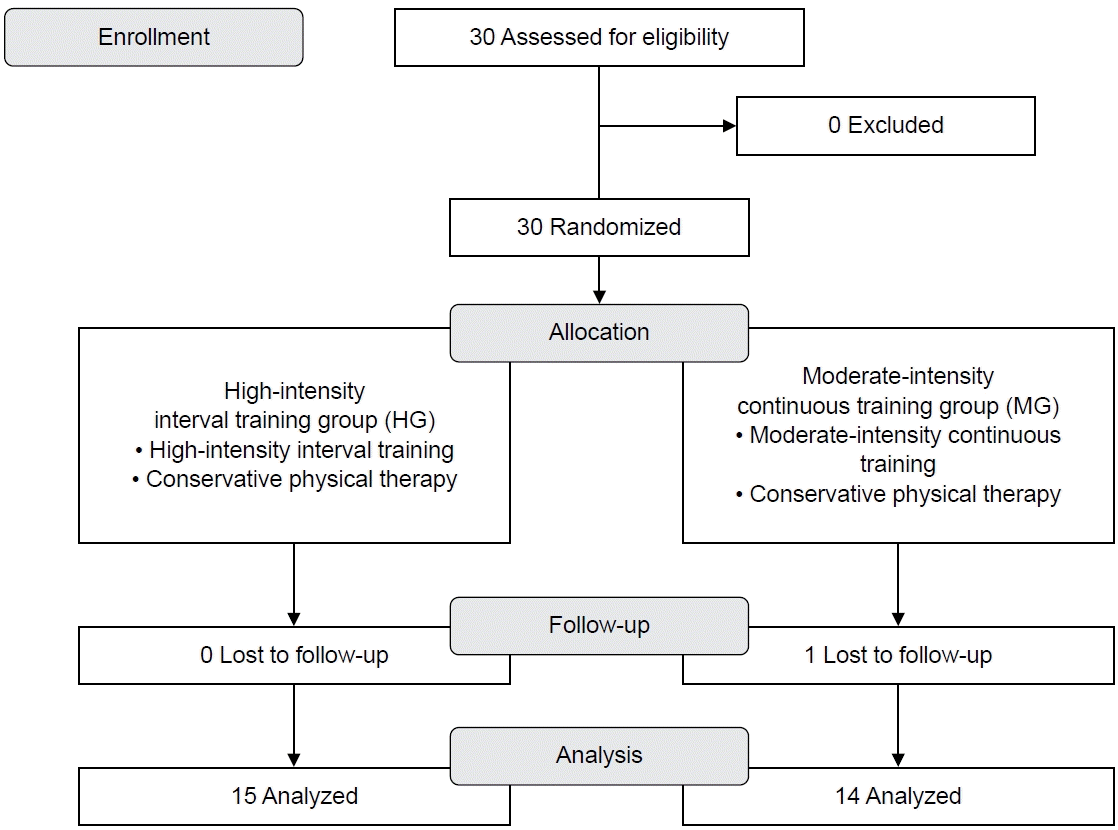
This single-blind randomized controlled trial involved 30 eligible participants randomly assigned into two groups (n=15 each): HIIT group (HG) and MICT group (MG). Participants received a standardized intervention of 30 minutes of conventional physical therapy, followed by 40 minutes of respective aerobic training (includes 5 minutes warm-up and 5 minutes cool-down), three sessions weekly for six weeks. The flow of participants through the trial is presented in Fig. 1.
Sample size calculation
Sample size was calculated using G*Power 3.1.9.2 for a two-way repeated-measures ANOVA (2 groups×2 time points) with α=0.05 and power=0.80. Based on VO2peak improvements reported in a 4-week preliminary randomized feasibility trial of HIIT vs. MICT in ambulatory chronic stroke [9], where the HG demonstrated a gain of 3.4 mL/kg/min compared with no change in MG and standardized effect sizes were described as moderate to very large, we assumed a moderate-large effect size (f=0.55; partial η²partial=0.23). In the present study, VO2max was operationally treated as the highest oxygen consumption value obtained during the test (i.e., peak VO2); therefore, the VO2peak-based estimate from the prior trial was used for sample size determination. This yielded a required total sample size of 22 participants; allowing for 25% attrition, 30 participants (15 per group) were recruited.
Randomization and blinding
Randomization was performed using permuted block randomization with allocation concealment (sealed envelopes). A research assistant not involved in the intervention conducted group assignment. Outcome assessors and statisticians were blinded to group allocation.
Intervention protocols
HIIT
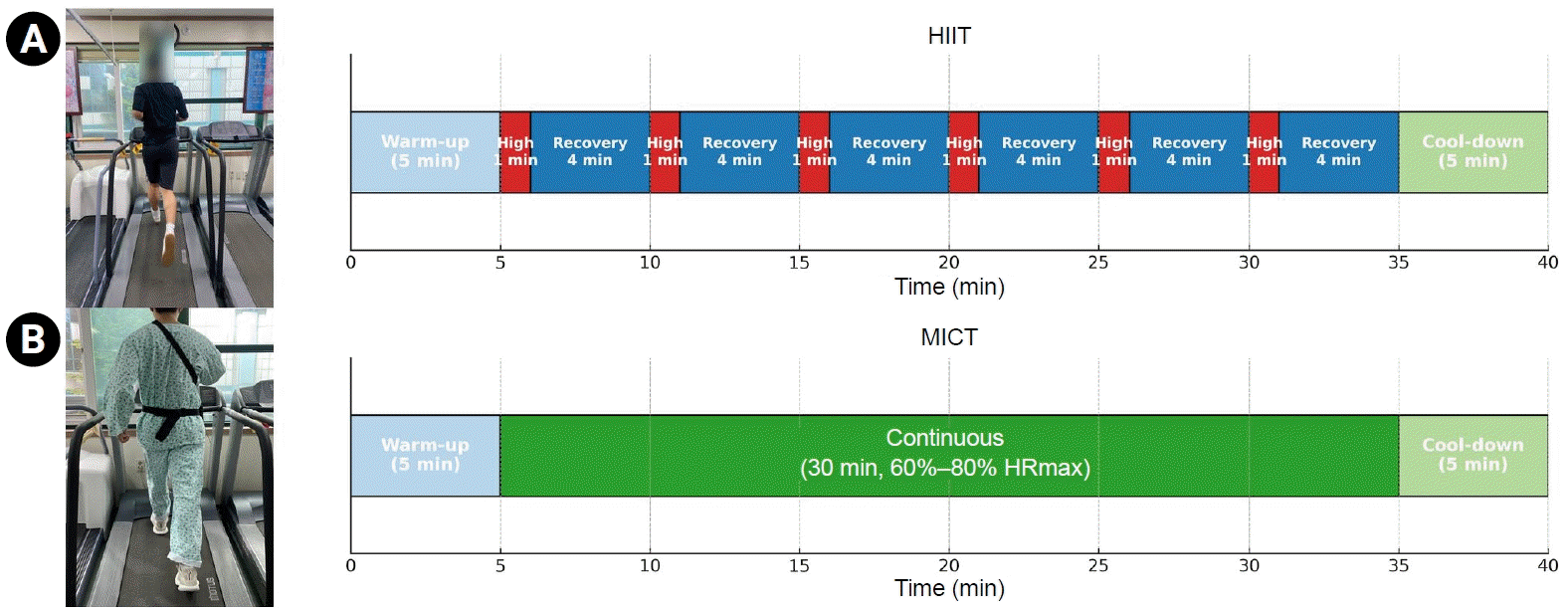
Participants completed supervised HIIT, three times weekly for six weeks. Each 70-minute session consisted of 40 minutes of HIIT (Includes 5 minutes of light full-body stretching before and after each session) and 30 minutes of conventional physical therapy. HIIT comprised six cycles, each with 1 minute of high-intensity exercise (80%–100% maximum heart rate [HRmax]) followed by 4 minutes of active recovery (≤60% heart rate reserve [HRR]). Participants exercised using treadmills or cycle ergometers, selected based on individual conditions and daily status. For participants who performed HIIT using a cycle ergometer, training was performed on a computerized bicycle ergometer (Quinton Cardiology Systems). During the training phase, participants pedaled at a constant cadence of 50–60 revolutions per minute, consistent with American College of Sports Medicine (ACSM) guidelines [2]. Resistance (watts) was set at the start of each 1-minute high-intensity bout to elicit 80%–100% HRmax, and was reduced during the subsequent 4-minute active recovery (≤60% HRR). A total of six such cycles were completed in each session. Continuous electrocardiogram (ECG) monitoring (Q-Tel RMS; Mortara Instrument, Inc.) and therapist guidance were provided to maintain the prescribed target heart rates [10,11]. The interval training setup is illustrated in Fig. 2.
MICT
Participants undertook MICT, conducted three times weekly for six weeks. Each 70-minute session included 40 minutes of MICT (includes 5 minutes of light full-body stretching before and after each session) and 30 minutes of conventional physical therapy. Training intensity was maintained at 60%–80% HRmax. Participants performed continuous exercise on treadmills or cycle ergometers based on daily condition. Continuous ECG monitoring (Q-Tel RMS) was provided. After a brief warm-up, participants exercised continuously at the prescribed moderate intensity (target 60%–80% HRmax), with therapists providing real-time adjustments and verbal cueing to sustain targets and ensure safety [10,11]. Identical supervision, equipment, and predefined modification/termination criteria were applied across groups in line with published guidance [11,12].
Outcome measures
Cardiovascular function
Cardiorespiratory fitness was assessed using a graded bicycle ergometer test, with continuous 12-lead ECG monitoring (Quinton) and expired gas analysis (TrueOne 2400; ParvoMedics) [1]. The testing protocol adhered to the ACSM guidelines and consisted of four incremental stages (25, 50, 75, 100 W), each lasting three minutes at a constant pedaling cadence of 50 revolutions per minute [3]. The criteria for maximal exertion were defined as meeting at least two of the following: a rating of perceived exertion (RPE) of 18 or higher, a respiratory exchange ratio (RER) of 1.15 or greater, or achieving 90% or more of the predicted HRmax. The test was discontinued if these conditions were satisfied, or if the participant requested termination, demonstrated systolic blood pressure exceeding 250 mmHg or diastolic pressure exceeding 115 mmHg, exhibited signs of dyspnea or chest pain, or was unable to maintain the required cadence [2]. The primary outcome variables were VO2max, defined as the highest oxygen consumption value obtained during the test [4], and HRmax, defined as the highest heart rate reached at test termination [5]. End-exercise indices (RPE and RER) were recorded at test termination; HRmax was captured continuously. In addition, average heart rate during ambulation was measured using an Apple Watch (Series 6 or 7) during the 6MWT. Participants walked at a self-selected pace on a 20-meter indoor walkway for six minutes, with verbal time cues provided at 1, 3, and 5 minutes and at the final 10 seconds. Heart rate data were collected using the Apple Health exercise monitoring feature. Participants were allowed to pause and resume walking as needed, and no physical assistance was provided during the test. We additionally derived post hoc session ECG metrics to quantify both the speed and the fidelity of intensity attainment. A threshold was counted as reached only when HR≥threshold was sustained for ≥5 seconds; HIIT intervals not reaching a threshold within 1 minute were right-censored at 60 seconds; recovery thresholds used ≤60% HRR with HRR=HRmax-HRrest and HRrest fixed at 70 bpm. The primary derived variables were time-to-80%/90% HRmax during each 1-minute high-intensity interval (summarized by bout-pairs 1–2/3–4/5–6), time to ≤60% HRR during the subsequent 4-minute recoveries, and time to ≥60%/≥70%/≥80% HRmax from the start of MICT. Full operational details and tabulations appear in Supplementary Tables S2 and S3.
Gait ability
Walking ability was assessed using the 6MWT, Timed Up and Go test (TUG), and 10-Meter Walk Test (10MWT).
6MWT was used to assess walking endurance. Participants walked on a 20-meter indoor track for six minutes. The total distance walked was recorded. The test has demonstrated high reliability in stroke populations (intraclass correlation coefficient [ICC]=0.94) [6].
TUG was employed to evaluate functional mobility. Participants were instructed to rise from a seated position, walk 3 m, turn, and return to the chair. The average of three trials was recorded in seconds. This test demonstrates excellent reliability (intrarater ICC=0.944–0.987; interrater ICC=0.954–0.988) [7].
Hematological variables
Venous blood samples (5 mL) were collected from the median cubital vein after a 12-hour fast. Samples were drawn into serum separator tubes, inverted gently, left at room temperature for 30 minutes, and centrifuged at 1,300 g for 10 minutes. The resulting serum was aliquoted into cryotubes and stored at -70°C until analysis. Laboratory assays measured concentrations of LDL, HDL, and TG.
Statistical analysis
SPSS version 25.0 (SPSS for Windows, SPSS Inc.) was used for data analysis. Shapiro–Wilk test was used to assess normal distribution of all parameters. Chi-square test was used to test homogeneity of categorical variables, and independent samples t-test was used to test continuous variables. A paired-samples t-test was used to evaluate within-group (pretest vs posttest) differences. Two-way repeated measures ANOVA was performed to compare the effects between the HG and the MG to analyze the time-group interaction (group×time). Partial eta square was used to compare the effect size of the interaction, and a value of 0.01 or greater indicates a small effect size, 0.06 or greater indicates a medium effect size, and 0.14 or greater indicates a large effect size [13]. Bonferroni’s method was used for post hoc analysis, and all significance levels (α) were set to less than 0.05 for statistical determination. Age-predicted HRmax was computed using the Nes equation (211-0.64×age), and as a descriptive end-exercise index we summarized the proportion of participants achieving ≥90% of the age-predicted HRmax at cardiopulmonary exercise test (CPX) termination (Supplementary Table S4). Session ECG metrics were summarized descriptively as group mean±SD (minutes with seconds in parentheses for time variables; bpm for HR), and no additional hypothesis testing was prespecified for these post hoc metrics. Exploratory post hoc comparisons are reported in Supplementary Tables S2 and S3(two sided α=0.05).
RESULTS
In this higher-functioning cohort (n=29), of the 30 participants initially enrolled, one participant from the MG dropped out, resulting in a total of 29 participants (HG, n=15; MG, n=14) included in the final analysis (Fig. 1). There were no significant differences in general characteristics between the HG and MG. Specifically, height, weight, age, MMSE-K scores, disease onset duration, sex distribution, diagnosis type, and affected side were all similar between groups (p>0.05) (Table 1).
Cardiovascular function
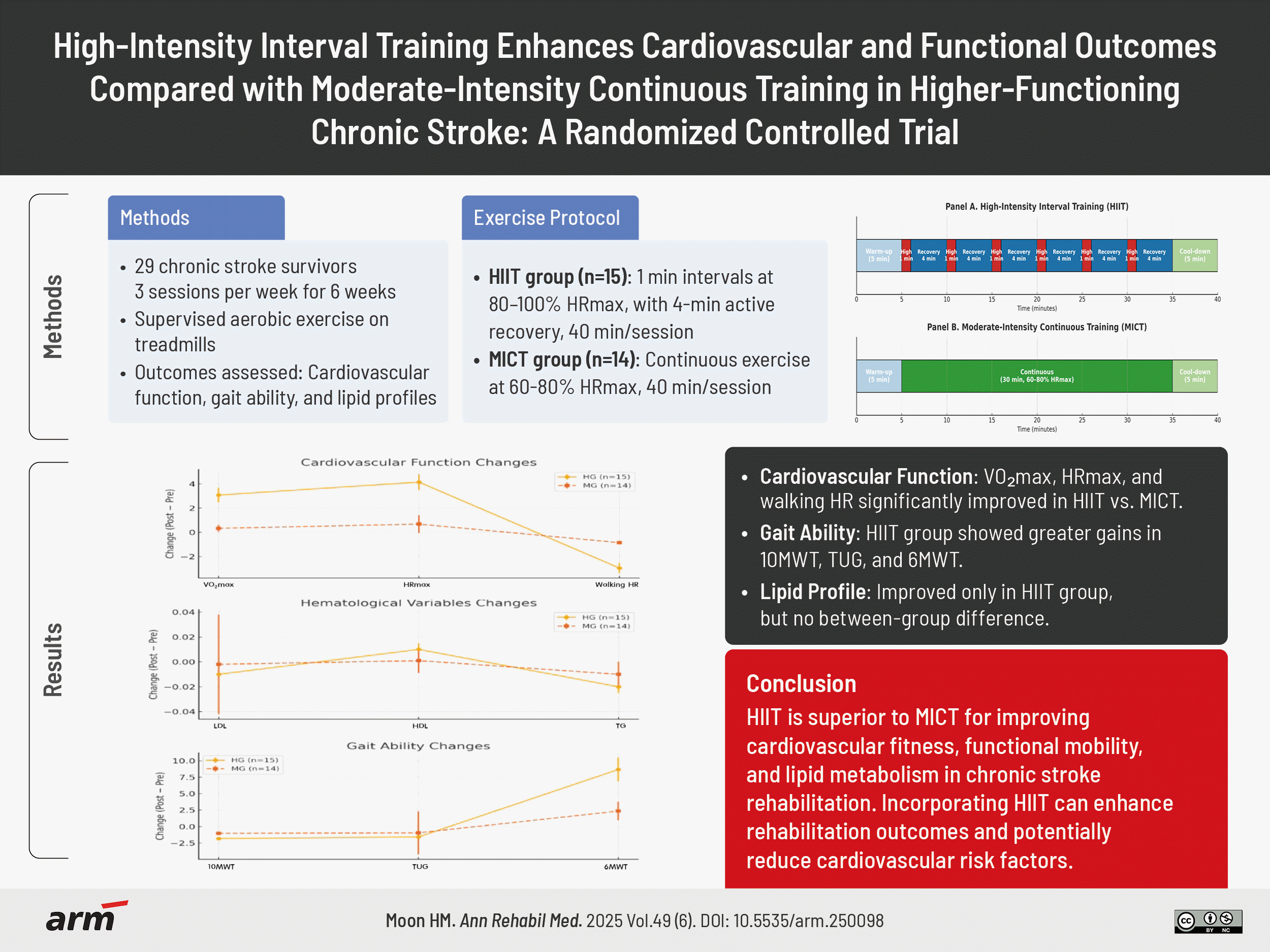
Significant time-group interaction effects were observed in cardiovascular function parameters between groups. Specifically, the HG showed significantly greater improvements compared to the MG in VO2max (F=40.574, p=0.001, η²partial=0.603), HRmax (F=24.661, p=0.001, η²partial=0.484), and heart rate while walking (F=11.277, p=0.002, η²partial=0.308). Post-hoc analyses indicated that the HG demonstrated significantly greater changes over time compared to the MG for all cardiovascular function measures (p<0.001). Additionally, paired-sample t-tests confirmed significant within-group improvements from pre to posttest in the HG for all cardiovascular parameters (p<0.001) (Table 2). Using the Age-predicted HRmax, the proportion achieving ≥90% of the age-predicted HRmax increased in the HG (72.12% to 89.84%) and remained similar in the MG (88.00% to 87.43%) (Supplementary Table S4). In post hoc ECG-derived analyses, participants rapidly reached the prescribed targets during HIIT and re-entered ≤60% HRR within each 4 minutes recovery; headline time to target values (mean±SD) were 0.44±0.12/0.79±0.33, 0.33±0.14/0.66±0.25, and 0.27±0.16/0.59±0.29 minutes for 80%/90% HRmax across HIIT bout-pairs 1–2/3–4/5–6, with corresponding recovery time to ≤60% HRR of 1.08±0.47, 1.26±0.58, and 1.44±0.63 minutes; for MICT (continuous), the time to ≥60%/≥70%/≥80% HRmax from session start was 0.82±0.36/1.58±0.62/3.12±1.27 minutes (Supplementary Tables S2 and S3).
Gait ability
In functional mobility tests, significant time-group interactions were observed for the 10MWT (F=20.865, p=0.001, η²partial=0.517), TUG (F=12.317, p=0.002, η²partial=0.430), and 6MWT (F=9.742, p=0.004, η²partial=0.325). Post-hoc analyses indicated significantly greater improvements over time in the HG compared to the MG for all measures (p<0.05). Paired-sample t-tests showed significant within-group improvements for both HG and MG in the 10MWT and TUG tests (p<0.05), while only the HG group showed significant within-group improvement in the 6MWT (p<0.001) (Table 3).
Hematological variables
No significant time-group interactions were identified for blood lipid profiles, including LDL cholesterol (F=0.682, p=0.418, η²partial=0.032), HDL cholesterol (F=0.453, p=0.507, η²partial=0.027), and TG (F=0.813, p=0.371, η²partial=0.042). However, paired-sample t-tests indicated minor yet statistically significant within-group improvements in LDL, HDL, and TG levels within the HG only (p<0.05) (Table 4).
DISCUSSION
This study rigorously compared the effects of HIIT and MICT on cardiovascular function, gait ability, and hematological variables among chronic stroke survivors, demonstrating clear, differential benefits associated with training intensity. As an effort check at CPX termination, the proportion achieving ≥90% of the age-predicted HRmax was high and comparable between groups, supporting the validity of maximal/near-maximal testing in this sample (Supplementary Table S4). Session-level ECG analyses showed rapid attainment of the prescribed high-intensity targets and prompt re-entry to ≤60% HRR between intervals, indicating high protocol fidelity and feasibility of HR-targeted HIIT in this cohort (Supplementary Table S2).
In interpreting these findings, it is pertinent that the program was delivered three times per week for six weeks and evaluated immediately post-intervention. Under our exposure-matched schedule (3 sessions/week×6 weeks), the MICT arm maintained a stable 60%–80% HRmax workload with minimal ≥80% exposure and no prolonged overshoot confirming adherence to a truly moderate prescription yet this stimulus was not associated with a detectable post-intervention improvement in peak cardiorespiratory fitness (VO2max) in this higher-functioning cohort, whereas a higher relative stimulus with HIIT was observed to improve VO2max (see Supplementary Table S3C for MICT intensity distribution; Supplementary Table S3A for HIIT exposure). Evidence from shorter and longer protocols using a thrice-weekly schedule indicates that clinically meaningful adaptations can emerge within a comparable time window when intensity and task specificity are prioritized. A 4-week, 3×/week preliminary randomized study in ambulatory chronic stroke showed that treadmill-based HIIT yielded moderate-to-very-large between-group effect-size estimates at post-intervention for aerobic capacity and walking outcomes, supporting the capacity of brief high-intensity exposure to initiate central and peripheral cardiopulmonary adaptation [9]. Complementarily, an 8-week, 3×/week multicenter RCT reported post-intervention improvements in walking distance and balance with treadmill-based HIIT and noted that only executive function (Trail Making Test-B) remained significant at 12-month follow-up, while superiority in peak aerobic capacity over the long term was not sustained together with our results, this pattern suggests that the most prominent cardiopulmonary effects of HIIT emerge early and require continued training for persistence [10,14]. From a mechanistic perspective, interval prescriptions at high relative intensity accelerate stroke-volume augmentation, endothelial adaptation, and skeletal-muscle mitochondrial remodeling with a modest weekly time dose, providing a rationale for robust effects over six weeks at three sessions per week [15,16]. Positioned against higher-dose comparators, a 24-week randomized trial contrasting MICT (five days/week) with a HIIT-based regimen demonstrated greater improvements in VO2peak with HIIT while walking-distance gains were similar between groups, underscoring that intensity is the primary driver of cardiorespiratory fitness, whereas endurance-type walking performance may converge over time [12]. These dose duration timing considerations were explicitly accounted for when aligning the present findings with prior literature (our assessment: post-6 weeks; comparators: post-4 weeks and post-8 weeks with an additional 12-month follow-up) [9,10,14].
Our results revealed significant improvements in cardiovascular parameters, particularly VO2max and HRmax, within the HG. The short time to 80%/90% HRmax during 1-minute intervals and the consistent 4-minute recovery to ≤60% HRR suggest that intensity dosing was delivered as intended while preserving recovery capacity, a pattern that aligns with established HR on/off kinetics and supports the translatability of HR-guided interval prescriptions to post-stroke rehabilitation. The observed enhancement in VO2max is consistent with previous studies emphasizing HIIT’s superior capacity for augmenting cardiovascular fitness through central and peripheral adaptations such as increased stroke volume, mitochondrial density, and endothelial function [15,17]. Additionally, a considerable effect size underscores the marked physiological response elicited by high-intensity training modalities, reinforcing the robust cardiovascular benefit of HIIT in chronic stroke populations.
In contrast to HG, the MG showed only minimal and non-significant changes in VO2max and HRmax after six weeks of thrice-weekly training. This likely reflects the limited training dose, as moderate-intensity continuous exercise generally produces measurable cardiovascular adaptations only after longer (≥12 weeks) and more frequent (≥5 sessions per week) protocols [9,12]. In addition, our participants were relatively high-functioning chronic stroke survivors (FAC≥4, BBS≥41), leaving little margin for further improvement in aerobic capacity within such a short timeframe. Taken together, these factors explain the absence of significant VO2max improvement in the MG. Nevertheless, previous research has shown that MICT can yield cardiovascular benefits when applied over longer durations and higher frequencies, suggesting that the lack of effect here reflects the limited intervention dose and participant characteristics rather than an inherent inefficacy of MICT. Fidelity analyses further confirmed that participants performed the training as prescribed: thresholds of ≥60%/≥70%/≥80% HRmax were typically reached within minutes of session onset and then maintained predominantly within the 60%–80% band, with minimal exposure above 80% HRmax (Supplementary Table S3); groupwise background-care dose (setting, sessions per week, and minutes per session) is summarized in Supplementary Table S1. This pattern indicates that MICT provided a stable and controlled aerobic workload, with high target adherence and minimal overshoot, even though it did not elicit significant cardiovascular improvements within the short study period.
The principal finding of this trial is that HIIT produced substantially greater improvements in cardiovascular fitness compared with MICT. The HG demonstrated marked gains in VO2max and HRmax, and importantly, also showed a significant reduction in heart rate while walking, suggesting improved cardiovascular efficiency during submaximal functional activity. By contrast, changes in the MG were negligible. These results emphasize that short-term, thrice-weekly HIIT is sufficient to produce measurable cardiovascular adaptations, whereas MICT may require longer duration and higher frequency to achieve comparable benefits.
Functional mobility assessments revealed pronounced improvements in gait parameters, including the 10MWT, TUG, and 6MWT, notably superior within the HG. The significant reductions in time observed in the 10MWT and TUG, and improved endurance reflected by enhanced 6MWT performance, align with findings by Gjellesvik et al. [10] and Lau and Mak [18], highlighting that HIIT promotes muscular adaptations crucial for improved neuromuscular coordination and endurance. These adaptations are instrumental in translating enhanced physiological capacity into tangible functional improvements, critical for daily life activities in chronic stroke survivors.
Interestingly, MICT also showed beneficial effects on functional mobility, although smaller compared to HIIT. The consistent yet modest improvements in gait speed and mobility observed in the MG corroborate evidence suggesting its utility in scenarios requiring gentler physiological adjustments and gradual improvements in functional capacity [9].
Hematological analysis showed small but statistically significant within-arm improvements in LDL, HDL, and TG in the HG at six weeks, without a group×time interaction; all lipid samples were obtained after a standardized 12-hour fast with identical procedures, and lipid-lowering medications were neither used at entry nor changed during the intervention (see Methods and Participants). A single aerobic session lowers very low density lipoprotein triglycerides (VLDL-TG) the next day and for up to ~2–3 days by increasing plasma clearance and (in some cohorts) modestly reducing hepatic secretion demonstrated directly with human stable-isotope tracer kinetics [19]. When this stimulus is repeated three times per week, these 24–72 hour windows overlap and accumulate, so TG fall first, with smaller, slower shifts in LDL/HDL emerging over several weeks [19]. Over weeks, interval training can also reduce hepatic VLDL-TG secretion rate in humans [20], and exercise transiently up-regulates skeletal-muscle lipoprotein-lipase, which accelerates removal of triglyceride-rich lipoproteins and reinforces the early fall in TG when bouts are repeated [21]. In these data, HIIT sessions consistently reached the prescribed high-relative-intensity bouts with recovery between bouts (Supplementary Tables S2, S3), whereas the dose-matched MICT arm was kept predominantly in the 60%–80% HRmax band with minimal ≥80% exposure (Supplementary Table S3C); consequently, a small but detectable within-HIIT improvement at six weeks is physiologically coherent under medication-neutral, conditions, while MICT shows no detectable change over the same horizon.
This study has several limitations that warrant consideration. First, the six-week intervention period precludes firm conclusions about durability; longer follow-up (e.g., ≥3–6 months) is needed to clarify maintenance of effects. Second, participants were treated in both inpatient and outpatient settings, and a subset of outpatients received additional conventional therapy at other institutions. Inpatients (HIIT: 11, MICT: 8) typically completed the three supervised study sessions per week plus two routine 60-minute sessions, whereas most outpatients (HIIT: 4, MICT: 6) attended only the three study sessions, with a small number receiving extra sessions elsewhere (1–2 sessions/week). To limit bias, the intervention was defined a priori as the protocolized sessions only, and any outside-institution therapy was prospectively logged and treated as non-exposure. Importantly, descriptive summaries in Supplementary Table S1 indicate no material between-group difference in background rehabilitation dose, and participants did not change care setting during the intervention. Nonetheless, unmeasured co-interventions cannot be completely excluded. Beyond these internal-validity considerations, generalizability is bounded to higher-functioning, ambulatory chronic stroke survivors; applicability to lower-functioning or non-ambulatory populations requires dedicated evaluation. Given the high intensity involved, HIIT may pose risks for patients with significant cardiovascular comorbidities or severely impaired physical function. Therefore, careful patient screening and risk assessment are imperative when translating HIIT protocols to clinical practice. Future studies should explore the feasibility, safety, and specific strategies for adapting HIIT across a broader spectrum of stroke severity and clinical settings to enhance applicability. Finally, two measurement/analysis constraints warrant mention: time-to-target and exposure metrics were derived post hoc from session ECGs and summarized descriptively (not prespecified outcomes), and mechanical speed/workload was not standardized across treadmill and cycle sessions because prescription was HR-based; accordingly, emphasis was placed on modality-agnostic, HR-derived attainment and recovery metrics.
In conclusion, this study provides robust evidence advocating for HIIT as a highly effective rehabilitation strategy for improving cardiovascular fitness, gait performance, and metabolic profiles in chronic stroke survivors. It also reinforces the continuing relevance of MICT, particularly for patients who require more gradual physiological adaptations, underscoring the necessity of individualized rehabilitation approaches based on patient-specific functional capacities and goals.
Conclusion
In higher-functioning chronic stroke survivors, HIIT was superior to MICT for cardiovascular fitness and functional mobility under a matched exposure, while lipid changes occurred within the HIIT arm only without between-group differences. These results support incorporating HIIT for appropriately selected higher-functioning patients and highlight the need to evaluate applicability in lower-functioning cohorts. Future studies should investigate long-term effects and optimal implementation strategies of HIIT for sustained stroke rehabilitation outcomes.

 XML Download