



 PDF
 Citation
 Print


INTRODUCTION
Gallbladder and other biliary tract cancer (GBC) is a rare malignancy, comprising 0.6% of all newly diagnosed cancers in 2020 [1]. Although clinical protocols for GBC diagnosis and management have improved, the prognosis remains poor, reflected by a five-year survival rate of 18% in the United States [2]. Surgical resection is the only curative treatment for GBC; however, post-resection survival remains low. In the United States, the median survival after surgical resection is 12 to 14 months, compared with six months for those receiving palliative stenting [2]. The low survival among GBC patients is largely due to advanced disease at diagnosis. When GBC is detected at a localized stage, the five-year survival rate approaches 60%, whereas it drops to 25% for regional and 2% for distant stage at diagnosis [2]. Diagnostic delays are common, as GBC often presents with no symptoms or non-specific clinical signs [3].
Accumulating evidence indicates that perioperative red blood cell (RBC) transfusions are associated with adverse outcomes, including short-term complications and increased long-term morbidity and mortality, in patients with gastrointestinal cancers such as gastric, colorectal, liver, and pancreatic cancers [4-7]. Despite this, data on outcomes related to perioperative transfusions for GBC remain scarce. One previous study demonstrated that perioperative transfusion is linked to reduced overall and recurrence-free survival in patients with GBC who have undergone surgical resection [8]. Although standardized transfusion protocols for hepatobiliary surgery have not been established, in contrast to other surgical types [8,9], current academic guidelines encourage surgeons to minimize transfusions by considering a hemoglobin threshold of 7 g/dL and integrating the principles of patient blood management (PBM) programs [8,9]. In light of these evolving guidelines, advancements in GBC surgical techniques, and the recent adoption of laparoscopic procedures for early-stage GBC, it is plausible that perioperative transfusion rates have decreased. Nonetheless, to our knowledge, no investigation has specifically assessed perioperative transfusion trends for GBC surgery.
Accordingly, this study aimed to investigate perioperative transfusion patterns for GBC surgery using a nationwide database and to describe how transfusion trends have changed over time in Korea, which has one of the highest incidences and mortalities of GBC worldwide [10,11]. Furthermore, we explored the factors associated with perioperative transfusion in patients diagnosed with GBC.
MATERIALS AND METHODS
Study design and participants
This study utilized customized data from the National Health Insurance Service-National Health Information Database (NHIS-NHID) of Korea. The NHIS-NHID, managed by Korea’s National Health Insurance Provider, encloses comprehensive health data for all individuals covered by the nation’s universal health insurance. This large-scale database offers detailed records of healthcare utilization, health examination results, demographic characteristics, and longitudinal medical histories.
Patients newly diagnosed with GBC who underwent hepatobiliary surgery between January 2012 and December 2020 were identified through the International Classification of Diseases, 10th Revision (ICD-10) codes C23 and C24, together with rare and intractable disease (RID) codes, resulting in the selection of 22,418 patients. The RID program alleviates the financial burden of patients with RIDs, and the mandatory requirement of a cancer diagnosis certificate for support enhances the accuracy of patient identification through the use of RID codes. Patients who underwent surgery more than 180 days after their cancer diagnosis (n = 1,854) were excluded. The final cohort included 20,564 patients who had surgery within 180 days of their GBC diagnosis.
This study received approval from the Institutional Review Board (IRB) of Hanyang University (approval number: HYUIRB-200207-001-5). Informed consent requirements were waived due to the retrospective study design and reliance on anonymized data from the NHIS-NHID. All personal identifiers were de-identified to maintain participant confidentiality and privacy.
Criteria for RBC transfusion in GBC patients
Perioperative RBC transfusion was defined as the presence of procedure codes for leukoreduced RBC (X2021, X2022), washed RBC (X2031, X2032), and frozen RBC (X2092, X2111, X2112, X2131, X2132) involving at least 1-pack in the medical claims of GBC patients from 7 days prior to surgery up to 30 days following surgery. A case was categorized as not having received perioperative RBC transfusion if the GBC patient neither received an RBC transfusion nor received any blood product transfusion other than RBC during the specified perioperative period.
Variables and measurements
The sociodemographic variables considered were age at GBC diagnosis, sex, and residential area (categorized as metropolitan or non-metropolitan). Income was classified into quartiles based on the National Health Insurance (NHI) premium system, where Q1 represented the lowest-income beneficiaries and Q4 corresponded to the highest-income group. These quartiles were utilized as an indicator for income, given that NHI premiums are proportional to the income level.
Clinical characteristics encompassed the year of cancer diagnosis (2012–2020), the interval between cancer diagnosis and surgery (measured in days), and the surgical procedure type, including cholecystectomy (Q7342), choledochoenterostomy (Q7380), other gallbladder and biliary tract surgeries (Q7410 and Q7430), pancreaticoduodenectomy (Q7571 and Q7572), and combined surgery (defined as the concurrent performance of two or more procedures within a single operation). Cancer types were categorized into gallbladder cancer (C23), extrahepatic bile duct cancer (C24.0), and other bile duct cancers (C24, C24.1, C24.8, C24.9). Medical institutions were classified as tertiary (including upper-tier and general hospitals) or non-tertiary (comprising small hospitals and clinics). The Charlson comorbidity index (CCI) score, derived from records spanning the 2 years prior to cancer diagnosis, was used to evaluate the severity of comorbidities among GBC patients.
Statistical methods
We compared the sociodemographic and clinical characteristics of patients with GBC who received perioperative RBC transfusions to those who did not by performing descriptive analyses, chi-square tests, and t-tests. The associations between these characteristics and RBC transfusion status were analyzed, with results reported as odds ratios (ORs) and 95% confidence intervals (CIs), after adjustment for the identified variables. Additionally, we examined these associations by categorizing patients into three time intervals based on the year of GBC diagnosis: 2012–2014, 2015–2017, and 2018–2020. To evaluate trends in perioperative RBC transfusion rates among GBC patients from 2012 to 2020, we calculated the average annual percent change (AAPC) with corresponding 95% CIs. Linear regression analysis was utilized to derive the AAPC, allowing assessment of average yearly changes over the specified interval and identification of significant temporal patterns. Temporal trend analyses were further stratified by subgroups based on sex, age group, type of surgical procedure, and type of medical institution. We conducted all statistical analyses using SAS version 9.4 (SAS Institute) and considered p-values less than 0.05 as statistically significant.
RESULTS
A total of 20,564 patients who underwent GBC surgery were included in this study, with 6,795 (33.0%) receiving perioperative RBC transfusions (Table 1). The transfused group was older, with a mean age of 70.1 years, in contrast to 68.3 years in the non-transfused group (p < 0.0001). A greater proportion of transfused patients originated from metropolitan areas (45.1% vs. 39.7%, p < 0.0001). The transfused group also contained a larger proportion of individuals in the lower income brackets. In particular, 24.1% and 16.6% of the transfused patients were from the lowest-income quartiles (Q1 and Q2), whereas the non-transfused group had a higher proportion in the high-income quartiles (Q3 and Q4: 3,162 [23.0%] and 5,362 [38.9%], respectively; p < 0.0001). A higher proportion of non-transfused patients received care at tertiary hospitals compared to transfused patients (64.9% vs. 61.2%). The transfused group had higher CCI scores (mean 4.6) compared to the non-transfusion group (mean 4.2, p < 0.0001). The interval from cancer diagnosis to surgery was extended in the transfused patients (mean 12.7 days). Among GBC surgeries, pancreaticoduodenectomy was most frequently performed (43.3%). In the non-transfused group, cholecystectomy ranked as the second most common procedure (26.0%), whereas for transfused patients, cholecystectomy was typically performed in combination with other surgeries (1,301 [19.1%]). Overall, gallbladder cancer was the most frequently observed diagnosis (39.9%). However, within the transfused group, extrahepatic bile duct cancer was more prevalent (50.2%) than gallbladder cancer (24.4%).
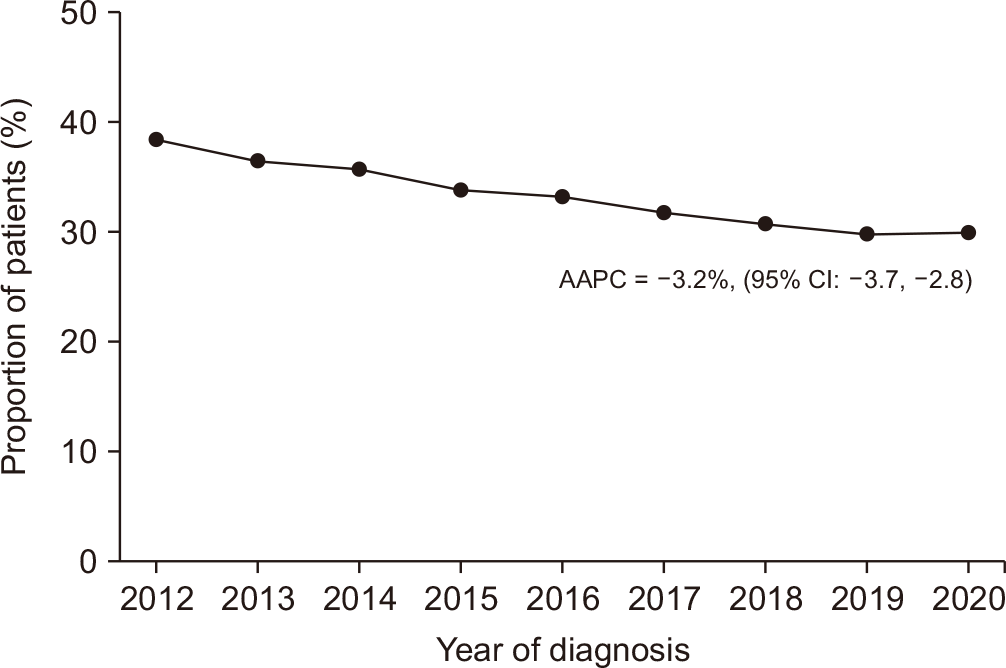
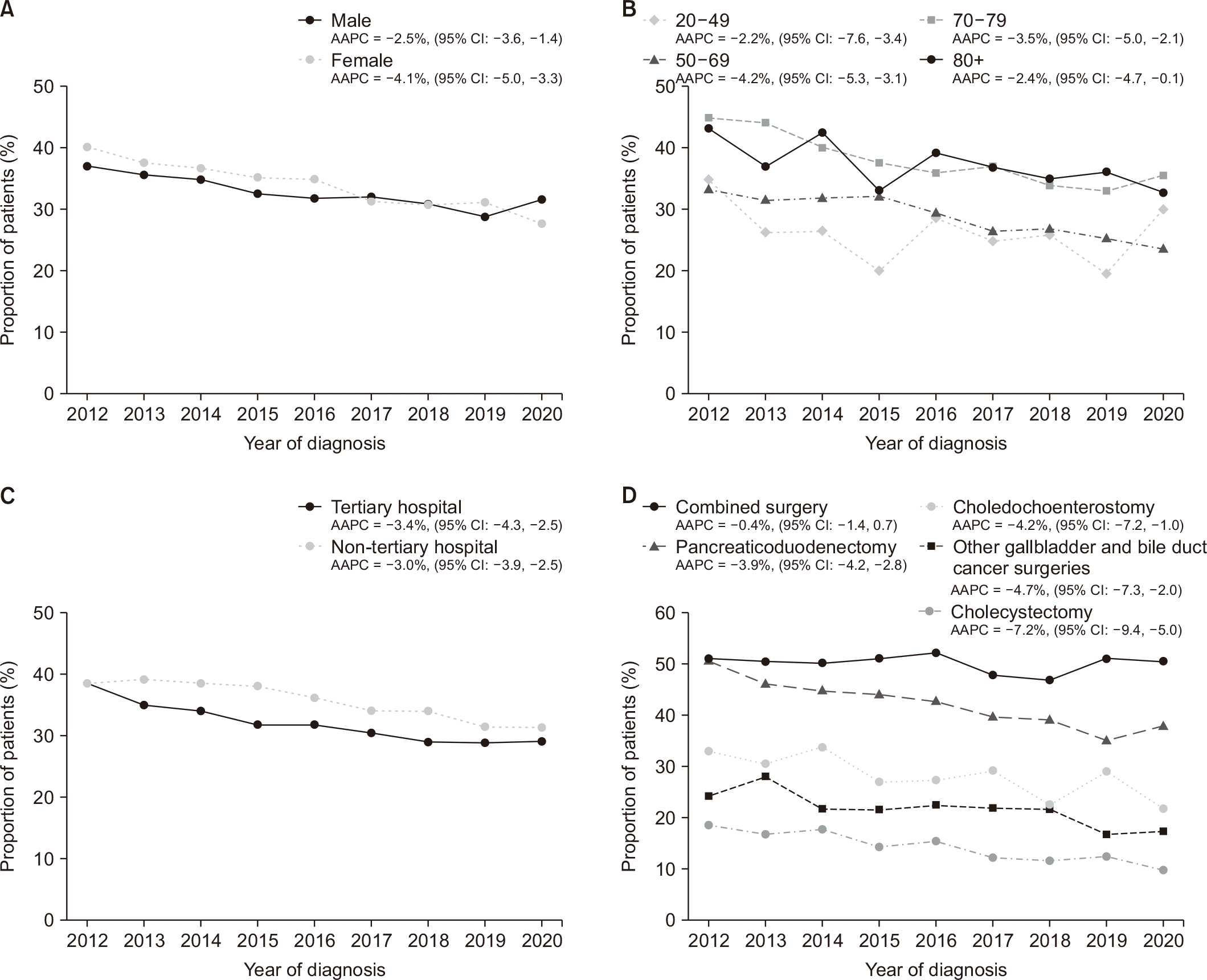
From 2012 to 2020, the proportion of GBC patients receiving perioperative RBC transfusions showed a notable decline, dropping from 38.4% to 29.9%, with an AAPC of –3.2 (95% CI, –3.7, –2.8) (Fig. 1). When analyzed by sex, female patients experienced a more pronounced reduction in perioperative RBC transfusions (AAPC = –4.1; 95% CI, –5.0, –3.3) compared to males (AAPC = –2.5; 95% CI, –3.6, –1.4) (Fig. 2A). The reduction in perioperative RBC transfusion rates was evident in all age categories, with the most significant decreases among patients aged 50 to 69 years and 70 to 79 years (Fig. 2B). Trend analysis by type of medical institution demonstrated similar declines in both tertiary and non-tertiary hospitals (Fig. 2C). Trends in transfusion rates differed by surgical procedure, with cholecystectomy showing the greatest decline (AAPC = –7.2; 95% CI, –9.4, –5.0). Significant reductions were also observed for choledochoenterostomy, other gallbladder surgeries, and pancreaticoduodenectomy (Fig. 2D).
A range of sociodemographic and clinical characteristics correlated significantly with the probability of perioperative RBC transfusion among GBC surgery patients, as shown in Table 2. For each additional 10-year increase in age, the chance of requiring perioperative RBC transfusion rose by 1.50 times (95% CI, 1.43–1.57), and women had a 1.23-fold higher risk of transfusion (95% CI, 1.15–1.31). The overall probability of receiving a transfusion declined year by year (OR = 0.93, 95% CI, 0.92–0.94), while the likelihood increased progressively with lower income (Q1: OR=1.38; 95% CI, 1.27–1.50 versus Q4). Across all time periods, those residing in non-metropolitan areas were less likely to be transfused (OR = 0.83; 95% CI, 0.78–0.88), and patients treated in non-tertiary hospitals had higher transfusion probabilities (OR = 1.31; 95% CI, 1.23–1.40). Furthermore, the greatest transfusion likelihood was observed among patients with a CCI score of 5+ (OR = 1.33; 95% CI, 1.21–1.46). Compared to pancreaticoduodenectomy, biliary tract procedures (cholecystectomy: OR = 0.29; 95% CI, 0.24–0.34; choledochoenterostomy: OR = 0.46; 95% CI, 0.41–0.51; other gallbladder and biliary surgeries: OR = 0.53; 95% CI, 0.45–0.63) were related to lower odds of transfusion. In contrast, patients who underwent multiple surgeries were at higher risk for transfusion (OR = 1.76; 95% CI, 1.58–1.95), with this risk increasing over the study period (OR = 1.42 to 1.96). Relative to gallbladder cancer, patients diagnosed with extrahepatic cholangiocarcinoma and other cholangiocarcinomas were more likely to require transfusion, particularly in 2015–2017 (extrahepatic cholangiocarcinoma: OR = 1.97; 95% CI, 1.54–2.51; other cholangiocarcinoma: OR = 1.77; 95% CI, 1.36–2.30).
DISCUSSION
From 2012 to 2020, the perioperative RBC transfusion rate, defined as the transfusion of ≥ 1 pack of allogenic RBCs among GBC patients, was 33.0% among patients who underwent GBC surgery. The proportion of RBC transfusions declined from 38.4% in 2012 to 29.9% in 2020, indicating an average annual decrease of 3.2%. Advanced age at cancer diagnosis, female sex, lower income, treatment at medical institutions other than tertiary hospitals, and higher CCI scores were factors associated with an increased likelihood of RBC transfusion. Conversely, a longer interval between GBC diagnosis and surgery as well as more recent diagnosis years were linked to a reduced likelihood of transfusion. Different surgical approaches and cancer sites were independently associated with higher RBC transfusion rates, with patients with extrahepatic cholangiocarcinoma and other biliary tract cancers showing higher transfusion rates compared to those with gallbladder cancer. Furthermore, compared to pancreaticoduodenectomy, procedures involving the biliary tract, such as cholecystectomy, choledochoenterostomy, or other surgeries of the gallbladder and biliary tract, showed a lower transfusion rate; in contrast, combined surgery was associated with a higher transfusion rate.
In a multi-center study, the perioperative RBC transfusion rate for gallbladder cancer resection was 23.3% [8], which is lower than the rate reported in our findings. Although this study found an overall transfusion rate of 33.0% for all GBC surgeries, when stratified by cancer type, the transfusion rate for gallbladder cancer surgery was 20.2% (1,661 of 8,196 surgeries), aligning with the earlier study [8]. Another report demonstrated a perioperative RBC transfusion proportion of 28% for extrahepatic cholangiocarcinoma [12], which is lower than the 42.2% rate (3,412 of 8,080 surgeries) found in the current study. Variability in transfusion rates across cancer types suggests that direct comparison with prior studies is limited by differences in the types of GBC surgeries included. Nevertheless, in Korea, a relatively high transfusion rate across various surgeries has become a significant challenge for national blood management initiatives [13-15]. Between 2012 and 2020, the rate of RBC transfusion during GBC surgery declined rapidly, regardless of sex and medical institution type, and the perioperative RBC transfusion proportion for all GBC in 2020 was similar to previous reports. This downward trend may be related to greater awareness of high transfusion rates and intensified efforts to optimize blood transfusion practices.
Regarding the type of surgery, cholecystectomy has demonstrated a significant rapid reduction in RBC transfusions. Advances in surgical techniques, including the recent adoption of laparoscopic approaches for early-stage gallbladder cancer [16], may have contributed to the decrease in RBC transfusions for GBC surgeries in this study. Although there is ongoing debate concerning the use of laparoscopic surgery for GBC, the application of laparoscopic procedures by surgeons has become more prevalent in recent years [16]. Coupled with an increase in laparoscopic cholecystectomies performed for other gallbladder diseases [17], it is likely that expanding the concept of laparoscopic cholecystectomy for GBC has promoted increased attention to minimally invasive surgical principles among GBC surgeons and subsequently led to lower transfusion rates. In Korea, the NHIS does not reimburse for surgical laparoscopy; as a result, trends in laparoscopic cholecystectomy for GBC could not be evaluated using the NHIS database. The RBC transfusion rate in cholecystectomies for GBC reported in this study was similar to that of a previous report focused on open cholecystectomies in Finland [18], supporting the assumption that most cholecystectomies for GBC were conducted using open surgical techniques.
Patient factors associated with RBC transfusion in GBC surgery, as explored in this study, have rarely been investigated. Nevertheless, factors such as older age, female sex, and pre-existing pre-operative comorbidities have been consistently linked to hepatobiliary and gastrointestinal cancer surgeries [7,19-22]. A reduction in transfusions was noted among GBC patients who underwent delayed surgery. While we were unable to assess the specific underlying conditions or medications among those who received surgery at a later date, it is plausible that delayed surgery, commonly recommended for patients taking anticoagulant agents due to comorbidities [23], reflects adherence to clinical guidelines or a less critical clinical presentation permitting delayed intervention. One challenge to PBM implementation is the NHIS reimbursement system in Korea. Although the NHIS offers extensive coverage for direct medical treatments, reimbursement for preventive services remains limited [24]. While RBC transfusions are fully covered by the NHIS, most interventions aimed at elevating hemoglobin levels, such as erythropoietin, ferritin, vitamin B12, volume expanders, and blood augmentation therapies, as well as intraoperative technologies for minimizing blood loss like cell salvage [9], are not reimbursed. Consequently, patients must pay the full cost of PBM, which may have contributed to higher RBC transfusion rates in lower-income GBC patients.
Although new guidelines on transfusion recommend restrictive transfusion strategies [25,26], there is often a gap between evidence-based recommendations and actual clinical practice, leading to substantial variation in transfusion policies across hospitals and among surgeons [22,27,28]. According to quality assessment reports from the Health Insurance Review and Assessment Service in Korea, tertiary hospitals demonstrate more advanced transfusion management systems and pre-operative anemia care planning [13]. The reduced intraoperative RBC transfusion rate for GBC surgeries in tertiary hospitals, as shown in this study, may reflect the benefits of superior PBM systems. These observations highlight the necessity of implementing comprehensive institutional-level PBM systems for GBC surgery. Additionally, a recent meta-analysis emphasized the influence of nonclinical factors—including social pressures, environmental context, regional differences, and behavioral regulation—on transfusion decisions [29]. Prior research has indicated a higher likelihood of blood donation among residents of urban communities compared to those in rural locations [30]. Thus, the observed lower transfusion rate in non-metropolitan areas may be partially explained by regional discrepancies in the social and environmental context surrounding blood donation and transfusion.
One of the strengths of this study lies in its comprehensive nationwide dataset covering GBC surgeries in Korea over a nine-year period within a real-world clinical framework. We believe that our findings provide valuable insights into RBC transfusion patterns and associated patient-and clinical-level characteristics. Nevertheless, the study has several important limitations. First, the dataset utilized consisted of administrative claims data, which did not capture surgical details such as the use of laparoscopic or robotic techniques and excluded PBM-related interventions not covered by NHIS, as well as key laboratory measures like pre-operative hemoglobin levels that directly impact RBC transfusion. Furthermore, crucial clinical details such as GBC stage, tumor size, surgical duration, and the scope of the procedure were not available in the data. In an effort to avoid including patients with advanced GBC—such as those undergoing surgery after extended chemotherapy or for palliative purposes—a 180-days interval from diagnosis was set; however, this approach may not fully address the limitations resulting from missing critical clinical factors. Instead of evaluating the surgical extent directly, we examined GBC surgical methods and verified that an increased extent of surgical intervention correlated with higher RBC transfusion rates. Although previous studies report similar outcomes between restrictive and liberal transfusion strategies, and improved surgical outcomes without transfusion compared to with transfusion, our study did not compare postoperative outcomes between transfused and non-transfused GBC patients, instead focusing exclusively on the patterns of RBC transfusion.
In conclusion, our study demonstrates that from 2012 to 2020, the perioperative RBC transfusion rate among 20,564 GBC patients who underwent surgery within one year of diagnosis was 33.0%, which is notably higher than the rates documented in earlier studies from Western countries. Notably, a consistent average annual decrease of 3.2% in the transfusion rate was observed, with the rate declining from 38.4% in 2012 to 29.9% in 2020. Although the choice of surgical method was a principal factor influencing RBC transfusion, patient-level and higher-level variables also showed significant associations with perioperative RBC transfusion in GBC cases. Considering the increased transfusion rates among patients with lower income (medical aid) and the limited NHIS coverage for newly developed transfusion-reduction techniques, there is a need for PBM in Korea to enhance NHIS policy coverage to include broader strategies, rather than restricting support to transfusions alone.
 XML Download