



 PDF
 Citation
 Print


INTRODUCTION
Liver cancer (LC) is among the most common causes of cancer-related mortality worldwide, exhibiting significant geographic differences in both incidence and death rates [1]. In Korea, LC has long posed a major public health challenge, largely attributable to chronic hepatitis B virus (HBV) infection alongside other established risk factors [2]. Our previous investigation assessed trends in LC incidence, mortality, and survival in Korea for the years 1999 to 2019. We detected reductions in hepatocellular carcinoma (HCC) incidence and mortality, along with enhanced survival rates, most likely resulting from progress in early diagnosis and improvements in treatment options. Nonetheless, an increasing incidence of intrahepatic cholangiocarcinoma (IHCC) and stagnant survival rates persisted as significant concerns [3]. Following the conclusion of our earlier study, newly available datasets have enabled further analysis of contemporary LC epidemiologic trends. Additionally, recent developments in diagnostic techniques and therapeutic approaches, particularly immune checkpoint inhibitors and targeted agents, may have altered LC prognosis [4-6]. Accordingly, the objective of this study is to provide updated epidemiological data for LC in Korea, with an emphasis on incidence, mortality, and survival from 1999 through 2022. Separate analyses were conducted for HCC and IHCC, considering stage at diagnosis and treatment methods to determine their effects on survival. The data generated from this analysis offer critical information to inform both public health policy and clinical decision-making.
MATERIALS AND METHODS
Data source
Epidemiologic data on primary LCs were obtained from the Korea Central Cancer Registry (KCCR), utilizing the Korea National Cancer Incidence Database [7]. The KCCR database is regarded as one of the most reliable sources of population-based cancer registry data in Korea and currently includes over 90% of newly diagnosed cancer cases nationwide [8]. Patients classified as C22 (LC) according to the International Classification of Diseases, tenth revision (ICD-10), from 1999 to 2022, were included in this analysis [9]. Subgroup analyses were conducted for HCC (C22.0), IHCC (C22.1), and other LCs (C22.2-C22.9). The total study period (1999 to 2022) was divided into three distinct intervals for streamlined interpretation of cancer incidence and survival rate patterns: period I, 1999–2005; period II, 2006–2014; and period III: 2015–2022.
The Surveillance, Epidemiology, and End Results (SEER) stage has been provided by KCCR since 2006. SEER stage at diagnosis was categorized as localized (invasive cancer confined to the organ of origin), regional (tumor spreading beyond the organ of origin), distant disease (metastasis to distant sites from the primary tumor), and unknown stage [10]. As per SEER staging guidelines, localized LCs are defined as cancers restricted to the liver, either as a single tumor without vascular invasion or as multiple tumors confined to one lobe without vascular involvement. Regional extension of LCs includes tumors invading adjacent organs or tissues such as the diaphragm, extrahepatic bile duct(s), extrahepatic blood vessels (i.e. hepatic artery, portal vein, and vena cava), gallbladder, lesser omentum, or peritoneum. LCs involving both liver lobes, a single tumor with vascular invasion, or regional lymph node involvement are also considered regional disease. The regional lymph nodes refer to those located at the liver hilum. Any LC extending beyond these defined anatomical regions or presenting distant metastasis is classified as distant disease. Information regarding SEER stage for LC has been available in the KCCR database since 2006.
The initial treatment approach was classified into three groups, based on documented cancer-directed interventions administered within four months following the date of initial diagnosis [10]; surgical (surgery alone, surgery combined with chemotherapy, surgery combined with radiotherapy, or surgery with both chemotherapy and radiotherapy), non-surgical (chemotherapy alone, chemotherapy combined with radiotherapy, or radiotherapy alone), and cases with no active or unknown treatment information [11]. Transcatheter arterial chemoembolization performed for HCC was classified under the non-surgical treatment group.
Statistical analysis
The study duration was divided into three time periods: I (1999–2005), II (2006–2014), and III (2015–2022). Rates are presented as crude rate (CR) and age-standardized rate (ASR) per 100,000 individuals. CRs were calculated as the number of incident and mortality cases divided by the mid-year population for each specified time frame. ASRs represent the weighted average of rates, adjusted to Segi’s world standard population for standardization [12]. The annual percent change (APC) in ASRs and the average APC (AAPC), which serves as a weighted average of APCs for the study period, were determined. Relative survival rates were calculated using the Ederer II method with minor modifications [13], utilizing an algorithm implemented in SAS and provided by Paul Dickman. All statistical analyses were two-tailed, and significance was established at p-values < 0.05. Analyses were conducted using SAS 9.4 (SAS Institute, Inc.) and Joinpoint 4.7.0.0 (National Cancer Institute).
RESULTS
Baseline characteristics of patients with LCs
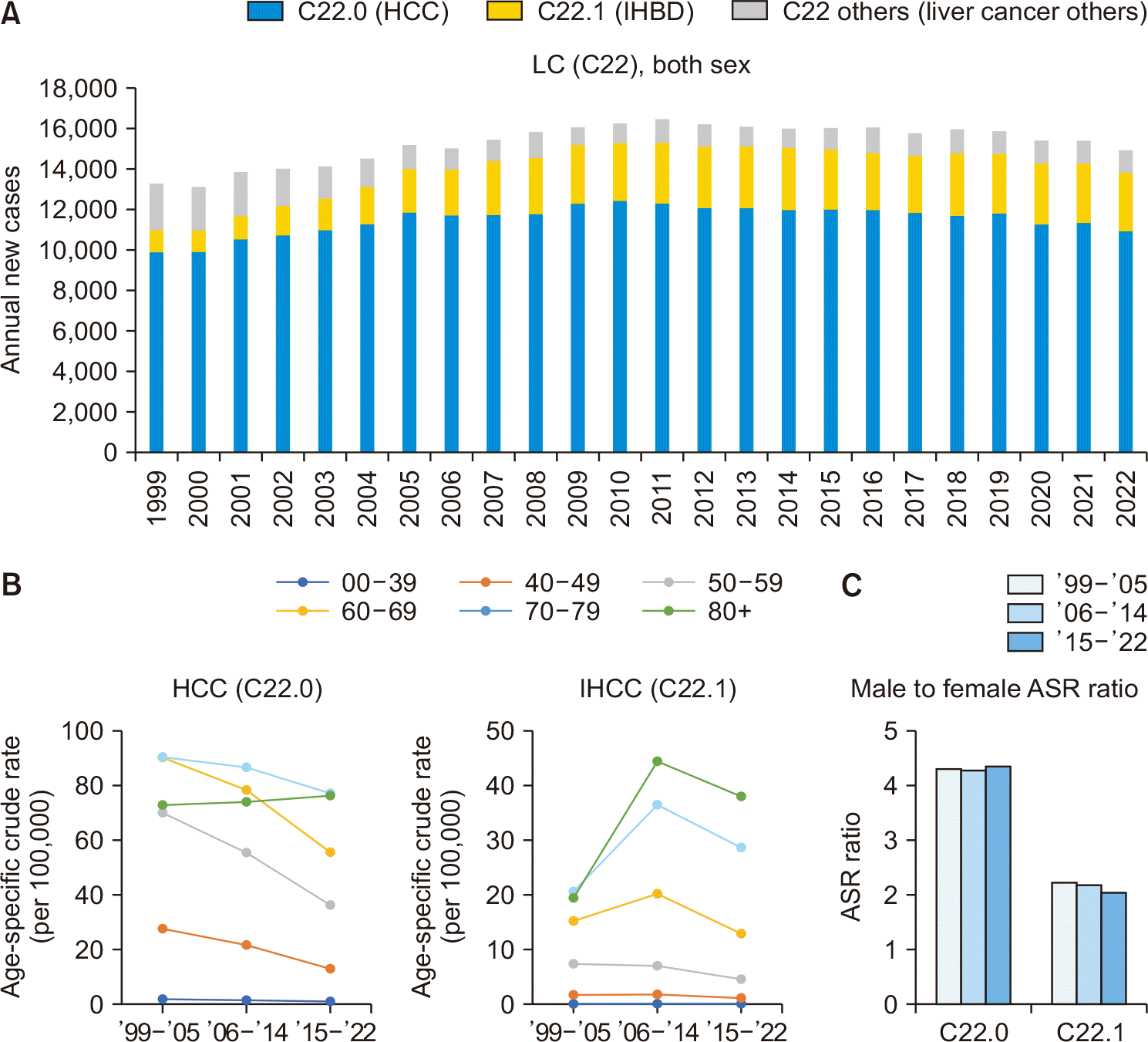
From 1999 to 2022, a total of 366,409 individuals were newly diagnosed with primary LC. Among these, 276,517 (75.5%) were HCCs, 59,456 (16.2%) were IHCCs, and the remaining 30,436 (8.3%) were LCs other than HCC and IHCC. The annual incidence of primary LC increased from 1999 until 2011, followed by a declining trend through 2022. In 1999, there were 13,262 reported cases of LC, with the annual number peaking in 2011 when 16,447 new cases were diagnosed. In 2019, the number of new LC cases slightly declined to 15,844, a trend that continued to 2022 with 14,913 new cases identified. Similarly, the CR of incidence for LC rose from 28.1 per 100,000 in 1999 to 32.8 per 100,000 in 2011, then declined to 29.1 per 100,000 in 2022 (Supplementary Table 1, 2). For ASR, both the incidence and mortality rates exhibited an overall decline during 1999–2022. By 2022, the ASR for HCC incidence and mortality was 13.4 and 8.37 per 100,000, respectively (Supplementary Table 1, 2).
The age-specific incidence of LC followed trends similar to those described in prior investigations. HCC was most frequently diagnosed in the 50 to 59 age group, accounting for 80,432 new cases from 1999 to 2022, which represented 29.1% of all HCC cases. The next highest number was in the 60 to 69 age group with 76,571 new cases (27.69%). Notably, over half (53.31%) of HCC cases were first diagnosed at age 60 years or above. In contrast, the incidence of IHCC steadily increased with advancing age; 76.61% of newly diagnosed IHCC patients were over 60 years old (Table 1, Fig. 1B).
The male-to-female ratio in both malignancies remained consistent over time, with a persistent male predominance. Males comprised 78.2% of HCC and 61.7% of IHCC patients, respectively. The male-to-female ASR ratio for HCC was 4.31 during period I (1999–2005), 4.29 in period II (2006–2014), and 4.35 in period III (2015–2022). Across the entire study period (1999–2022), the overall male-to-female ASR ratio for HCC was 4.32. Male predominance in IHCC was less marked; the male-to-female ASR ratio was 2.23 in period I, 2.19 in period II, and 2.04 in period III, with an overall ratio of 2.14 for the entire study duration (Fig. 1C).
Surgery as the initial treatment, performed within 4 months after diagnosis, was carried out in 18.5% of all LC patients (n = 67,867). Among those with HCC, a surgery-first approach was observed in 17.4% (n = 48,222), representing a modest increase from findings reported in previous studies. Other primary treatments such as systemic chemotherapy, transcatheter arterial chemoembolization (TACE), and radiotherapy were administered to 41.3% of HCC patients. In IHCC, surgical intervention followed initial diagnosis in 22.9% (n = 11,565) of cases, consistent with proportions observed previously. Nearly half of HCC patients (49.9%, n = 100,428) were diagnosed at the localized SEER stage, whereas only 23.3% (n = 11,424) of IHCC cases presented in the localized stage (Table 1).
Hepatocellular carcinoma
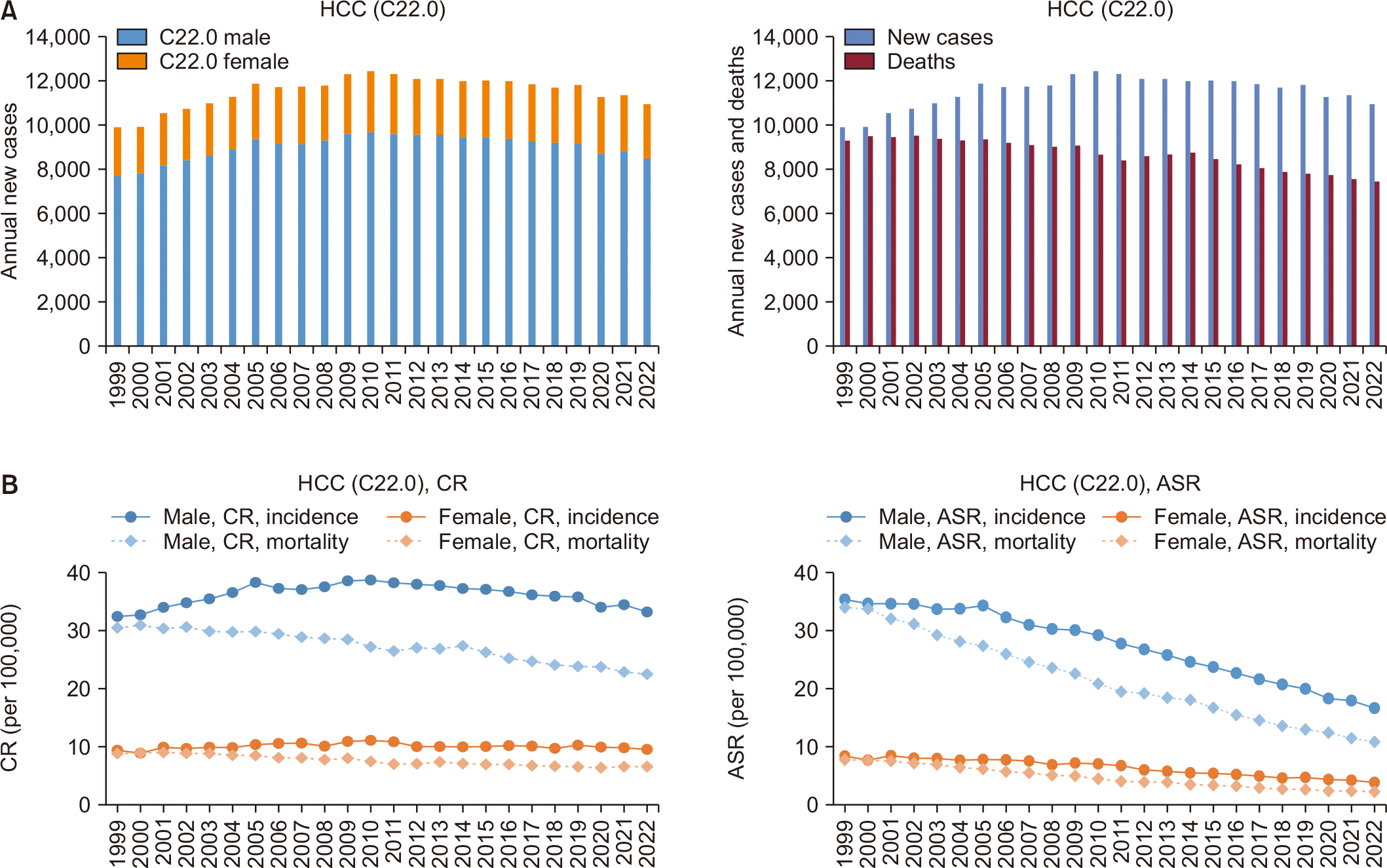
Between 1999 and 2011, the annual number of new HCC cases grew from 9,895 to 12,305, before subsequently declining to 10,938 by 2022; during the same period, cancer deaths from HCC steadily decreased from 9,290 in 1999 to 7,438 in 2022 (Fig. 2A, Supplementary Table 2). HCC was mainly diagnosed in males, maintaining a stable male-to-female ASR ratio of 4.32 throughout the study periods. The male-to-female ASR ratios in periods I, II, and III were 4.31, 4.29, and 4.28, respectively. The incidence CR for both sexes followed a similar trend as the annual incidence rates, peaking in 2010 at 24.9 per 100,000 and then gradually decreasing to 21.3 per 100,000 by 2022. Among males, the incidence CR of HCC increased more markedly, reaching 38.7 per 100,000 in 2010 before dropping to 33.2 per 100,000 in 2022. In contrast, the incidence CR for females remained relatively unchanged, with a maximum of 11.1 per 100,000 in 2010 before stabilizing at 9.55 per 100,000 in 2022.
The ASR of HCC incidence showed a statistically significant downward trend in both sexes (Fig. 2B). Overall, the incidence ASR declined from 20.7 per 100,000 in 1999 to 9.95 per 100,000 in 2022. The reduction in ASR was more notable in males, decreasing from 35.3 per 100,000 in 1999 to 16.6 per 100,000 in 2022. In females, the incidence ASR also declined, from 8.36 per 100,000 in 1999 to 3.81 per 100,000 in 2022. The AAPC for HCC incidence from 1999 to 2022 was –2.99 (95% CI –3.29, –2.69; p < 0.001), substantiating a significant overall reduction in incidence ASR. Specifically, the AAPC was –3.13 (95% CI –3.38, –2.87; p < 0.001) in males and –3.25 (95% CI –3.65, –2.85; p < 0.001) in females.
Mortality rates also showed a notable decline throughout the study period. The ASR of HCC mortality dropped from 19.5 per 100,000 in 1999 to 6.2 per 100,000 in 2022. For males, the mortality ASR decreased from 34.0 per 100,000 in 1999 to 10.8 per 100,000 in 2022, while for females, it declined from 7.7 per 100,000 in 1999 to 2.2 per 100,000 in 2022. (Fig. 2B, Supplementary Table 2). The AAPC for HCC mortality was –4.89 (95% CI –5.19, –4.58; p < 0.001) overall, –5.03 (95% CI –5.25, –4.80; p < 0.001) in males, and –5.43 (95% CI –5.80, –5.06; p < 0.001) in females.
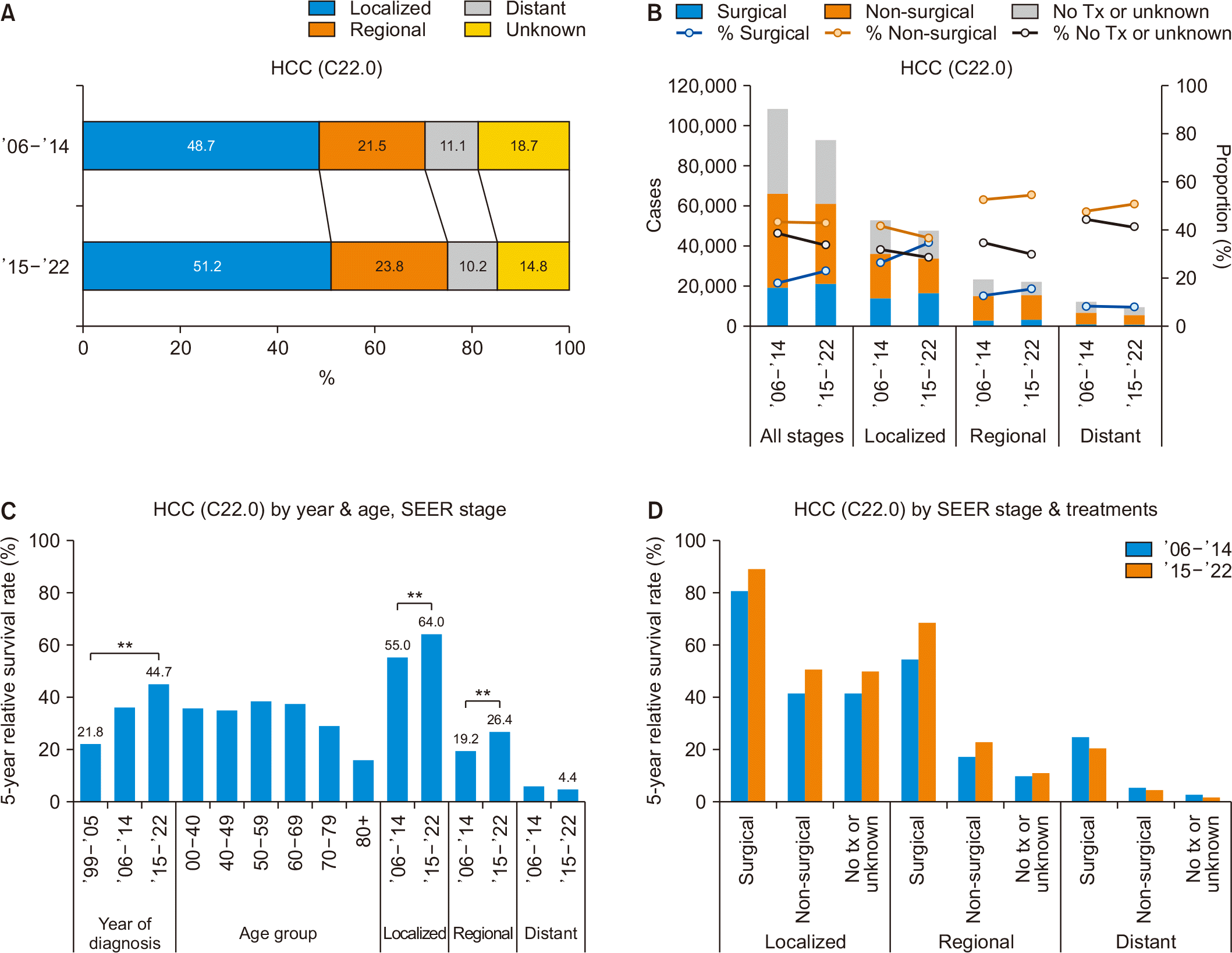
A significant rise in the proportion of patients diagnosed at a localized SEER stage was evident (Fig. 3A). During 2006 to 2014 (period II), 48.7% of HCC patients were identified with localized disease, with regional and distant disease comprising 21.5% and 11.1%, respectively. Between 2015 and 2022 (period III), the proportion of localized-stage diagnoses further increased to 51.2%, with regional and distant SEER stages representing 23.8% and 10.2%. The proportion of patients who received surgical treatments as initial management rose from 17.9% in period II to 23.0% in period III. Notably, this increase was most substantial in the localized SEER stage, growing from 26.4% to 34.9% (Fig. 3B). Among patients with regional stage disease, the rate of surgical intervention was 12.8% in period II and 15.6% in period III.
A marked improvement in overall survival rates was documented from 1999 to 2022. Median survival for HCC at all stages reached 37 months in period III, up from 10 months in period I and 23 months in period II. Patients diagnosed at localized, regional, and distant SEER stages demonstrated median survival times of 90, 14, and 3 months, respectively. Consequently, the 5-year survival rate increased substantially: from 21.8% in period I to 35.9% in period II and 44.7% in period III (Fig. 3C). Patients with localized HCC who underwent surgical treatment exhibited significantly elevated survival outcomes (64.0%) in period III. Improvement in 5-year survival was observed in both surgery-first and non-surgical treatment groups (Fig. 3D). Between period II and period III, the 5-year survival rate for localized SEER stage patients managed with a surgery-first approach increased from 80.8% to 89.3% (p < 0.01), and for regional SEER stage patients treated surgically, the rate rose significantly from 54.3% to 68.6% (p < 0.01). In contrast, the 5-year survival for surgically treated distant SEER stage patients remained low, with a slight, non-significant decrease from 24.6% in period II to 20.0% in period III (p = 0.119).
Intrahepatic cholangiocarcinoma
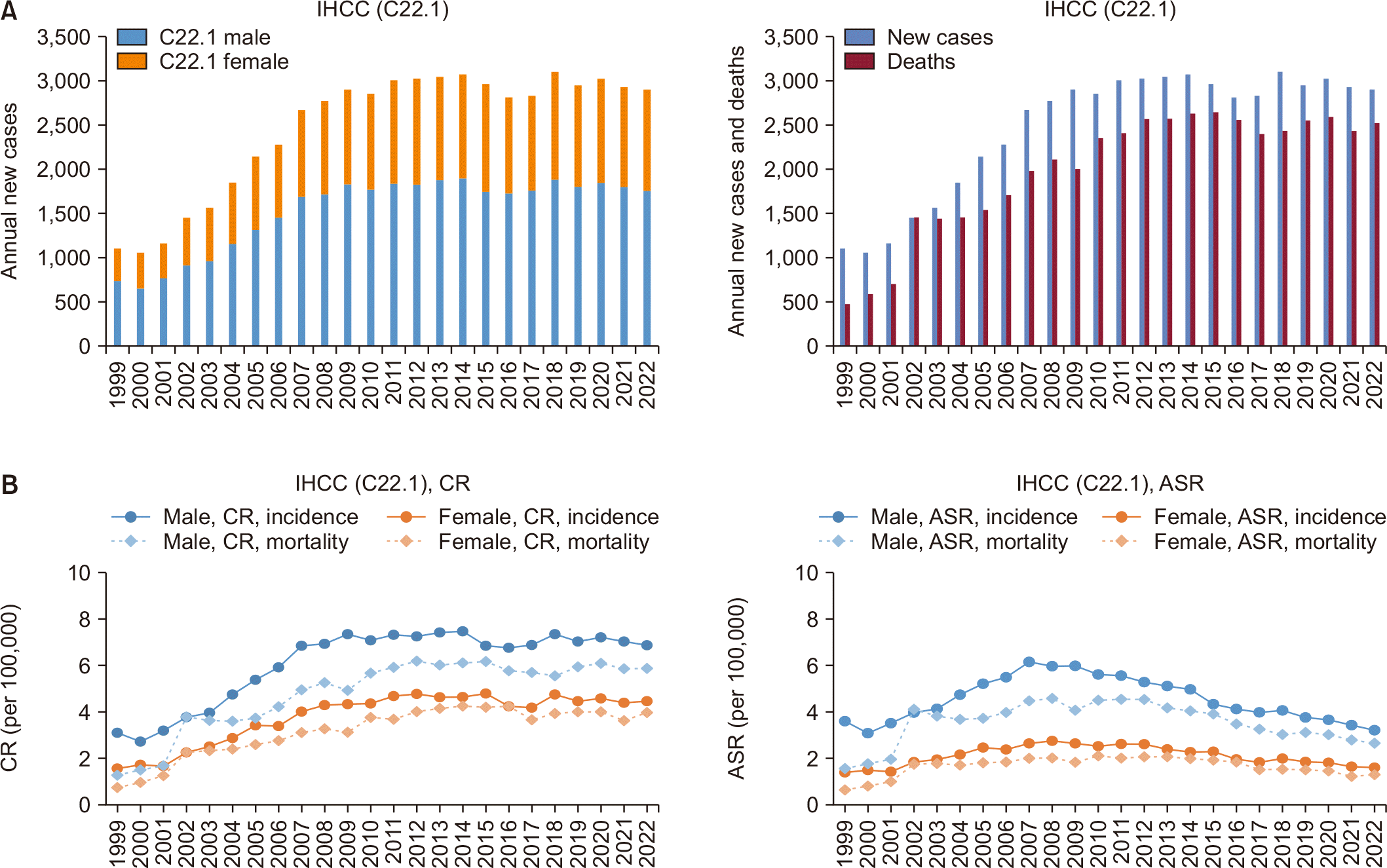
The annual incidence of IHCC in Korea steadily increased from 1999 to 2014, followed by a plateau that persisted through 2022. In 1999, 1,102 new cases were reported, rising to a maximum of 3,072 in 2014. By 2022, the number of cases was 2,901, with no definitive indication of a decreasing trend. Mortality related to IHCC reflected a similar trajectory. In 1999, there were 474 deaths, which climbed to 1,454 in 2002. Following this, mortality exhibited a gradual rise and reached stabilization after 2015. In 2022, 2,520 deaths were associated with IHCC (Fig. 4A, Supplementary Table 1–3). IHCC is more frequently diagnosed in males, with a male-to-female ASR ratio of 2.14 observed during period III (Fig. 1C). For males, the CR of IHCC incidence started at 3.10 per 100,000 in 1999 and experienced a modest increase to 7.35 per 100,000 in 2009, after which it leveled off to 6.87 per 100,000 by 2022. Among females, the CR was 1.56 per 100,000 in 1999 and remained fairly stable after 2012, recorded at 4.77 per 100,000. In the final year of observation (2022), the incidence CR for IHCC in women was 4.46 per 100,000. Although CR values increased, the ASR of IHCC incidence declined after reaching its peak in 2008. The ASR for males decreased from 5.97 per 100,000 in 2008 to 3.21 in 2022, while in females it decreased from 2.75 to 1.60 per 100,000 over the same interval. During period III, the AAPC was –4.68 (95% CI –5.02, –4.35; p < 0.001) for males and –3.28 (95% CI –4.34, –2.21; p < 0.001) for females.
Mortality patterns closely matched those observed for incidence. The CR increased from 1999 then stabilized in subsequent years. In 2022, the CR of IHCC mortality was 5.9 per 100,000 in males and 4.0 per 100,000 in females. The ASR for IHCC mortality demonstrated a modest decline, particularly among males, with corresponding ASR values of 2.7 per 100,000 in males and 1.3 per 100,000 in females (Fig. 4B, Supplementary Table 4–6). The AAPC for IHCC mortality from 2011 to 2022 was –5.00 (95% CI –5.79, –4.20; p < 0.01) in males, and from 2013 to 2022, –5.71 (95% CI –6.98, –4.63; p < 0.001) in females.
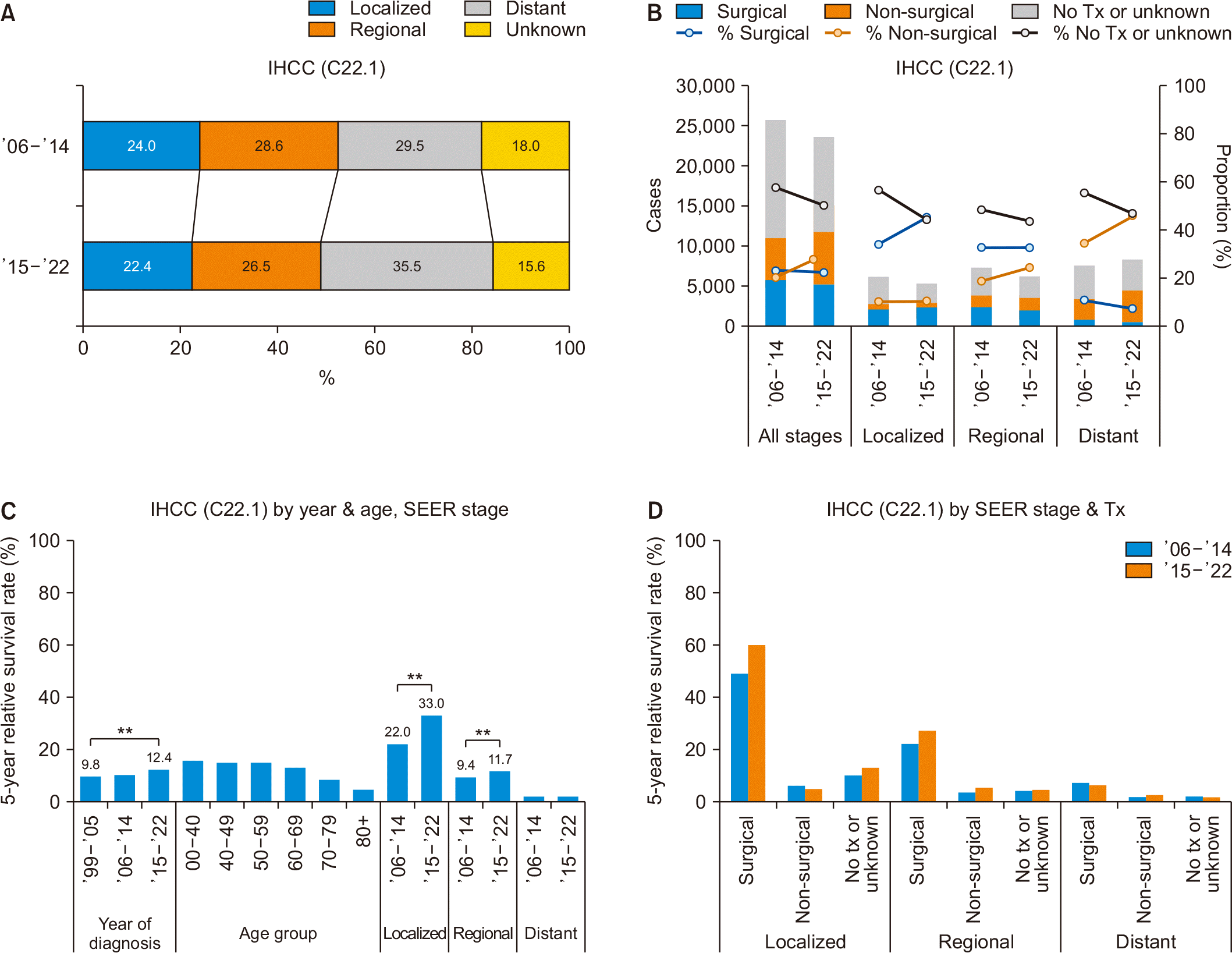
The distribution of SEER stage at diagnosis exhibited minor shifts across the analyzed years. In particular, the proportion of early-stage diagnoses decreased from 24.0% in period II to 22.4% in period III, concurrent with an increase in the proportion of cases presenting at the distant SEER stage from 29.5% to 35.5% (Fig. 5A). The overall rate of surgical management rose from 17.9% in period II to 23.0% in period III, chiefly driven by an increase among localized SEER stage cases. Specifically, the proportion of localized-stage IHCC patients who underwent surgery increased from 26.4% to 34.9% (Fig. 5B).
Over the past two decades, the 5-year survival rate for IHCC has shown improvement. Specifically, it was 9.8% in period I, increased to 10.4% in period II, and reached 12.4% in period III (p < 0.01). The greatest gain was evident in the localized SEER stage, where the 5-year survival rose from 22.0% in period II to 33.0% in period III (p < 0.01). For regional SEER stage disease, 5-year survival improved from 9.4% to 11.7% (p < 0.01) over the same timeframe (Fig. 5C). Subgroup analyses demonstrated that patients treated surgically, particularly those with localized or regional disease, experienced the most remarkable increases in survival (Fig. 5D).
DISCUSSION
This study offers an updated analysis of incidence, mortality, and survival trends for LC in Korea from 1999 to 2022, extending our earlier research. Our expanded assessment identifies both persistent patterns and significant shifts in the epidemiology of HCC and IHCC, thus providing crucial perspectives for public health strategies and clinical management. In the latest year analyzed, the incidence ASRs for LC, HCC, and IHCC were 13.4, 9.95, and 2.34 per 100,000, respectively, while the mortality ASRs were 8.37, 6.2, and 1.9.
Echoing our prior results, the incidence and mortality rates of HCC have continued to decline, as confirmed by a statistically significant reduction in ASRs among both males and females. This ongoing decrease in incidence and mortality may result from a combination of causes. Korea, where HBV is endemic, has benefited from effective HBV vaccination efforts, leading to reduced rates of chronic infection—a key risk factor for HCC [14]. In addition, higher awareness, expanded screening and surveillance for at-risk groups, and improvements in diagnostic imaging have facilitated earlier HCC detection. Advances in surgical techniques, locoregional therapies (such as TACE and radiofrequency ablation), and systemic therapy have markedly enhanced prognosis for HCC, impacting both regional and distant SEER stage patients. The introduction and adoption of novel systemic agents, including immune checkpoint inhibitors and molecularly targeted drugs, have broadened therapeutic possibilities and may also be contributing to increased survival [5,15].
In contrast to HCC, IHCC presents a consistently more complex clinical scenario. Although the initial sharp rise in incidence was previously attributed to the topographic misclassification of hilar cholangiocarcinoma, as highlighted in our prior publication, the incidence has since stabilized and the mortality rate has shown little change [3]. The proportion of early detected cases has not markedly increased, with only 22.4% of IHCC patients being diagnosed at the localized SEER stage. Multiple factors are likely responsible for these ongoing diagnostic and management difficulties. IHCC commonly manifests with non-specific symptoms, and by the time symptoms appear, the disease is often already advanced. The lack of an effective nationwide screening program is widely recognized as a significant contributor, as previously discussed in the literature [16]. Additionally, treatment options for IHCC are relatively limited. Surgical resection is currently considered the only curative approach, yet many patients are diagnosed at a stage unsuitable for surgery. Systemic chemotherapy demonstrates only modest benefits, and novel treatment modalities remain under investigation. Notably, despite the stable mortality rates, our data indicate improved 5-year survival among patients with localized IHCC who underwent resection. These findings suggest that aggressive surgical intervention, when feasible, may enhance survival outcomes for selected individuals.
The findings of this study have several important implications. The introduction of a targeted screening program for high-risk populations, such as individuals with chronic liver disease, may support earlier diagnosis of both HCC and IHCC. Ongoing research is crucial to identify new therapeutic targets and to develop more effective treatment options, especially for advanced cases. Moreover, the observed potential survival advantage related to surgical resection in localized IHCC underscores the need for further studies to define optimal criteria for patient selection.
This study has several limitations. Firstly, comprehensive longitudinal data on treatment are not available in the cancer registry. The impact of surgery as the initial treatment may be overestimated since alternative non-surgical therapies, such as chemotherapy, chemoembolization, and radiotherapy, can be implemented following cancer recurrence. The specific contributions and effectiveness of each treatment modality, including surgery, remain uncertain. Additionally, some non-surgical interventions—notably chemoembolization—may be used as bridging treatments prior to liver transplantation. Patients undergoing such bridging therapy may have been categorized as receiving non-surgical treatment, potentially introducing bias into the survival data. Secondly, the survival data may not capture patients with LC who died of liver failure due to progressive liver cirrhosis. Furthermore, LC patients who were unable to undergo aggressive anti-cancer treatments owing to impaired liver function might have been classified as having unknown or no treatment, possibly leading to an overestimation of survival in the surgical group.
In conclusion, there has been a sustained improvement in both incidence and mortality rates of HCC. Despite a significant increase in the 5-year survival rate among localized SEER stage IHCC patients who underwent surgical management, early detection rates for IHCC remain suboptimal. Therefore, strategies to enhance early detection are warranted.
SUPPLEMENTARY DATA
Supplementary data related to this article can be found at https://doi.org/10.14701/ahbps.25-150.
 XML Download