



 PDF
 Citation
 Print


INTRODUCTION
After first appearing in Wuhan, China, in December 2019, the coronavirus disease 2019 (COVID-19) caused fear worldwide, and South Korea was no exception to its impact. Since the first domestic case in 2020 until now, more than four years later, new COVID-19 cases have continued to develop, with approximately 34 million cumulative confirmed cases and over 35,000 deaths as of October 2023.1 This is the seventh-highest incidence among 237 countries.1
Before COVID-19, outbreaks of novel infectious diseases, such as severe acute respiratory syndrome (SARS) in 2003, novel influenza A (H1N1) in 2009, and Middle East respiratory syndrome (MERS) in 2015, were already occurring. Each outbreak has led to major changes in healthcare service systems in multiple countries, including South Korea.2345 In South Korea, the SARS epidemic highlighted the need for negative pressure (emergency) wards,6 and the H1N1 pandemic led to widespread revisions of laws related to infectious diseases.7 The MERS outbreak led to institutional alignment (ward standards, emergency room maintenance, preparation of negative pressure [emergency] wards), and thorough further revisions of the “Infectious Disease Control and Prevention Act.”6
Before COVID-19, MERS was the novel infectious disease that caused the greatest problems in South Korea. Several problems with the response were identified at the time, including “late mobilization of isolation units and preparation of control systems” and “insufficient personnel for smooth operation of emergency response systems and problems with professionalism.”8 To solve these issues, policies were established and supported to construct structured response systems and form organic cooperative relationships between infectious disease-related organizations, including the central government, local governments, and healthcare institutions.9 One such strategy was the founding of “infectious disease control and prevention support groups,” as civilian support groups assisting with regionally suitable infectious disease control and rapid initial response through the cultivation of a professional infectious disease workforce. 10
Among Korea’s metropolitan cities, Ulsan has less experience with the infectious disease response than other cities and provinces, having had no confirmed cases or deaths during the previous MERS outbreak. Due to this lack of experience, during the COVID-19 pandemic as well, Ulsan suffered from a severe shortage of infrastructure for responding to novel infectious diseases. Even though the “infectious disease control and prevention support groups” started being founded nationwide in 2014, the Ulsan group was founded much later, in July 2020.11 The Ulsan Geriatric Hospital12 is the only public healthcare facility available for responding to large-scale infectious disease outbreaks, with a notable shortage of professional staff, such as field epidemiologists. This not only reveals the lack of support for the infectious disease response in Ulsan but also demonstrates that the same problems observed in other cities during the MERS outbreak are persisting in Ulsan even during the COVID-19 pandemic and that further solutions are still required for the inadequate response infrastructure.8
Korea’s COVID-19 control broadly consists of preventing spread through epidemiological investigation and isolation of contacts, preventing spread through early detection, and preventing entry through border control.13 However, research on workers in the local government (city officials, public health centers, and public health branch offices) and other organizations involved in the response who can be considered the “first line of defense” in the control of infectious diseases has been notably lacking.141516 As such, exploring the experiences of these individuals during the COVID-19 response, understanding their difficulties, and identifying measures to address these difficulties is necessary.
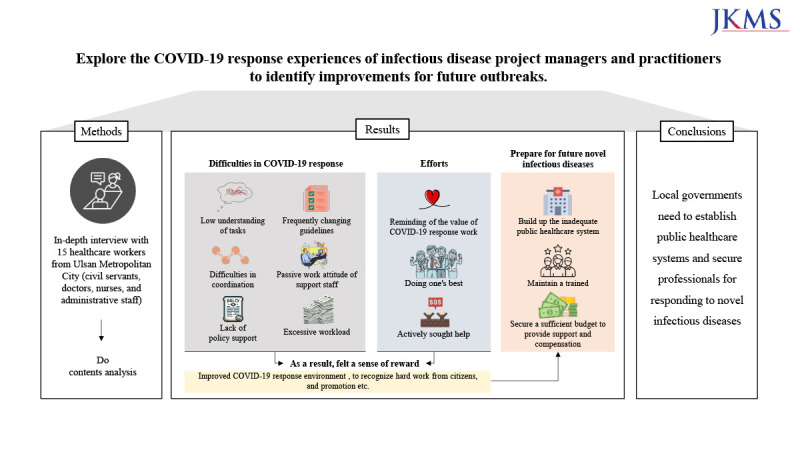
Several experts are predicting that, even after the end of the COVID-19 pandemic, other novel infectious diseases could emerge at shorter intervals.17 This means that, in South Korea as well, investigating how the novel infectious disease of COVID-19 was handled in Ulsan, which lacks infrastructure for infectious disease response, and exploring the experiences of that response is crucial. This study aimed to understand how managers and practitioners involved in the infectious disease response in Ulsan experienced the response to COVID-19 and explore the perspectives of experts and staff to improve infectious disease response systems. In this way, we aimed to provide evidence for the construction of an environment that could minimize harm in the event of a novel infectious disease via a systematic response.
METHODS
In this study, we employed the qualitative methodology of conducting in-depth interviews with managers and practitioners at infectious disease management organizations.18 Among qualitative methods, we used content analysis, which considers both quantitative and qualitative aspects, making it suitable for analyzing broad data. Specifically, we used conventional content analysis, which is based on inductive methods and most exhibits the characteristics of qualitative research.19 We describe the details of the method according to guidelines for the reporting of qualitative research, as follows.20
Research team composition
As members of Task Forces to Support Public Health and Medical Services in Ulsan Metropolitan City, the investigators had a deep understanding of Ulsan. Specifically, the main research team consisted of one PhD candidate in medical science (preventive medicine), one nurse and master’s candidate in medical science (preventive medicine), and one other nurse. One team member has published numerous qualitative studies as a first author, using various qualitative methodologies. In addition to the main research team, a professor of medicine, who has experience writing a graduate thesis on qualitative research and has persistently delivered lectures on qualitative research, participated as a supervisor.
Participant inclusion criteria
The participant inclusion criteria were as follows: 1) workers with experience constructing COVID-19-related response systems at the level of institutions or organizations, or healthcare workers who have performed a practical role in caring for confirmed COVID-19 patients; 2) residents of Ulsan; and 3) adults aged 19 years or older. In the process of participant selection, it was difficult to identify COVID-19-related practitioners due to changes in occupations at some organizations (e.g., Ulsan Metropolitan City hall). As such, we recruited participants through targeted sampling and snowball sampling.18
Data collection methods and procedures
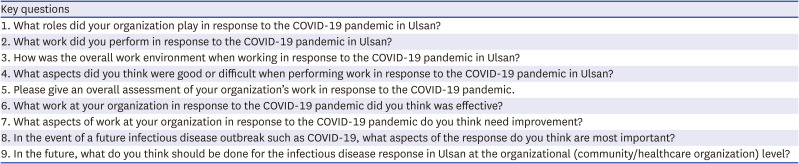
The research team developed guidelines based on a review and discussions of important prior literature.212223 Next, a pre in-depth interview was conducted with one person meeting the participant inclusion criteria, and the guidelines were partially modified. The final guidelines consisted of two categories: experiences of work related to infectious disease outbreaks and perceptions of infectious disease response systems (Table 1). Work experience consisted of organizational and personal work in response to COVID-19, work environment, and positive and negative experiences. Perceptions of response systems consisted of work that was effective in the COVID-19 response, areas for improvement, and important areas to prepare for novel infectious diseases. The in-depth interviews were conducted individually as 1:1 or 2:1 (two interviewers, one participant) interviews, once per participant, and lasted approximately 1 hour on average. Data was collected through in-depth interviews between March 27th and May 2nd, 2023. During analysis, additional data that was deemed necessary was collected from two participants over the telephone and/or in writing.
Table 1
Semi-structured guidelines
Analysis methods and procedures
Content analysis was performed as follows19: First, the research team extracted semantic units from all the transcribed data using a line-by-line approach. Second, a consensus was reached for the semantic units in all transcribed data. In the event of conflicting opinions between investigators, we prioritized the opinions of the interviewer who conducted the in-depth interview with that participant. Third, after reaching a consensus, we classified the semantic units into broad, primary themes and then identified more specific shared experiences to generate subcategories. We then derived the main categories by considering the temporal and contextual relationships between subcategories.
Validation
To ensure the validity of the study, we adhered to the four criteria suggested by Guba and Lincoln24 (1989:294). To ensure the truth value, we contacted the 15 participants by telephone or electronic message and checked whether their experiences were properly reflected in the final categories and their content. To ensure applicability, we used the telephone and messages to contact four persons (one civil servant, three nurses) who met the inclusion criteria but had not participated in the study and asked them to review whether they had similar experiences to the content described in the category chart. We collected data until saturation when no new data were obtained from the participants. To maintain consistency, we made efforts to thoroughly follow the research methods and procedures and described the data collection and analysis processes in detail. To ensure neutrality, the researchers made their personal pre-understandings clear before the in-depth interviews, exchanged and checked one another’s pre-understandings, and made efforts to maintain a bracketing approach.
RESULTS
Sociodemographic information
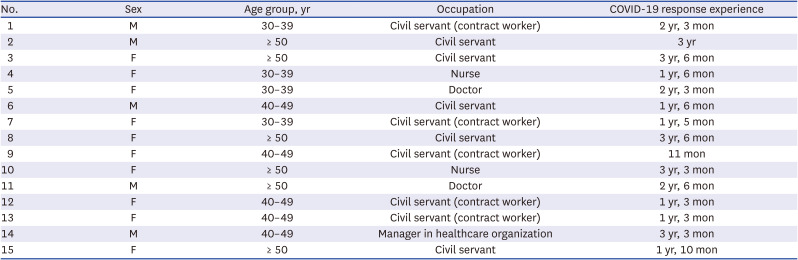
Of the 15 participants, five were male and five were aged ≥ 50 years old. The mean length of experience with the COVID-19 response was two years and three months. Three civil servants were affiliated with Ulsan Metropolitan City, and seven were affiliated with one of five district or county public health centers. Among the remaining participants, two were affiliated with the Public Healthcare Support Group in relation to the response to infectious diseases, two with a specialist COVID-19 hub hospital, one with a public hospital in Ulsan, and one with a specialist maternity hospital for COVID-19 patients. One of the participants from the Public Healthcare Support Group in relation to the response to infectious diseases and one of those affiliated with the specialist COVID-19 hub hospital were the same person. Table 2 shows basic information about the 15 participants.
Table 2
General characteristics of participants
Analysis results
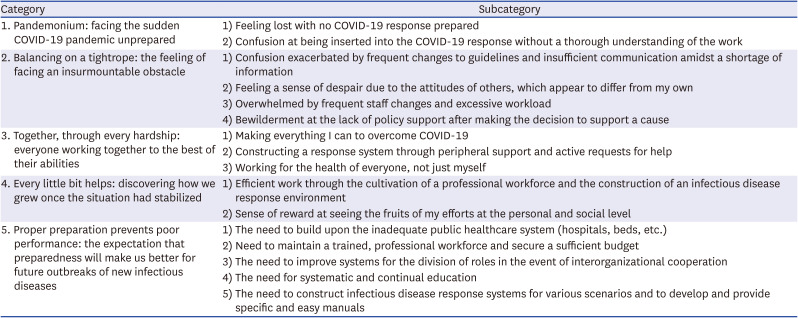
We extracted 1,469 semantic units in total, from which we generated 16 subcategories and 5 categories (Table 3).
Table 3
Category chart
Pandemonium: facing the sudden COVID-19 pandemic unprepared
1. Feeling lost with no COVID-19 response prepared
The sharp increase in COVID-19 patients in the absence of a professional response system for infectious diseases caused confusion, fear, and pressure for some participants. One participant described the urgency and intensity of the COVID-19 response as “making guns and bullets in the middle of a gunfight.” One of the civil servants had felt despair and misery when urgently visiting other cities and provinces and practically begging for hospital beds or making repeated requests to private hospitals in Ulsan. Some participants also reported anger at the ham-fisted handling of work in the absence of a well-defined system.
“I remember the infection control unit had only just called to say that a suspected COVID-19 patient was coming from Seoul to Ulsan, and then suddenly the patient was already coming into the hospital. So we had to prepare for hospitalization, and listen to things that were previously only theoretical, and to get things set up, and then we received the suspected patient.” [Participant 10]
2. Confusion at being inserted into the COVID-19 response without a thorough understanding of the work
The participants expressed various reasons for taking on COVID-19 response work, including curiosity, feeling it was an obvious part of their role, and wanting to help others. However, regardless of whether they participated voluntarily, almost all the participants started working without clear guideline or education about the work they would be performing. Work roles were not well defined, and work had to be performed haphazardly, making the task more difficult. Participants also reported feeling burdened by the lack of sufficient reliable and trustworthy sources of support.
Balancing on a tightrope: the feeling of facing an insurmountable obstacle
1. Confusion exacerbated by frequent changes to guidelines and insufficient communication amidst a shortage of information
The central government’s constantly changing COVID-19 guidelines exacerbated the participants’ confusion. In certain situations, the participants had to make decisions for themselves due to impractical, unspecific guidelines. Additionally, participants’ work was restricted by the lack of interorganizational communication and the attitudes of superordinate organizations, who seemed to engage only in desk-bound theorizing.
2. Feeling a sense of despair due to the attitudes of others, which appear to differ from my own
Due to the unmanageable spread of COVID-19, some participants could only perform their work with support from other departments in their organization or from staff at other organizations. However, participants felt a sense of relative deprivation due to the attitude of support staff who received high wages while doing only the minimum amount of work. The irresponsible, self-centered attitudes of the public were another cause of despair among most participants. Additionally, the participants had difficulty completing their work because of the attitudes of organizations, pushing work onto one another, journalists making one-sided requests for information, and excessive meetings.
“There were a lot of misunderstandings. We all understand the need for specialist infectious disease hospitals, but why does it have to be this hospital? Why are you doing this at the hospital where my parents are? Aren’t you just doing all this to make more profit for the hospital?... We received a huge number of complaints like that.” [Participant 5]
“[Some people had attitudes like,] I’ve been put to work, but it’s not my responsibility. I’m just helping. It’s not my work. It’s not my own work. Since it’s not my work and I’m just here temporarily, it’s not 100% my responsibility, and I can just go as soon as my hours are done…. The infectious disease response team was here until 12Am or 1Am, and the other team all left at 6Pm. I think there must have been some sense of relative deprivation.” [Participant 6]
3. Overwhelmed by frequent staff changes and excessive workload
The participants had to work at all hours due to the excessive workload of the COVID-19 response. This led to requests for job rotation or resignation. As a result, some of the participants in management roles in public organizations changed their COVID-19 response duties to six-month rotational positions. This impaired work continuity and caused internal and external problems. During the continually ongoing COVID-19 response, the participants suffered from depression, insomnia, stress, desire to resign, sense of burden, physical limitations, mental limitations, anxiety, and guilt at being unable to care for their own family.
“It was the worst. It was nothing you could call a ‘work environment’... I think it was when omicron broke out. I worked 250 hours of overtime in one month.” [Participant 2]
“It was quite difficult because [the person responsible] changed too frequently… They said the reason for the changes was for work equality across the public health center as a whole, but it was difficult, each time the person changed.” [Participant 12]
4. Bewilderment at the lack of policy support after making the decision to support a cause
Some of the participants in management roles were contributing to the COVID-19 response with a sense of contributing to a great cause given the critical situation in Ulsan. However, they also experienced bewilderment due to sudden requests from higher authorities to convert to a specialist hospital and their lack of understanding of practical difficulties. One participant was surprised by the difference between the compensation plans at the time of designation as a “COVID-19 specialist hospital” and the actual compensation received. Additionally, the participants had to worry about whether the hospitals would be able to stop functioning as a “COVID-19 specialist hospital,” and return to their previous status.
Together, through every hardship: everyone working together to the best of their abilities
1. Making everything i can to overcome COVID-19
Since COVID-19 was a matter of life and death for the public, the participants felt the need to do their best, despite the sense of despair that they might not be able to overcome COVID-19. The efforts of the participants led to changes at personal, social, and structural levels. At a personal level, one participant constructed a systematic work manual to improve work efficiency. At social and structural levels, one participant secured rooms for temporary living facilities by persistently persuading lodging facilities. Another participant improved a problem with bonuses so that colleagues could receive proper recognition for their efforts.
2. Constructing a response system through peripheral support and active requests for help
At some point, participants faced situations that required help beyond their own abilities. Rapid revisions of personnel systems, replenishment of response personnel at the national level, and nursing staff support at regional healthcare institutions were very helpful for participants in managerial roles. Smooth cooperation between regional healthcare institutions and the local government was another key factor in enabling not only staff shortages but also various other problems to be solved during the emergency. One participant reported that consultations with regional healthcare institutions were a major factor in setting routes and obtaining beds for patient transfer during the transition to a specialist hospital.
“In Ulsan, the nurses’ association helped so much… They helped us acquire staffing; that was our biggest problem, and they helped to solve that…” [Participant 15]
“When we were having difficulties, a whole team came from ‘A’ Hospital, including the chief of the infection control team, and they gave advice on patient transfer routes and other affairs. In public health center work, we have to handle tasks such as bed transfer, and the city (took care) of all of that…” [Participant 14]
3. Working for the health of everyone, not just myself
The participants did their best because they understood the purpose and value of COVID-19 response work as well as anyone else, but in retrospect, they significantly compromised their own health. This led to symptoms such as work-related despair, lethargy, anxiety, insomnia, loss of appetite, headaches, and palpitations. Nevertheless, the participants were able to continue performing their work, mostly thanks to the support of colleagues. One participant in a managerial role was moved to tears when a colleague told them that they would always stay by the participant’s side after seeing the hard work they were doing. Most participants did not feel any regret because they had received support and backing from their colleagues and had given their best, with a sense of mission, in difficult circumstances.
“I remember that, because we worked continually, without weekends or holidays, it affected our health, and it wasn’t just me; some people resigned.” [Participant 13]
“The work was insanely difficult, but we had a really good atmosphere. Even though it was always difficult, we encouraged each other to work through it… We made a point of telling each other to eat, and we bought snacks for each other, and waited to finish work together, even if we could have left sooner.” [Participant 7]
Every little bit helps: discovering how we grew once the situation had stabilized
1. Efficient work through the cultivation of a professional workforce and the construction of an infectious disease response environment
The COVID-19 pandemic, lasting more than 3 years, made everyone into “COVID-19 response gurus.” The accuracy of healthcare workers who have performed thousands of PCR tests at screening centers has become unquestionable. Private hospitals have also accumulated enough experience to claim expertise in the COVID-19 response. The participants reported that, from a work perspective, in addition to screening tests, vaccinations and epidemiological investigations had been effective at mitigating the spread of COVID-19. Thus, the involvement of a trained, professional workforce in the COVID-19 response, effective response strategies, simplified systems, and fewer COVID-19 patients gradually stabilized the situation after the initial pandemonium of the pandemic.
“Following the 3T strategy, the infectious disease response involves testing, tracing, and treatment, and over the course of 3 years, we’ve all become gurus in our fields. Total experts. Internally, we’ve become complete pros in each field. Even though it was difficult, this is an outcome that cannot be expressed in terms of monetary value.” [Participant 3]
2. Sense of reward at seeing the fruits of my efforts at the personal and social level
Over time, almost all the participants experienced personal growth. These changes led to a sense of reward and satisfaction. Most of the participants recognized the fruits of their efforts when they heard messages of gratitude or support from citizens or patients. One participant felt that their efforts had been recognized when a patient told them that “COVID-19 patients should absolutely go to ▲▲ Hospital (the participant’s affiliated institution).” Otherwise, tokens of social recognition, such as awards, promotions, or special promotions, were also rewards that made the participants objectively realize their own growth and feel a sense of fulfillment.
“I was so grateful whenever [a mother] gave birth to a healthy child there, and left the hospital after recovering their own health. It was fantastic how happy we felt to think that we had saved a life… And the dialysis patient [I mentioned] earlier, who called every day, crying, saying “Save me, save me.” When the patient received dialysis and got better and said “Thank you”, I felt that we’d done something indescribable but essential, and I felt so glad that I’d chosen this line of work.” [Participant 15]
“It could be a financial reward or an award, or something, but more than that, I’d like it if the overall atmosphere in society was one of recognition for our hard work for all that time.” [Participant 1]
Proper preparation prevents poor performance: the expectation that preparedness will make us better for future outbreaks of new infectious diseases
1. The need to build upon the inadequate public healthcare system (hospitals, beds, etc.)
The participants agreed on the need to prepare for new infectious diseases. The biggest difficulty for participants in management roles during the COVID-19 pandemic was the lack of public hospitals. The participants had to make desperate requests to other cities and provinces to meet the demand for beds. Specialist COVID-19 wards had to be constructed in local private healthcare institutions. However, in the process, Ulsan citizens inevitably suffered harm due to the delayed response. Participants also reported that, alongside ensuring public healthcare facilities, ensuring the quality of healthcare services was equally important. One participant argued that, rather than simply waiting for the expansion of public healthcare facilities, discussions should be prioritized on how to efficiently utilize the healthcare resources already existing in Ulsan.
“First, it is extremely important to secure public healthcare facilities. It was so difficult for us because there were no public healthcare facilities… Now, Ulsan Industrial Accident Hospital has had its groundbreaking ceremony, but it’s still not enough. We need an Ulsan Citizens Medical Center, and it’s a little frustrating that we still don’t have that.” [Participant 2]
2. Need to maintain a trained, professional workforce and secure a sufficient budget
Some participants were affiliated with departments created in response to the COVID-19 pandemic and returned to their previous work after the pandemic settled down. However, an “emergency workforce” or “professional workforce” will be required in the event of another infectious disease outbreak. In this regard, most participants reported the need not only to return to previous work but also to maintain and develop a professional workforce to respond to new infectious diseases. Additionally, participants with a managerial role emphasized the need to improve the problem of insufficient budget, mentioning that they were unable to provide proper eagles for overtime. Given that the lack of budget has major effects on both hiring and maintaining a professional workforce, preparing a sufficient budget to respond to future infectious diseases is essential.
“Now, I wonder whether we don’t need to secure some standing level of personnel who could respond in an emergency. Although there are emergency work systems, those systems don’t come into effect just because of 1 or 2 infectious diseases outbreaks...” [Participant 7]
“It was so difficult for me to make people work without giving them proper bonuses, because we didn’t have enough for things like overtime pay, and not providing enough to eat… I can’t even describe it. Where do you get money from when there’s no money?” [Participant 8]
3. The need to improve systems for the division of roles in the event of interorganizational cooperation
Unclear division of roles in the event of an unexpected global disaster ultimately led to wasted time. As such, some participants mentioned the need for organizations to take the time to understand each other’s perspectives and to clearly define roles. As factors that would help in the response to future novel infectious diseases, the participants highlighted active cooperation in one’s own field of expertise when several organizations are cooperating and the construction and activation of networks between infectious disease-related organizations and collaborating departments.
“There is a discrepancy between the limitations in what can be done in districts and counties and what is desired by the city. We are an organization that performs hands-on work… When we do something, when there is an infectious disease outbreak, we listen to districts and counties… And they should give a little more consideration to situations where we also have no choice because of the situation” [Participant 7]
4. The need for systematic and continual education
Most of the participants initially experienced difficulties when performing work because they had not received relevant education. One participant performing practical work received education related to the infectious disease response as COVID-19 was subsiding, and the amount they learned clearly demonstrated the need for education. Almost all the participants reported that ongoing education was essential for the response to future novel infectious diseases. They mentioned that all civil servants and healthcare workers should receive education. Specifically, one participant in a managerial role mentioned that education and training were needed even more at institutions that could not provide medical treatment, such as nursing homes and community care centers.
5. The need to construct infectious disease response systems for various scenarios and to develop and provide specific and easy manuals
Although the broad framework for infectious disease response was developed during the COVID-19 pandemic, it still does not reflect diverse scenarios. The participants emphasized the need to construct infectious disease response systems for specific scenarios, such as critical patient transfer systems, complete data registration and linkage systems, healthcare systems (beds, staffing) for confirmed pediatric cases, and response systems for obstetric patients. Some participants also experienced the need to simplify and clarify guidelines in response to ongoing questions about guidelines. Additionally, participants mentioned the need to continually review and add details to manuals after development.
DISCUSSION
In this study, we used qualitative methods to explore in-depth, on the topic of improving infectious disease response systems, the experiences and opinions of managers and practitioners at infectious disease management organizations in Ulsan, which is one of major cities in South Korea. Specifically, we identified positive and negative experiences in relation to the COVID-19 response, and we explored important aspects of the response to future novel infectious disease outbreaks. We expect that our findings can be used to identify areas of improvement for systematic response to infectious disease not only in Ulsan but also by other local governments with inadequate response capabilities. Based on our analysis results, we derived several implications for the response to novel infectious diseases (Fig. 1).
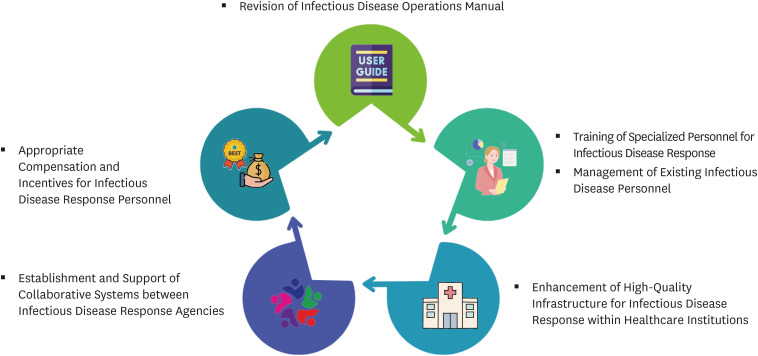
The first point is to “re-prepare work manuals for infectious disease.” During the rapid spread of COVID-19, the lack of work manuals, frequent changes to guidelines, and uncertain division of labor caused confusion. These poorly equipped systems have been highlighted throughout multiple outbreaks of novel infectious diseases, including MERS,625 indicating persistent instability. Therefore, essential efforts should include constructing unified infectious disease response manuals, forming rapid communication systems to prevent delays in issuing guidelines, and establishing systems for division of work between central, municipal, and local government, as well as support organizations.
The second point is to “cultivate a professional workforce for the infectious disease response.” Since novel infectious diseases arrive without warning, prompt and appropriate responses are essential. However, as COVID-19 has subsided, some organizations have been dissolved, and the professional workforce developed through three years of the COVID-19 response has returned to their previous work. In these circumstances, the participants were concerned that the same confusion experienced in the initial stages of the COVID-19 pandemic could be repeated in the event of a novel infectious disease outbreak. To prevent this, the participants highlighted the need to prepare systems for the maintenance of a professional workforce for the response to infectious diseases.
The third point is “the importance of managing the existing infectious disease workforce.” To respond to novel infectious diseases, epidemiological investigations should be prioritized. Accordingly, the need for professional field epidemiologists has been emphasized since the MERS outbreak.4 However, during the initial COVID-19 outbreak, Ulsan had only one field epidemiologist, resulting in an excessive workload that was ultimately harmful to the epidemiologist’s health. Indeed, most participants had to work at all times of the day, without weekends, which resulted in worsening physical and mental health. This is consistent with previous studies showing that excessive workloads have direct effects on emotional burnout.15
,
2627 Since infectious disease response workers are vulnerable to health problems for this reason, long-term health monitoring is essential for this group.28
The fourth point is to “expand high-quality infrastructure for the infectious disease response.” Existing literature indicates that the national response to COVID-19 has exacerbated pre-existing inequalities and intensified disparities in access to existing infrastructure.29 Additionally, the shortage of medical personnel and infrastructure was linked to a surge in cases of damage caused by COVID-19.30 The number of public hospital beds in South Korea is 1.2 beds per 1,000 population, which is considerably lower than the OECD average (2.8 beds per 1,000 population).31 The situation is especially dire in Ulsan, where the only public hospital is Ulsan Geriatric Hospital, and the issue of the lack of public healthcare infrastructure has only been highlighted without any improvements for over 10 years. The participants had to visit facilities in other cities and provinces to secure residential treatment centers and remodel private hospitals by arguing the conditions for financial support. This made the participants feel under pressure. As such, securing suitable public healthcare facilities is essential for the infectious disease response,25 and furthermore, repeated education on the infectious disease response will be needed to ensure high-quality healthcare services.
The fifth point is to “construct and support systems of interorganizational cooperation in the infectious disease response.” The participants were able to construct a response system during the spread of COVID-19 with the help of local healthcare organizations in Ulsan in forming a response environment, replenishing staff, and providing response-related education. Regarding environmental factors, such as public healthcare facilities, considering the difficulties of rapid expansion within existing facilities, constructing a system of cooperation between regional healthcare institutions will be essential.25 Moreover, when the lack of public hospitals necessitates private hospitals joining the response to infectious diseases, as observed in Ulsan, political systems must be prepared to provide suitable compensation and support a return to previous work.
The sixth point is to “provide suitable compensation and reward for workers in the infectious disease response.” The participants entered the COVID-19 response based on a sense of “mission” and “responsibility,” but when they faced limitations, they considered changing jobs, redeployment, or resignation. In these circumstances, the participants were motivated by recognition and support from citizens, promotion, rewards, and awards. Previous studies have also shown that insufficient reward is associated with emotional burnout, cynicism, and decreased vocational self-efficacy.32 In this context, we propose that the “deokbune” (“Thanks”) challenge previously performed for healthcare workers could be extended to workers in infectious disease management organizations to acknowledge the efforts of these workers. In the future, we believe that implementing special reward systems of points-based promotion would help to motivate workers involved in infectious disease response.2526
The seventh point is to “cultivate a standing professional workforce for the response to infectious diseases.” All participants experienced excessive workloads and frequent changes in personnel with the spread of COVID-19. This is consistent with a previous study, in which time-based systems and temporary redeployment of staff from other departments due to the lack of a professional workforce led to reduced work efficiency.20 Thus, to maintain an efficient workflow, it will be necessary to construct infectious disease response TF teams that can be mobilized at short notice.26
This study has several limitations. First, we focused on the experiences of managers and practitioners involved in the infectious disease response in Ulsan. Naturally, the experiences and opinions of the participants are related to the central government (systems and guidelines, communication processes, etc.) and regional characteristics specific to Ulsan. Since all participants in our study were Ulsan residents, applying their interpretations of experiences and opinions to other regions may pose challenges. Additionally, there were variations in the COVID-19 response periods among the participants, which means that even if they experienced the same situations, their interpretations might differ. Furthermore, while previous studies have indicated differences in COVID-19 response experiences based on occupational status and gender, this study did not take those factors into account.333435 In the future, conducting further research in regions with a similar scale or healthcare infrastructure to Ulsan and considering the impact of variations in response periods, occupational status, and gender on the experiences and opinions of participants would be valuable.
The sudden appearance of COVID-19 in an unprepared state brought various improvements to the infectious disease response systems in Ulsan. Frequent changes in guidelines implied the need to construct infectious disease response systems and to develop and provide manuals for various scenarios. Due to poor communication, participants highlighted the need to improve systems for division of labor in the context of interorganizational cooperation, and frequent changes in personnel showed the importance of systematic, ongoing education and the maintenance of a trained, professional workforce. Sufficient budgeting and construction of public healthcare systems (hospitals, beds, etc.) were some of the most important factors in the novel infectious disease response and were mentioned by most of the participants. We anticipate that our study will serve as a guide, based on the lessons learned from past experiences, for local governments to construct and maintain systems that enable a more efficient and appropriate response to future outbreaks of novel infectious diseases.
 XML Download