



 PDF
 Citation
 Print


Vaccines have played a crucial role in public health, and their role is expected to expand substantially in the future with the development of novel vaccines. Demographic factors such as sex, age, race, and ethnicity can affect not only immune responses post-vaccination, but also the adverse events.12 The maintenance of effective surveillance system for adverse events following immunization (AEFI), aligned with national vaccination policies and demographic characteristics, is important to ensure the timely detection and responses to vaccine safety issues.
In South Korea, the surveillance system for AEFI was first implemented in 1995, and has maintained a passive surveillance system depending on reports from patients and physicians.3 Passive surveillance systems, while convenient to implement, have limitations in accessing complete clinical data and determining population-level incidence.4 These limitations pose challenges in determining the causality between vaccination and adverse events. South Korea’s online registration system for vaccination, which requires recording vaccine name, administration date, and lot number, helps to overcome some of the limitations of passive surveillance.56 However, this registration system applies only to National Immunization Program (NIP) vaccines, excluding non-NIP vaccines.
As of 2024, the NIP in South Korea recommends 17 infectious diseases under the Infectious Disease Control and Prevention Act.7 Most these NIP vaccines are for infants and young children, while only the influenza vaccines and 23-valent pneumococcal polysaccharide vaccine are for older adults. Most newly introduced vaccines are classified as non-NIP; therefore, a gap in safety monitoring may arise under the current system until these vaccines are incorporated into the NIP.
Active surveillance offers several advantages over passive surveillance, including more accurate incidence rate estimation and improved assessment of causality.8 The Vaccine Safety Datalink (VSD) in the United States (U.S.) and the Immunization Monitoring Program ACTive (IMPACT) in Canada are representative examples of active surveillance systems.91011 The VSD regularly monitors the incidence rate of pre-defined adverse events of special interest (AESIs) after vaccination using electronic medical record (EMR) data from 11 large healthcare institutions. Through rapid cycle analysis of data shared under a common data model, VSD can identify the safety concerns highlighted in medical literature or by a U.S. passive surveillance system such as Vaccine Adverse Event Reporting System (VAERS).91012
We have previously reported on various attempts to establish a system for monitoring AEFI of non-NIP vaccines.13 In the present study, we provide a tool which can function as a sentinel surveillance on AESIs following non-NIP vaccination in South Korea.
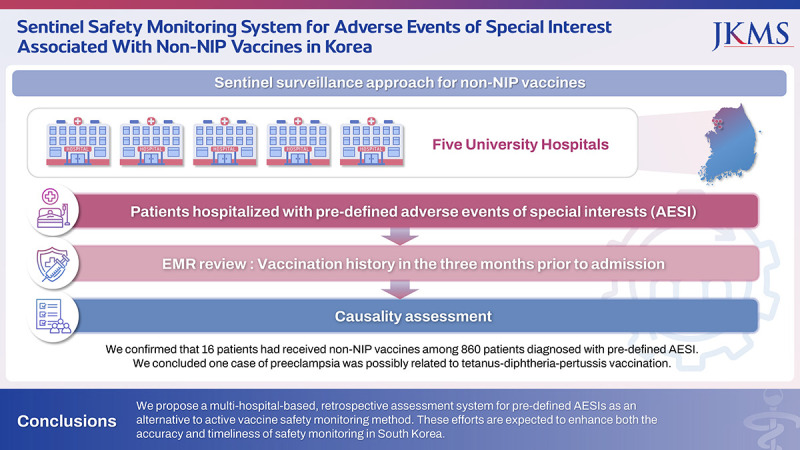
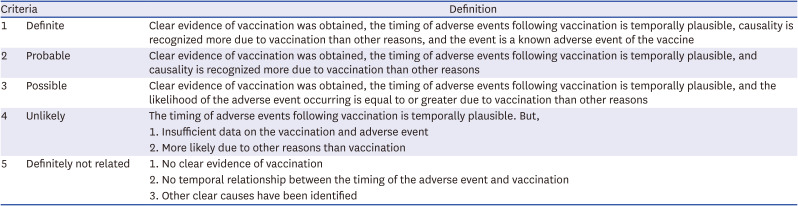
This study was conducted at five university hospitals in South Korea (Korea University Guro and Ansan Hospital; Hallym University Kangnam Sacred Heart Hospital; Catholic Kwandong University International St. Mary’s Hospital; and Ajou University Hospital) from September 2022 to August 2024. We received a monthly list of patients discharged with pre-defined AESI diagnoses from the medical information team. The AESI diagnoses were identified based on the International Classification of Diseases, Tenth Revision (ICD-10) codes. Adults aged 18 years and older were included in the study and the patients who had the same AESI codes within the past year were excluded. We reviewed the EMR and collected data on patient demographics, pre-existing medical conditions, and the vaccination history in the three months prior to admission. Prior to the beginning of the study, we requested the departments and wards related to the AESI diseases to conduct a thorough investigation of vaccination history, with particular emphasis on confirming the vaccination status of non-NIP vaccines among patients with AESIs. Additionally, we asked them to notify the researchers if any non-NIP vaccination history is identified. For patients with non-NIP vaccination history, infectious diseases specialists at each hospital reviewed their EMRs and conducted interviews to assess causality between vaccination and AESIs. For those who were discharged, interviews were conducted over the phone. The causality was assessed based on the guidelines of the Korea Disease Control and Prevention Agency (Table 1).14 Non-NIP vaccines included pneumococcal conjugate vaccines, tetanus-diphtheria-pertussis (Tdap), live attenuated and recombinant zoster vaccines. The pre-defined AESIs were classified into six categories, with the corresponding diagnoses and ICD-10 codes as follows: neurologic disorders (G03.8, G03.9, G04.0, G04.8, G04.9, G05.8, G36.8, G36.9, G37.3, G37.8, G37.9, G51.0, G61.0, G61.8, G61.9, M53.1, M54.1, R27.0, R56.8), including seizure, radiculopathy, aseptic meningitis, Guillain-Barré syndrome, transverse myelitis, encephalitis, Bell’s palsy, acute disseminated encephalomyelitis, and ataxia/cerebritis; autoimmune disorders (E10, M05, M06, M32), such as rheumatoid arthritis, systemic lupus erythematosus, aseptic arthritis, and type 1 diabetes mellitus; cardiologic disorders (I30.8, I30.9, I40.8, I40.9, I51.4), including myocarditis and pericarditis; obstetric disorders (P95, O03, O06), such as spontaneous abortion, stillbirth, and preeclampsia; hematologic disorders (D69.0, D69.3), including immune thrombocytopenia and Henoch–Schönlein purpura; and allergic disorders (T78.2, T88.6), specifically anaphylaxis.
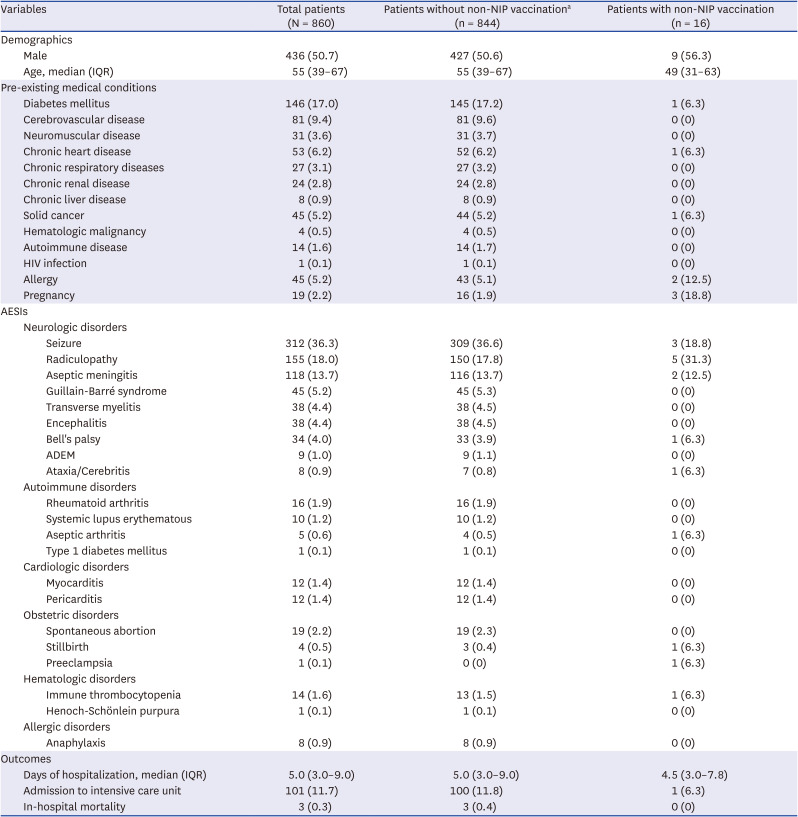
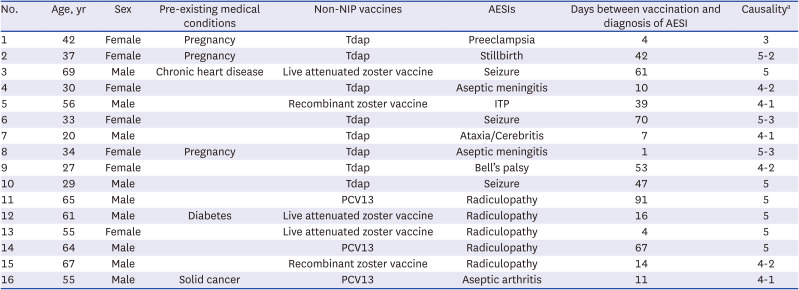
A total of 860 patients were included in the study. The median age of the patients was 55 years (interquartile range, 39–67 years) and 436 patients (50.7%) were male (Table 2). Neurologic disorders were the most frequent category of AESI, accounting for 88.0% of cases. Seizure was the most common individual diagnosis (36.3%). Among the 16 patients who received non-NIP vaccines, the most frequent AESI diagnosis was radiculopathy (31.3%), followed by seizure (18.8%), aseptic meningitis (12.5%), Bell's palsy (6.3%), ataxia/cerebritis (6.3%), aseptic arthritis (6.3%), stillbirth (6.3%), and preeclampsia (6.3%). The characteristics of patients who received non-NIP vaccines and the results of causality assessment are presented in Table 3. In 15 cases, the causality between vaccination and AESI were determined to be unlikely or not related. In one case of preeclampsia following Tdap vaccination, a possible causal relationship was identified. The case involved a 34-week pregnant patient with pre-existing gestational diabetes and hypertension who presented with vomiting, dizziness, proteinuria, and elevated blood pressure four days after receiving the Tdap vaccine. This temporal and clinical association led to a causality assessment of “possibly related.”
This is the first study reporting the AESI after non-NIP vaccination in South Korea using multi-center sentinel surveillance by medical record review. We identified 860 patients diagnosed with AESI, among whom 16 had received non-NIP vaccines. Ultimately, we concluded that one case of preeclampsia was possibly related to the Tdap vaccination.
The VSD, an active surveillance system in the U.S., compares the incidence rate of AESI between vaccinated and unvaccinated individuals using multi-institutional EMR data. It detects safety warnings for vaccines when the incidence rate of AESI in vaccinated individuals significantly exceeds that in unvaccinated individuals.910 In the present study, we retrospectively confirmed the vaccination status of patients with AESI diagnoses, and infectious diseases specialists directly assessed the causality between non-NIP vaccines and AESI. Although our approach does not allow for the calculation of the incidence rate as done in the U.S. VSD, it may provide a signal indicating the need for further evaluation of the causal relationship between AESI and non-NIP vaccination.
In the past, efforts in South Korea to establish an active surveillance system attempted to conduct post-vaccination surveys via phone or email; however, these efforts faced limitations due to low response rates and high labor demands, which precluded practical implementation.15 The sentinel surveillance in the present study may serve as a useful method for monitoring AESIs—key considerations in vaccine safety—while requiring relatively low cost and labor.
This study has several limitations. First, the vaccination status of non-NIP vaccines may have been underestimated, as it was identified solely through EMRs of each hospital where the patient admitted. Along with the underestimation, the number of non-NIP vaccine recipients was low. Increasing the number of participating institutions may be required to overcome these limitations. Second, we identified study participants solely based on ICD-10 codes. This was intended to establish a system that could be easily implemented and reduce labor.
In 2019, the World Health Organization Global Vaccine Safety Blueprint 2.0 (2021–2023) proposed to develop active and hospital-based sentinel surveillance systems. It also emphasized the need to strengthen countries’ capacity for investigating serious AEFIs and providing high-quality data for causality assessments.16 Our approach addresses the global need for improved vaccine safety surveillance. The key elements for improving our approach include the establishment of a centralized and trustworthy database of vaccination records led by public health authorities. All vaccination records should be mandatorily registered in online database, and this data should be accessible to institutions participating in the sentinel surveillance. Additionally, the implementation of a common data model across participating institutions is also necessary to ensure data standardization. These efforts are expected to enhance both the accuracy and timeliness of safety monitoring.
In conclusion, we propose a multi-hospital-based, retrospective assessment system for pre-defined AESIs as an alternative to active vaccine safety monitoring method. This approach can serve as an effective alternative in South Korea, where a functioning active surveillance system is currently lacking.
Ethics statement
This study was approved by the Institutional Review Board of each participating hospital (approval No. Korea University Guro Hospital, 2022GR0339; Korea University Ansan Hospital, 2022AS0238; Hallym University Kangnam Sacred Heart Hospital, 2022-07-014; Catholic Kwandong University International St. Mary’s Hospital, IS22ENME0051; and Ajou University Hospital, AJOUIRB-OB-2024-170).
 XML Download