



 PDF
 Citation
 Print


C-reactive protein (CRP) is a more reliable marker than erythrocyte sedimentation rate (ESR) for detecting acute inflammation, with a relatively rapid response to inflammation and short half-life. A discrepancy between CRP and ESR has been reported while detecting inflammation, and ESR test shows lower sensitivity and specificity than does CRP test.12 Co-ordering of these two tests can lead to clinical confusion and unnecessary medical interventions, thereby increasing healthcare costs and posing a risk to the patient’s health. Ordering CRP test instead of ESR test for detecting acute inflammation in patients with undiagnosed conditions has been recommended by the American Society for Clinical Pathology through the Choosing Wisely campaign.3 In Korea, co-ordering of ESR/CRP tests in a single center over a year has been reported to be 31.1%.4 Nevertheless, to the best of our knowledge, no nationwide report has been generated on the ESR/CRP co-ordering status. Herein, we examined the current trends of ordering for ESR and CRP tests using insurance claims data over the past 5 years and subsequently focused on co-ordering of ESR and CRP tests in 2022.
The data were retrieved from an open data platform (https://opendata.hira.or.kr) operated by the Health Insurance and Review Agency (HIRA), the headquarter for processing healthcare reimbursements in Korea covering 98% of the total population.5 The annual (2018–2022) use and cost of CRP and ESR testing, total patient days of inpatients, and patient encounters of outpatients were acquired. All claims with test codes ESR (D0100) and CRP (D0111, D01112, and D0113) for hospital visits between January 1, 2022 and December 31, 2022 were acquired; the data of only one year were available owing to the limitation of cloud storage on the HIRA platform. HIRA data included demographics, inpatient admission and discharge dates, outpatient visit dates, diagnosis codes, test and procedure codes, and prescription drug codes; however, test results were not available in all cases, and the exact date of testing was not identified for inpatient cases because only the admission and discharge dates were recorded on the claim.
All data were separately analyzed for inpatient and outpatient settings. The total number of orders for CRP and ESR testing and number of claims with CRP and ESR orders were counted. The proportion of claims with co-order for CRP and ESR testing was compared among different types of hospitals and departments. For comparison, only departments with > 10,000 claims were included. Random forest analysis was performed to identify variables predicting co-orders of CRP and ESR testing. The co-ordering proportion by patient age and department was visualized as a heatmap that grouped patient age in 5-year increments. All statistical analyses were performed using R v.4.2.3 with the following libraries: haven v.2.5.3 for data import, dplyr v.1.1.3 and tidyr v.1.3.0 for data manipulation, ggplot v.2.3.4.4 for visualization, and randomForest v.4.7-1.1 for random forest analysis.
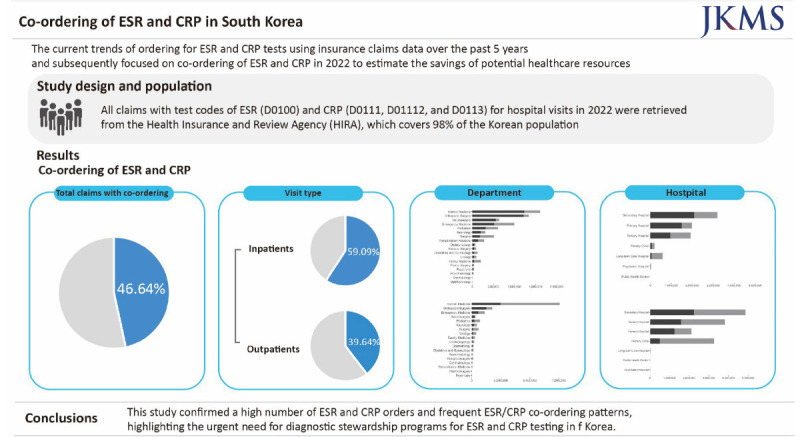
Numbers of CRP and ESR testing gradually increased over five years in the outpatient setting compared to that in the inpatient setting, excluding a slight decrease between 2019–2020. In the outpatient setting, CRP testing showed a more pronounced increase of 59.1% over five years than a 37.0% increase in ESR testing (Fig. 1). In 2022, the total number of claims for any of the CRP and ESR tests in the inpatient and outpatient settings were 7,912,231 and 14,077,801, respectively. Based on these claims, 32,382,257 CRP tests and 15,668,372 ESR tests were ordered. The number of patients undergoing CRP and/or ESR tests was 10,809,468, including 8,160,884 outpatients and 4,805,144 inpatients. (Supplementary Table 1). The numbers of CRP and ESR tests per 1,000 patient*days in the inpatient setting were 441.46 and 217.02 respectively. In contrast, for the outpatient setting, 169.71 CRP and 80.28 ESR tests per 1,000 hospital visits were ordered. Co-ordering of CRP and ESR tests was observed in 46.64% of all claims with any of the CRP and ESR orders, among which 59.09% was in inpatient settings, and 39.64% was in outpatient settings.
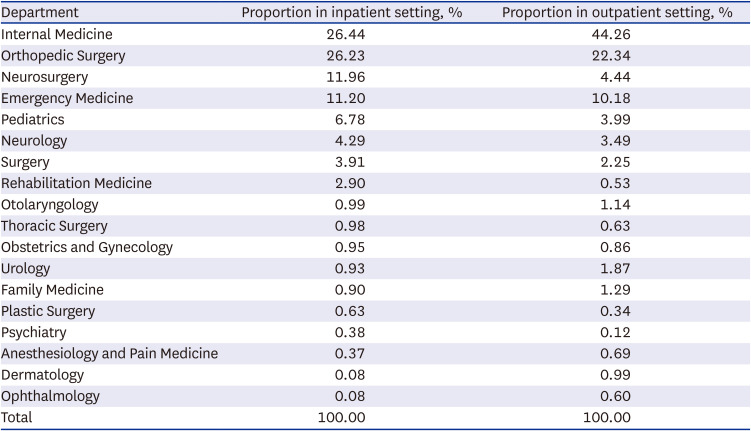
Over 50% claims with co-ordering of CRP and ESR testing were noticed in internal medicine and orthopedic surgery, followed by neurosurgery in inpatient settings, and emergency medicine in outpatient settings (Table 1). Interestingly, > 60% claims in both settings were observed with co-ordering from orthopedic surgery, neurosurgery, and plastic surgery departments. The proportion of co-ordering was higher in inpatient than in outpatient settings (Fig. 2). The number of claims with co-ordering was highest in secondary hospitals with the highest volume for CRP and ESR testing. Nevertheless, the proportion of co-ordering was highest in primary hospitals, followed by those in secondary and tertiary hospitals in both settings (Fig. 3).
A random forest analysis revealed that hospital type and department were the most significant contributing variables, followed by patient age. Department was the most significant contributor in both settings, followed by hospital type and patient age with approximately equal contributions, as indicated by the Gini index (Supplementary Fig. 1). Heatmap analysis of patient age and specialty showed that the association between older age and co-ordering was variable across specialties. However, departments with high co-ordering proportions, such as neurosurgery and orthopedic surgery, showed a high co-ordering proportion throughout all age groups. (Supplementary Fig. 2).
The concurrent testing of CRP and ESR was 46.65% in 2022. This study used nationwide data covering 98% of the Korean population5 and compared them with those in previous studies on a single insurance body or center.46789 The proportions of co-ordering CRP and ESR tests prior to intervention was observed between 28.5–48% with 48% in the largest safety net system, 28.5% in a community health system, and 31.3% in a secondary hospital in Korea.489 Considering the relatively high proportion of co-ordering CRP and ESR tests observed in this study, a national laboratory stewardship program to reduce CRP/ESR co-ordering in Korea is required. Furthermore, a potential future study on a national laboratory stewardship campaign could evaluate the rate of concurrent testing observed in this study.
A gradual increase in CRP and ESR testing was observed, except for a drop in 2020 amid the COVID-19 pandemic, probably owing to a decrease in hospital visits; overall claims decreased to 1.3 billion in 2020 and 2021 from > 1.5 billion in 2018 and 2019 in Korea. The proportion of population receiving CRP or ESR tests in the Korean insurance system was 10.8 million patients/51 million target population, which was 3.3-times higher than 1.2 million patients/19 million target population among the commercially insured population in the US. Furthermore, the total number of ESR tests was 217.02 per 1,000 patient days for inpatients and 80.28 per 1,000 hospital visits for outpatients, which were 18- and 13-times higher, respectively, than 12.02 per 1,000 patient days and 6.09 per 1,000 patient visit observed in the largest safety net health system.9 The particularly high number of CRP and ESR tests in addition to high concurrent testing necessitates a national campaign for a laboratory stewardship program in Korea to reduce the overuse of CRP and ESR tests along with their co-ordering.
More than half of the claims with co-ordering for CRP and ESR tests was noticed in internal medicine and orthopedic surgery, followed by emergency medicine and neurosurgery. This is consistent with previous reports of the relatively high co-ordering frequencies in internal medicine, rheumatology, emergency medicine, gastroenterology, and orthopedic surgery.69 The relatively high proportion of co-ordering could be influenced by specialty-related clinical situations requiring ESR testing such as the evaluation of orthopedic infections101112 and the diagnostic and monitoring criteria for rheumatic131415 and hematological diseases.16 In a study introducing diagnostic stewardship, the indications for ESR testing included giant cell arteritis, polymyalgia rheumatica, prosthetic joint infection, osteomyelitis, Hodgkin’s disease, rheumatoid arthritis, and systemic lupus erythematosus.6 Another similar study has included rheumatic diseases and active malignancies.7 Therefore, co-ordering of ESR and CRP testing is inevitable in some departments, such as rheumatology and orthopedic surgery, and orders for testing ESR should be regarded as appropriate indications for patients suspected of having these diseases.6
Laboratory stewardship programs have successfully reduced orders for ESR tests by 33–53% and co-ordering of CRP and ESR tests by 25–50%.46789 A 40% reduction in co-ordering for CRP and ESR tests may reduce the annual cost by $1,000,000 for 19 million population in the US.8 In 2022, the annual cost of ESR test in co-ordering of CRP and ESR testing was $7,600,000 in Korea. A reduction in co-ordering of CRP and ESR tests by 40–50% can save $3,200,000–3,800,000. Furthermore, unnecessary testing leads to an increase in healthcare costs and relatively high false-positive rates,117 causing clinical confusion and subsequently, unnecessary medical interventions, thereby posing potential harm to patient health.
Previous studies have presented two approaches using clinical decision support (CDS): intrusive and nonintrusive CDS. Studies using intrusive CDS have adopted indication selection when ordering ESR and elimination of the ability to concurrently order CRP and ESR testing; however, clinicians have been confused by such an approach.67 In contrast, a pop-up discouraging ESR order has been adopted when CRP and ESR are concurrently ordered in studies using nonintrusive CDS.89 Given the clinical confusion observed with intrusive CDS, encouraging the ordering of CRP alone with a nonintrusive pop-up CDS system is relatively safe when implementing a diagnostic stewardship program for reducing co-ordering of CRP and ESR testing in Korea.
This study was limited by the unavailability of data on patients’ underlying diseases; therefore, we could not discuss the appropriateness of ESR testing. In addition, the discrepancy in the patterns of health care utilization between the Korea and OECD countries may lead to discrepancies in estimating actual cost savings. Last, in some claims with both CRP and ESR tests from inpatient settings, they may have been tested separately because the HIRA data did not include the exact date and time of these tests. This could lead to overestimation of the concurrent testing status of CRP and ESR in inpatient settings.
This study indicated a considerably high number of ESR and CRP orders and frequent co-ordering of CRP and ESR tests in Korea. With appropriate measures for reducing co-ordering of CRP and ESR tests, $3.2 million can be saved in healthcare costs, and unnecessary tests or procedures can be reduced, highlighting the urgent need for diagnostic stewardship programs regarding CRP and ESR testing in Korea.


 XML Download