



 PDF
 Citation
 Print


INTRODUCTION
Polycystic ovary syndrome (PCOS) and endometriosis are prevalent gynecological disorders that significantly affect approximately 10% of women of reproductive age, including adolescents.12 The incidence of both diseases has steadily increased in recent years in developed countries, such as South Korea.34 These conditions pose substantial challenges to the overall well-being and reproductive health of women, often leading to female infertility, hormone imbalances, menstrual disorders, and ultimately impacting their quality of life, long-term health, and life expectancy.56 Moreover, both PCOS and endometriosis are associated with various comorbidities, further complicating the management of these conditions.
Despite their high prevalence and significant impact on women’s health, limited research comparing the specific comorbidities associated with PCOS and endometriosis is available. While both conditions are widely recognized as significant risk factors for women’s reproductive health, notably, the underlying mechanisms influencing fertility may differ between them.6 Infertility in women with PCOS is typically associated with anovulation, whereas in women with endometriosis, it appears to be related to abnormal folliculogenesis, oxidative stress, altered immune function, decreased ovarian reserve, and reduced endometrial receptivity.7 Furthermore, PCOS has been reportedly linked to a range of chronic cardiometabolic disorders, while endometriosis has been associated with different comorbidities, such as autoimmune diseases, asthma, allergic manifestations, and ovarian cancers, which are not typically associated with PCOS.8 There are both similarities and distinct differences in the various comorbidities associated with PCOS and endometriosis. Recent research has suggested that these two disorders represent diametric outcomes of variations in the development and activity of the hypothalamic–pituitary–gonadal (HPG) axis, resulting in opposite phenotypes.9
Recently, a number of methods have been developed to efficiently profile population-level phenotypes using electronic health records (EHRs) or health insurance claims data. One approach involves the creation of phenome-wide association study codes (phecodes), which manually classifies the International Classification of Disease (ICD) codes to distinct phenotype categories to facilitate dimensional reduction.10 This high-throughput method allows for the comprehensive characterization of a wide range of diagnoses, symptoms, and findings, enabling efficient exploration of disease associations on a large scale.11 Particularly, insurance claims dataset offer an in-depth and extensive data source for conducting large-scale association analyses among clinical phenotypes.12 Previous studies have effectively demonstrated the advancement of disease phenotyping through population-level analyses using phecodes derived from insurance claims data.131415
We aimed to explore and compare the comorbidities of PCOS and endometriosis using a large-scale insurance claims data from a nationwide representative cohort of Korean women. While previous research has identified various comorbidities associated with both conditions, there is a lack of studies specifically comparing these comorbidities within the same population. A systematic comparison of comorbidity networks may provide valuable insights into the intricate relationships between PCOS and endometriosis, potentially leading to enhanced patient care and management strategies for individuals affected by both conditions.
METHODS
Study participants
We conducted an analysis utilizing the National Health Insurance Service-National Sample Cohort (NHIS-NSC) data, obtained from the Korean National Health Insurance Service (K-NHIS), the primary governmental entity overseeing medical insurance in the Republic of Korea. The majority of Korean nationals (97.1%) are mandatory subscribers to this service, with publicly available database, accessible to medical researchers upon request. The NHIS-NSC, established and released by the K-NHIS in 2014, encompasses health insurance claims filed from January 1, 2002, to December 31, 2013. In 2002, out of the 46,605,433 eligible individuals (comprising 97.40% of the entire Korean population), 1,025,340 individuals (2.2% of the target population) were randomly selected through systematic stratified random sampling. The NHIS-NSC database offers comprehensive demographic data, diagnosis codes, use of inpatient and outpatient services, pharmacy-dispensing claims, and mortality records, thereby serving as a rich and robust resource for phenotypical analyses. Additional cohort details and sampling methodology have been described previously.16
From the NHIS-NSC database, we selected female participants diagnosed with either PCOS or endometriosis between 2002 and 2013, and who were aged between 15 and 45 years at the time of diagnosis. For baseline characteristics analyses, we included a control group of healthy individuals without either diagnosis for comparative purposes. Various types of EHRs were collected from the study participants, including their profiles with International Classification of Disease, Tenth Revision (ICD-10) codes, routine health examination data, and demographic information. To ensure the accuracy and completeness of the data, we excluded women with missing information on routine health evaluation data on body mass index (BMI), fasting glucose levels, and serum total cholesterol levels. These variables were part of the routine health evaluations provided in the NHIS-NSC database. Since not all patients underwent health checkups, there was substantial missing data for these variables. The diagnoses of PCOS and endometriosis were validated through the presence of corresponding ICD-10 codes (E28.2 for PCOS and N80.9 for endometriosis) in either inpatient or outpatient records. To establish control groups for multivariate logistic regression analyses, we created age-matched cohorts for both PCOS and endometriosis cases, each consisting of individuals without a diagnosis of the respective condition from 2003 to 2013, in a ratio of 1:20. Patients diagnosed with both PCOS and endometriosis were excluded from the logistic regression analyses to prevent potential confounding factors.
Definitions of clinical phenotypes
Following the retrieval of inpatient and outpatient ICD codes of the study participants, we mapped each ICD code to its corresponding phecode using Phecode map v1.2 to reduce dimensionality in the dataset. Phecodes are alphanumeric codes assigned to curated sets of clinical diagnoses or conditions, facilitating the efficient analysis and comparison of large-scale EHR data. Phecodes serve as a widely utilized profiling method for population-level analysis of clinical phenotype based on insurance claims data, as evidenced by numerous previous studies. Phecodes used in this study are based on ICD-10 codes. Operational definitions for the clinical phenotypes in this study are as follows. PCOS was diagnosed with ICD-10 code E28.8. Endometriosis was diagnosed with any of the ICD-10 codes: N80, N80.0, N80.1, N80.2, N80.3, N80.4, N80.5, N80.6, N80.7, N80.8, N80.9.
Additionally, we restricted our cohort to those diagnosed before the age of 45 to enhance diagnostic accuracy, reflecting the reproductive age range during which these conditions are most commonly and accurately diagnosed.
Statistical analyses
To evaluate the phenotypic differences between patients with PCOS and those with endometriosis, we conducted multivariate logistic regression analyses on each of the 1,890 clinical phenotypes defined by the phecodes within the PCOS patient group and its matched control group, as well as within the endometriosis group and its respective control group. Patients diagnosed with both PCOS and endometriosis were excluded from the analysis to explore the distinct comorbidity patterns associated with each condition. Phecodes with fewer than 50 patients were removed from the analysis to mitigate the influence of outliers. To account for multiple comparisons, we applied the Bonferroni adjustment, a stringent correction method. Clinical phenotypes exhibiting a significant association with PCOS or endometriosis were identified based on a Bonferroni-adjusted P value < 0.05, and were further ranked according to their odds ratios. The findings were visualized using a Manhattan plot generated through the PheWAS R package (R Foundation for Statistical Computing, Vienna, Austria).
RESULTS
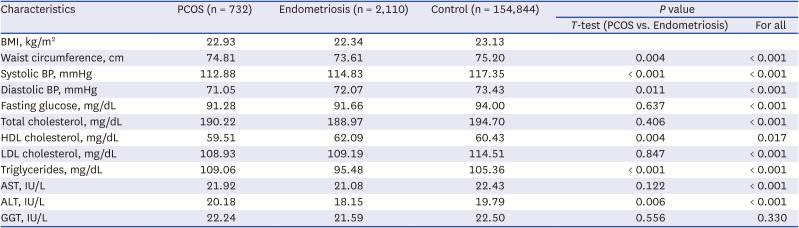
The study population comprised 801,650 Korean women aged 15–45 years sourced from the NHIS-NSC database. Following the exclusion of individuals lacking routine health examination data, a final sample size of 157,662 participants remained. Within this cohort, 732 women were diagnosed with PCOS, 2,110 women were diagnosed with endometriosis. Remaining 154,844 healthy individuals served as the control group for baseline characteristics analyses. Table 1 presents the baseline characteristics of the PCOS and endometriosis groups. Comparing the two groups, the mean BMI; waist circumference; and triglyceride, aspartate aminotransferase, and alanine transaminase levels were higher in the PCOS group compared to those in the endometriosis group. However, systolic and diastolic blood pressure, and high-density lipoprotein-cholesterol levels, were higher in the endometriosis group compared to those in the PCOS group.
Table 1
Comparison of baseline characteristics between PCOS and endometriosis groups in the Korean National Health Insurance Service sample cohort from 2003 to 2012
After excluding 24 patients diagnosed with both PCOS and endometriosis, logistic regression was conducted on 708 women with PCOS and 2,086 women with endometriosis. The control group for PCOS consisted of 14,160 healthy individuals, while the control group for endometriosis comprised 41,720 healthy individuals, selected through age-matched sampling at a 1:20 ratio. Comorbidities significantly associated with PCOS and endometriosis are represented in volcano plots (Figs. 1 and 2). Fig. 1 highlights significant comorbidities associated with PCOS, where the absolute odds ratio exceeds 2, using a comprehensive large-scale real-world data from Korean women. Fig. 2 presents regression results for various disorders correlated with endometriosis, providing insights into the multifaceted impact of this syndrome on women’s health. Additionally, in Fig. 2, the volcano plot illustrates significant comorbidities associated with endometriosis, where the absolute odds ratio exceeds 2, using a comprehensive large-scale real-world data from Korean women.


Our data-driven analyses have revealed several clinical phenotypes exhibiting significant associations with either PCOS or endometriosis, and in certain cases, both conditions. The graphical representation of the comorbidity network illustrates multiple noteworthy connections between PCOS, endometriosis, or both (Fig. 3).
Fig. 3
Graphical representation of the disease connectivity networks that present significant diseases associated with PCOS or EMS, or both in the study population.
PCOS = polycystic ovary syndrome, EMS = endometriosis, GERD = gastroesophageal reflux disease.
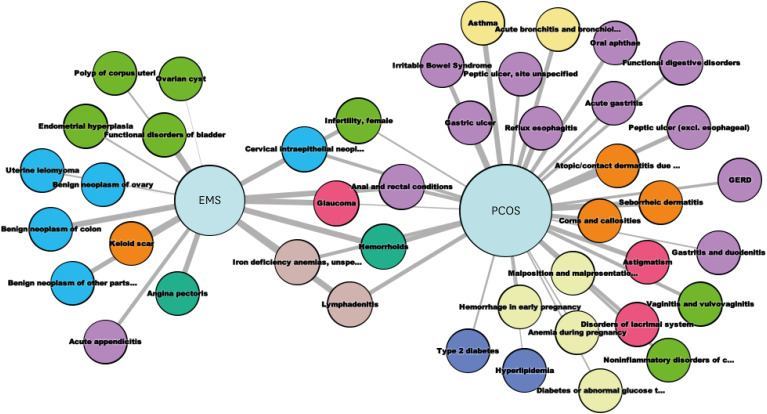
The comorbidity analysis of PCOS revealed 47 significant clinical phenotypes. Supplementary Table 1 presents the top phenotypes with the highest odds ratios associated specifically with PCOS, after adjusting for age, BMI, fasting glucose level, systolic blood pressure, and total cholesterol level. Excluding the symptom-related codes, the comorbidities exhibiting the highest odds ratios in relation to PCOS were hyperlipidemia, glaucoma, malposition and malpresentation of fetus or obstruction, anemia during pregnancy, gastritis and duodenitis, diabetes or abnormal glucose tolerance complicating pregnancy, infertility, and type 2 diabetes, listed in order of decreasing odds ratios. Among all the significant phenotypes associated with PCOS, 23.4% (11 phenotypes) were digestive disorders, 8.5% (four phenotypes) were categorized as pregnancy complications, and 12.8% (6 phenotypes) were related to genitourinary and sense organs.
The comorbidity analysis of endometriosis revealed notable connections between endometriosis and 28 significant clinical phenotypes. Excluding symptom-related codes, the highest odds ratios for comorbidities associated with endometriosis were found to be benign neoplasm of the ovary, ovarian cyst, uterine leiomyoma, polyp of corpus uteri, endometrial hyperplasia, acute appendicitis, infertility, and angina pectoris, listed in order of decreasing odds ratio (Supplementary Table 2). Among these significant phenotypes related to endometriosis, 35.7% fell under the categories of neoplasms and genitourinary disorders (five phenotypes each).
DISCUSSION
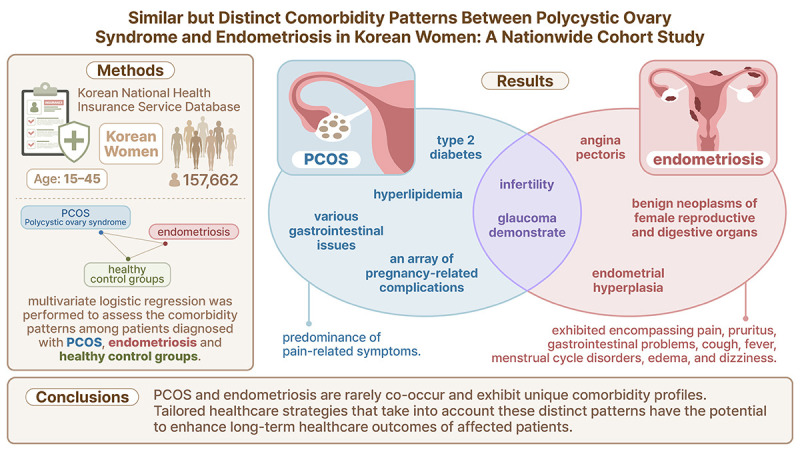
In this study, we aimed to analyze the nationwide health insurance claim data of 157,662 Korean women over a span of more than 10 years to identify distinct comorbidity patterns associated with PCOS and endometriosis, two of the most prevalent gynecological disorders among women of reproductive age. We observed differing patterns of comorbidity between PCOS and endometriosis, although they did not exhibit enough divergence to be considered completely opposite or diametric. Notably, the occurrence of dual diagnoses of PCOS and endometriosis was exceedingly rare, accounting for less than 0.02% of participants. Given the high prevalence of both PCOS and endometriosis, our findings support the hypothesis of PCOS and endometriosis as potentially diametric conditions, corroborating previous research that indicated a co-occurrence rate much lower than expected by chance.9
Table 1 shows that while the absolute differences in some baseline characteristics between the two groups might appear small, their statistical significance suggests meaningful differences.
Our results align with prior research regarding the association between PCOS and metabolic disorders, such as hyperlipidemia, abnormal glucose tolerance complicating pregnancy, gestational diabetes, and type 2 diabetes.417 Notably, these metabolic disorders, which contribute to increased cardiovascular risk, were not observed as comorbidities with endometriosis in our analysis. In contrast, angina pectoris was found to be closely associated with endometriosis rather than PCOS in this study. These results suggest potential divergent pathophysiologic mechanisms in the association of PCOS and endometriosis with cardiovascular health. A recent systematic review and meta-analysis demonstrated that endometriosis elevates the risk of ischemic heart and cerebrovascular diseases, with underlying mechanisms presumed to involve systemic inflammation, increased oxidative stress, or endothelial dysfunction. These mechanisms contrast with the metabolic dysfunctions associated with PCOS.18
As anticipated, infertility was identified as a common comorbidity of both PCOS and endometriosis. The comorbidity list for endometriosis included several diagnostic codes for gynecological and gastrointestinal (GI) nonmalignant lesions. While there have been reports suggesting that women with endometriosis may have an elevated risk of benign tumors such as uterine leiomyomas,19 it is also conceivable that these lesions were more readily diagnosed due to their discovery during imaging workups or surgical procedures for endometriosis. Interestingly, endometrial hyperplasia, typically considered a complication of PCOS,20 was also among the comorbidities associated with endometriosis. A recent study reported an elevated risk of developing endometrial hyperplasia and cancer in women with endometriosis, highlighting the need for further research in this area.2122
Notably, glaucoma has not been widely recognized as a common comorbidity of PCOS or endometriosis. Nonetheless, this study reveals a significant association between both conditions and glaucoma. Recent studies have suggested that women with PCOS may experience elevated intraocular pressure, potentially attributed to high testosterone levels.23 Similarly, elevated intraocular pressure and subsequent development of glaucoma in women have been linked to increased testosterone levels.24 Furthermore, regular oral contraceptive use, a common treatment for both PCOS and endometriosis, has been reported to be associated with an increased risk of glaucoma.252627 Second, PCOS was significantly associated with GI tract comorbidities, including gastritis, gastroesophageal reflux disease, gastric ulcers, and irritable bowel syndrome. While a few studies have noted associations between PCOS and various GI issues,28 the use of oral contraceptives may confound these findings. Third, our results indicate that PCOS is significantly linked to various pregnancy-related complications. Although a few studies have reported certain maternal complications in pregnant women with PCOS,29 the associations between PCOS and fetal malposition, anemia during pregnancy, and hemorrhage during early pregnancy have not been extensively addressed. Finally, when comparing symptom-related codes registered in women with each disease, it was observed that endometriosis primarily manifests pain-related symptoms, whereas PCOS presents a wider range of symptoms, including pain, pruritus, GI problems, cough, fever, menstrual cycle problems, edema, and dizziness. However, further comprehensive longitudinal studies are required to validate these findings.
Both PCOS and endometriosis involve alterations in the HPG axis, yet their underlying pathophysiological mechanisms differ. Dinsdale and Crespi930 recently hypothesized that PCOS and endometriosis exhibit opposite comorbidities, substantiated by evidence that endometriosis is mediated by low prenatal testosterone levels, whereas PCOS is associated with high prenatal testosterone.31 In PCOS, elevated androgen levels are a hallmark feature that also contribute to increased visceral adiposity and insulin resistance.32 These factors collectively increase the risk of metabolic comorbidities such as hyperlipidemia, type 2 diabetes, and gestational diabetes,33 which are identified as common conditions associated with PCOS in this study. However, some evidence indicates a correlation between endometriosis and lower levels of pre and postnatal testosterone, which are associated with higher levels of proinflammatory cytokines.34 Reduced testosterone levels and systemic inflammation are reportedly associated with an increased risk of ischemic cardiovascular disease in women.35 However, many variables regarding the pathophysiology of PCOS and endometriosis remain unknown, and further research is needed to verify hypotheses based on prenatal testosterone levels.9 To the best of our knowledge, this is the first study to examine and compare various comorbidities between PCOS and endometriosis using large-scale national representative cohort data from Korean women of reproductive age. Our study provides valuable insights into the associated clinical conditions with both PCOS and endometriosis among this homogenous population. Our results reveal several significant phenotypes associated with either or both disorders, suggesting that the pathophysiology of these conditions is intricate and influenced by multiple factors rather than being directly opposite or mutually exclusive.
Our study is constrained by a few limitations that warrant consideration. First, the cross-sectional design precludes the establishment of causal relationships, and the absence of sex hormone level data in the NHIS-NSC database limits the depth of our analysis. Second, despite adjusting for multiple confounding variables, there remains a potential for unaccounted confounders, such as medical treatment history including the use of combined oral contraceptives. Third, the reliance on insurance claim datasets within EHRs introduces the risk of coding inaccuracies, with the validity of ICD codes reported to vary substantially across diagnoses, institutions, and patient cohorts. This variability may arise from human error, incomplete entries, or financial incentives influencing coding practices. Moreover, our filtering process, although designed to enhance specificity, may introduce bias by excluding phenotypes represented by fewer than 100 cases. Lastly, the use of Bonferroni adjustment for multiple comparisons, while rigorous, may be overly conservative and risk false negatives. Future research employing longitudinal designs and more comprehensive datasets is needed to corroborate our findings.
Our data-driven analyses revealed that PCOS and endometriosis, two of the most prevalent reproductive disorders in women, rarely co-occur and demonstrate distinct patterns of associated comorbidities among Asian women. Healthcare providers should take these findings into consideration when designing long-term healthcare and screening programs tailored to address the specific needs of patients with these conditions. Further research is needed to validate the underlying mechanisms of our findings and explore potential contrasting comorbidity profiles between PCOS and endometriosis.
 XML Download