



 PDF
 ePub
 Citation
 Print


Abstract
Purpose
This research was done to compare obstetric pain, anxiety and cervical dilatation between an epidural analgesia group and a control group.
Methods
Participants were assigned to the experimental or control group depending on their decisions for pain relief. Subjective / objective obstetric pain, anxiety level and cervical dilatation were measured and ANOVA was used for comparison of groups and paired t-test to make pre-post comparisons.
Results
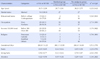
Homogeneity of pain, anxiety and cervical dilatation were assessed at the latent phase. Cervical dilatation was larger in the control group than the experimental group, at both the active and the transitional phase (F=22.9, p<.001; F=39.9, p<.001 respectively). The degree of pain and anxiety were not significantly different between the groups. Within the experimental group, subjective / objective pain and anxiety level were significantly lower postanalgesia compared to pre-analgesia in the active phase. All variables, except for sweating in the objective pain measurement, changed significantly at the transient phase.
Figures and Tables



Summary Statement
▪ What is already known about this topic:
In a Cochrane review involving 9,658 women, epidural analgesia was found to offer better pain relief, a reduction in the need for additional pain relief.
▪ What this paper adds:
Epidural analgesia seems to have an adverse effect to delay on cervical dilatation at first stage.
▪ Implications for practice education and/or policy:
RN in delivery room might apply non-phamacolgical pain control such as massage to relieve labor pain and to stimulus cervical dilatation.
References
1. Ahn SH, Ryu GS, Chung ES. Differences in physical discomfort and childbirth satisfaction between primiparous women with and without having taken epidural analgesia. Korean Journal of Women Health Nursing. 2003. 9:235–244.

2. Alexander JM, Sharma SK, McIntire DD, Leveno KJ. Epidural analgesia lengthens the Friedman active phase of labor. Obstetrics and Gynecology. 2002. 100:46–50.
3. Alipour Z, Lamyian M, Hajizadeh E. Anxiety and fear of childbirth as predictors of postnatal depression in nulliparous women. Women and Birth, September 27. 2011. Retrieved Feb 23, 2012. [Epub ahead of print]. from http://www.ncbi.nih.gov/pubmed/21959041.
4. Anim-Somuah M, Smyth R, Howell C. Editorial Group: Cochrane pregnancy and childbirth group. Epidural versus non-epidural or no analgesia in labour. 2009. http://dx.doi.org/10.1002/14651858.
5. Beijers R, Jansen J, Riksen-Walraven M, de Weerth C. Maternal prenatal anxiety and stress predict infant illnesses and health complaints. Pediatrics. 2010. 126:e401–e409.
6. Chestnut DH. Epidural analgesia and the incidence of cesarean section. Anesthesiology. 1997. 87:472–476.
7. Diego M, Jones N, Field T, Hernandez-Rief M, Schanberg S, Kuhn C, et al. Maternal psychological distress, prenatal cortisol, and fetal weight. Psychosomatic Medicine. 2006. 68:747–753.
8. Faul F, Erdfelder E, Buchner A, Lang AG. Statistical power analyses using G*Power 3.1: Tests for correlation and regression analyses. Behavior Research Methods. 2009. 41:1149–1160.
9. Han DW, Lee CH, Tak JG. Standardization of state-trait anxiety inventory. HaksaengJidoYeongu. 1993. 10:214–222.
10. Hawkins JL. Epidural analgesia for labor and delivery. New England Journal of Medicine. 2010. 362:1503–1510.
11. Kim SJ, Choi PS, Jeon HS, Hong HJ, Chung DY. A study of the effects of epidural analgesia on the course of labor and delivery mode. Korean Journal of Obstetrics & Gynecology. 2001. 44:1783–1789.
12. Kim SY, Kim JH, Kang YI, Kim MH, Bang EC, Lee HS, et al. Effect of obstetric epidural anesthesia on the progress of labor. Korean Journal of Obstetrics & Gynecology. 2000. 43:2215–2219.
13. Korean Society of Obstetrics and Gynecology. Obstetrics. 2007. 4th ed. Seoul: Koonja.
14. Kukulu K, Demirok H. Effects of epidural anesthesia on labor progress. Pain Management Nursing. 2008. 9:10–16.
15. Lang AJ, Sorrell JT, Rodgers CS, Lebeck NM. Anxiety sensitivity as a predictor of labor pain. European Journal of Pain. 2006. 10:263–270.
16. Lee JJ. Effect of relaxation on pain and anxiety during insertion of a vaginal speculum. 2001. Daegu: Keimyung University;Unpublished master's thesis.
17. Lee SW, Yang JH, Cho HJ, Hong DS, Kim MY, Ryu HM, et al. The effects of epidural analgesia on labor progress and perinatal outcomes. Korean Journal of Obstetrics & Gynecology. 2007. 50:1330–1335.
18. Lowdermilk D, Perry SE. Maternity and women's health care. 2004. 8th ed. St. Louis: Mosby.
19. McLachlan E. Recognizing pain. American Journal of Nursing. 1974. 74:496–497.
20. National Collaboration Center for Women's and Children's Health. Intrapartum care: Care of healthy women and their babies during childbirth. NICE clinical guidelines, No. 55. 2007. Retrieved Nov 09, 2011. London: RCOG Press;ISBN-13: 978-1-904752-36-3. from http://www.nice.org.uk/nicemedia/pdf/CG55FullGuideline.pdf.
21. Poole JH. Analgesia and anesthesia during labor and birth: Implications for mother and fetus. Journal of obstetric, gynecologic, and neonatal nursing : JOGNN / NAACOG. 2003. 32:780–793.
22. Saito M, Okutomi T, Kanai Y, Mochizuki J, Tani A, Amano K, et al. Patient-controlled epidural analgesia during labor using ropivacaine and fentanyl provides better maternal satisfaction with less local anesthetic requirement. Journal of Anesthesia. 2005. 19:208–212. http://dx.doi.org/10.1007/s00540-005-0316-2.
23. Smith CA, Levett KM, Collins CT, Crowther CA. Relaxation techniques for pain management in labor. The Cochrane Database of Systematic Reviews [electronic resource]. 2011. (12):CD009514.
24. Smith CA, Levett KM, Collins CT, Jones L. Massage, reflexology and other manual methods for pain management in labor. The Cochrane Database of Systematic Reviews [electronic resource]. 2012. 2:CD009290.
25. Spielberger CD. Anxiety as an emotional state: current trend in theory and research. 1975. Vol 1. New York: Academic Press.
26. Sun WH, Choi HM, Kim JW. The influence of epidural anesthesia on the progress of labor and perinatal outcomes. Korean Journal of Obstetrics & Gynecology. 2003. 46:1099–1103.
27. Wong CA. Advances in labor analgesia. International Journal of Women's Health. 2010. 1:139–154.
28. Yoshioka T, Yeo S, Fetters MD. Experiences with anesthesia of Japanese women who had childbirth in the United States. 2012. Retrieved Feb 23, 2012. from http://www.ncbi.nih.gov/pubmedhealth/.
 XML Download