



 PDF
 ePub
 Citation
 Print


INTRODUCTION
Diabetes is associated with poor clinical outcomes in acute myocardial infarction (AMI). Diabetic patients are at increased risk of acute heart failure, cardiogenic shock, re-infarction, and death after AMI than non-diabetic patients (1-3). It has been suggested that hyperglycemia as well as other factors of diabetes, including dyslipidemia, accelerated platelets aggregation and endothelial dysfunction, may contribute to poor outcomes (4, 5).
Although it has widely been recognized that mid- or long-term outcomes of AMI are poorer in diabetic patients than in non-diabetic patients (6-8), results on the effects of diabetes on short-term outcomes in AMI are still in conflict (1, 2, 9-12). In addition, despite technical advances in management and improvement of the mortality of AMI over the last decade, there have been few studies on the effects of diabetes on the prognosis of AMI patients who have undergone percutaneous coronary intervention (PCI) with drug-eluting stent (DES).
In this study, we compared short- and mid-term clinical outcomes of AMI between diabetic and non-diabetic patients and assessed the effects of diabetes on prognosis over time course after AMI onset in the DES era with a relatively large sample.
MATERIALS AND METHODS
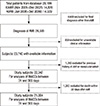
This study method, including patient enrollment, have recently been described in previous studies (13, 14). In brief, the Korea Acute Myocardial Infarction Registry (KAMIR) and, the Korea Working Group on Myocardial Infarction (KorMI) registry were established, with support from the Korean Society of Cardiology in November 2005, for prospective, open, observational, multicenter studies of AMI, including assessment of clinical outcomes. Between October 2005 and December 2009, AMI patients registered on the KAMIR and KorMI databases were enrolled in this study. Between November 2005 and December 2009, a total of 24,599 patients with AMI were identified from the KAMIR and KorMI database. Of these patients, 859 who had insufficient clinical information and 1,393 who had a history of AMI and/or coronary revascularization were excluded, and the remaining 22,347 patients were analyzed. Of these 22,347 patients, 79.2% underwent successful PCI, and 91.3% of whom received DES implantation. Since 1,283 patients (5.7%) died within 30 days of AMI, 21,064 patients who survived 30 days were included for the analysis of MACEs between 31 and 365 days of AMI. The flow chart for patient enrollment is shown in Fig. 1. AMI was diagnosed based on the patient's symptoms, cardiac enzyme elevation and electrocardiogram changes. Diabetes was defined by a previous history of diabetes or anti-diabetic medication. Demographic and clinical characteristics, including age, sex, body mass index (BMI), smoking status, a history of hypertension, dyslipidemia and ischemic heart disease, were identified. Systolic/diastolic blood pressure and heart rate were checked by trained nurses and left ventricular ejection fraction was determined by 2-dimensional echocardiography. The Killip classification was applied based on the presence of heart failure, acute pulmonary edema and shock at initial admission (15). Blood samples for baseline laboratory tests other than lipid measurement were collected at admission before initial treatment. Overnight fasting blood was also sampled for lipid levels. The initial treatment strategy for AMI patients was determined by the attending physicians based on guideline's recommendations. Multi-vessel disease was defined as 70% or more stenosis in at least 2 major epicardial coronary arteries or 50% or more stenosis of the left main coronary artery. Patients visited hospitals for follow-ups at 1, 6 and 12 months. The information on major adverse cardiac events (MACEs), including all causes of death, recurrent MI and revascularization (coronary bypass surgery or PCI), were collected by medical record review or telephone interviews if necessary. Only the first MACE was considered as the MACE of a patient. All data were entered in an electronic web-based case-report form.
Statistical analysis
Data were expressed as mean±standard deviation for continuous variables and percentages for categorical variables. Baseline clinical characteristics of diabetic and non-diabetic patients were compared with Pearson's chi-square tests for categorical variables or Student's t tests for continuous variables. Multivariate Cox proportional hazards regression analyses were performed to determine independent variables associated with short- and mid-term MACEs. All variables were entered en block, and the results were expressed as a hazard ratio (HR) with a 95% confidence interval (CI). Variables entered in the multivariate models were age, sex, BMI, a history of hypertension, dyslipidemia and ischemic heart disease, smoking status, Killip stage, multi-vessel disease, left ventricular ejection fraction and serum creatinine level. To assess the effects of diabetes on prognosis over the course of time after AMI onset, landmark analyses were performed with the pre-specified windows of AMI onset to day 30 and 365 (16). For landmark analyses from day 31 to 365, all 30-day survivors were included, regardless of whether MACEs had occurred during the first 30 days. For adjustment for confounding factors, we generated Cox regression survival plots instead of Kaplan-Meier curves. Propensity score matching using 1:1 nearest neighbor method was used to correct baseline characteristics for the comparison of outcomes between patients with and without diabetes. Baseline characteristics of study patients after 1:1 matching were shown in supplementary Table 1. Because missing data analysis showed monotonicity in the distribution of missing values, 129 patients with multiple missing values were excluded from the study (13). Missing binary data, whose proportion did not exceed 2% for each covariate, were then coded as absent and may have biased relationships between covariates and outcomes toward the null. A value of P < 0.05 was considered significant. All statistical analyses were performed using SPSS 16.0 (SPSS Inc, Chicago, IL, USA).
RESULTS
Baseline clinical characteristics
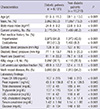
Of the total 22,347 patients, 6,131 (27.4%) had diabetes. Clinical characteristics at initial presentation of both diabetic and non-diabetic patients are shown in Table 1. Diabetic patients were significantly older, were more often women and had more unfavorable cardiovascular risk factors, such as high BMI, hypertension, dyslipidemia and ischemic heart disease, than non-diabetic patients (P < 0.05). Diabetic patients had lower left ventricular systolic function and more often presented with higher Killip classes and multi-vessel coronary disease than non-diabetic patients (P < 0.05). Serum cholesterol profiles and renal function were worse in diabetic patients (P < 0.05).
Clinical outcomes between diabetic and non-diabetic patients
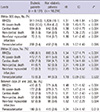
During the 1-yr of study period, a total of 2,547 patients (11.3%) suffered from MACEs. The total MACE and each component of MACEs occurred more frequently in diabetic patients (P < 0.05 for each) during 1-yr. Short-term MACEs, which occurred within 30 days of AMI onset, were observed in 1,364 patients (6.1%). The incidence of short-term MACEs was significantly higher in diabetic patients than in non-diabetic patients (8.1% vs 5.3%, P < 0.001). Among 30-day survivors, mid-term MACEs, which occurred between days 31 and 365 after AMI onset, were observed in 1,181 patients (5.4%). The incidence of mid-term MACEs was significantly higher in diabetic patients than in non-diabetic patients (6.7% vs 4.8%, P < 0.001). All these results are represented in Table 2.
Independent effects of diabetes on clinical outcomes
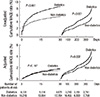
Differences in the occurrence of MACEs over time were compared using Cox regression models. In univariate Cox regression models, diabetes was significantly associated with all MACEs within 365 days (HR, 1.51; 95% CI, 1.40-1.64; P < 0.001), short-term MACEs within 30 days (HR, 1.54; 95% CI, 1.37-1.71; P < 0.001), and mid-term MACEs between days 31 and 365 (HR, 1.48; 95 CI: 1.31-1.67; P < 0.001) (Table 2). Multivariable analyses using Cox proportional hazards models were performed to identify the independent effects of diabetes on clinical outcomes after AMI (Table 3). After adjustment for confounders, diabetes was an independent predictor of all MACEs within 365 days (HR, 1.23; 95% CI, 1.09-1.39; P = 0.001) and MACEs between days 31 and 365 (HR, 1.25; 95% CI, 1.08-1.45; P = 0.002) but not for MACEs within 30 days (HR, 1.16; 95% CI, 0.93-1.44; P = 0.167). Cox regression plots showed that the unadjusted incidence of MACEs within 30 days was significantly higher in diabetic patients than in non-diabetic patients. However, after adjustment for confounders, the incidence of MACEs was similar between diabetic and non-diabetic patients, showing virtually identical survival curves. Cox regression plots on the incidence of MACEs between days 31 and 365 demonstrated that the incidence was significantly higher in diabetic patients than in non-diabetic patients, which remained even after adjustment for confounders (Fig. 2). Old age, high Killip stage, low ventricular systolic function, high serum creatinine level and multi-vessel disease were other independent MACE predictors of both short- and mid-term clinical outcomes (data not shown).
Comparisons of short- and mid-term outcomes between patients with and without diabetes were also performed using 1:1 (n = 3,319 in diabetics versus n = 3,319 in non-diabetics) propensity score matching. Supplementary Table 1 shows baseline clinical characteristics of matched patients. After matching, the distribution of risk factors in patients with and without diabetes became more similar than before matching. Multiple Cox regression analyses were performed using these matched patients. The results showed that diabetes was an independent predictor of mid-term clinical outcomes between 30 and 365 days (HR, 1.34; 95% CI, 1.10-1.63; P = 0.003) but not of short-term outcomes within 30 days (P = 0.383). These findings were similar to the results obtained before matching.
When our data were analyzed by patient groups according to coronary stent types, similar results were obtained: diabetes was an independent risk predictor of mid-term clinical outcomes between 30 and 365 days (HR, 1.21; 95% CI, 1.01-1.44; P = 0.032 in DES group, HR, 1.74; 95% CI, 1.17-2.59; P = 0.006 in BMS [bare-metal stent] group) but not of short-term outcomes within 30 days after AMI in both DES and BMS groups (P = 0.087, 0.858 in DES and BMS group, respectively).
DISCUSSION
Using unselected and consecutive patients of AMI from a large number of different hospitals, our study showed that the prognostic effects of diabetes were different on short- and mid-term outcomes in AMI. Diabetes was an independent risk factor for mid-term MACEs between days 31 and 365 but was not associated with short-term MACEs within 30 days of AMI.
Results from different studies are conflicting regarding differences in short-term outcomes following AMI between diabetic and non-diabetic patients. Some studies have reported that diabetic patients have poor short-term outcomes following AMI (17-19), whereas, others have reported no differences in short-term prognosis between diabetic and non-diabetic patients, which is consistent with our results (10-12, 20). The discrepancy between previous studies and ours may be explained by several reasons. Those studies were mainly conducted in the pre-DES era (10, 13, 17, 19, 21), and they did not investigate the independent effect of diabetes (17, 19). In addition, the data were largely collected from clinical trials (11, 18-20), and some of them did not adjust for confounders (10). Furthermore, differences in study design, case definition and study population may have contributed to discrepancies among studies. Unlike previous studies, ours has strengths in terms of nationwide estimates with a large sample size, unselected population, use of current treatment strategies with DES and proper adjustment for major potential confounders. In our study, diabetes was a risk factor for 30-day MACEs in univariate analyses but was not associated with MACEs after adjustment for confounders. Independent short-term MACE predictors were old age, high Killip stage, low left ventricular systolic function, high serum creatinine level and multi-vessel disease (data not shown), which is consistent with the results of other studies (15, 17, 21-23).
Most of the AMI complications occur during initial hospitalization and the mortality rate is the highest in this period. Numerous studies have suggested that short-term prognosis (mostly within 30 days of AMI) is determined in part by LV dysfunction, residual ischemia and electrical instability which are related to the severity of the initial event (15, 17, 21-23). Predictors of mid- or long-term outcomes may differ from those of short-term outcomes. It has been suggested that commonly employed methods for evaluating risk factors for clinical outcomes, which do not exclude short-term outcomes (10, 18, 20, 23-25), may fail to find specific factors that significantly affect outcomes beyond the acute phase (26, 27). Therefore, we selected day 30 as a cut-off for landmark analyses in order to precisely assess long-term MACEs by completely excluding the effect of short-term MACEs. This enables us to verify that diabetes is a significant predictor of mid-term poor outcomes. In this study, during the 1-year study period, more than half of all MACEs (53%) occurred within 30 days of AMI, and these events were not included during the analysis of long-term MACEs. When we performed analyses without stratification by the landmark time point, diabetes was an independent predictor of 1-year MACEs, which is in line with those of previous reports (18, 20, 23, 25). Similar to our study, several other studies have shown the differential effects of diabetes on short- and long-term prognosis in AMI; however, they did not exclude short-term events when they have assessed mid- or long-term outcomes (10, 20). To the best of our knowledge, this is the first study regarding differential effects of diabetes on adverse outcomes using landmark analyses with reference to a specific time point after AMI onset.
Apart from conflicting results regarding the effects of diabetes on the short-term outcomes of AMI, deleterious effects of diabetes on mid- or long-term outcomes in AMI patients have consistently been reported (6, 7). Underlying mechanisms of diabetes can cause atherosclerotic cardiovascular disease, leading to poor mid- or long-term outcomes in AMI patients are multi-factorial. Principal mechanisms include hyperglycemia, endothelial dysfunction, dyslipidemia, promotion of coagulation and increased systemic inflammation induced by diabetes (4, 5). In addition, increased susceptibility to myocardial pump failure, re-infarction (3), and combined risk factors, such as hypertension plus central obesity, result in the development of cardiovascular disease, which may contribute to poor outcomes in diabetic patients.
In our study, the relatively high prevalence of diabetes in AMI patients (27.4%) is within the previously reported range of 14% to 34% (18, 24, 28). The diabetic patients also had more traditional risk factors, such as high BMI, hypertension, dyslipidemia and previous history of ischemic heart disease (24, 29). Each condition also partially influences atherosclerotic cardiovascular disease and adverse outcomes as mentioned above. Therefore, we adjusted for these factors using multivariable Cox regression models in order to assess the independent effects of diabetes. Even after adjustment for these baseline risk factors, diabetes turned out to be an independent predictor of mid-term MACEs in AMI patients.
The higher incidence of long-term adverse events in diabetic patients strongly emphasizes the importance of vigorous preventive measures by modification of risk factors. A recent study has shown that diabetic patients have a high prevalence of adverse lifestyles and modifiable risk factors, such as smoking, obesity, hypertension and hypercholesterolemia at least 6 months after hospitalization due to ischemic heart disease and that because special attention has not been focused on these factors the prevention and management of these factors may not be feasible (30). Comprehensive care of AMI patients with diabetes is challenging and complex, however, a long-term, intensive approach using lifestyle modifications and pharmacologic interventions may result in a significant reduction in cardiovascular complications (11).
The results of this study are subject to several limitations. First, this is an observational study but not a randomized study. Second, information on the types and duration of diabetes and the method for management of diabetes is lacking. Third, we did not give detailed information on therapies or interventions after discharge, which could have generally influenced clinical outcomes. Fourth, since the causes of death were not identified, we could not elucidate the extent to which the correlations between diabetes mellitus and clinical outcomes were influenced by concomitant non-cardiac morbidity. Finally, some clinical events may not have been detected.
In conclusion, diabetes is a poor prognostic factor for mid-term MACEs but not for short-term MACEs after AMI onset. This result can provide insight into differential effects of diabetes on clinical outcomes of AMI patients in a time-dependent manner. Careful monitoring and intensive management of diabetic patients should be considered even after the acute stage of AMI.
 XML Download