



 PDF
 ePub
 Citation
 Print


Abstract
Purpose
To assess the accuracy of estimating postoperative deviation in large-angle exotropia over 40 prism diopters (PD).
Methods
A retrospective analysis was performed on 61 exotropia patients with over 40 PD exotropia who had undergone 2-muscle surgery by two surgeons and with at least 6 months follow-up. The accuracy was assessed by analyzing the discrepancy between preoperatively predicted residual deviation and deviation at postoperative 6weeks. Successful surgery was defined as deviation within ± 10 PD at the last postoperative visit.
Results
More accurate residual deviation was predicted in exotropia with prism diopters between 40 and 59 (97.8%) than in exotropia with 60 PD or more (62.5%). And there was no significant difference between two surgeons. Surgical success rates at six months and one year after surgery were 96.8%, 94.7% in exotropia with 40 to 49 PD, 71.4%, 60.0%, 50 to 59 PD, 50.0%, 45.5%, 60 PD or more, respectively. There were four patients of whom the postoperative deviation angle ex-ceeded more than 10 PD of the estimated deviation.
References
1. Lew HL, Lee JB, Kim TK. Comparison of surgical results between bilateral rectus muscle recessions and lateral rectus muscle recession and medial rectus muscle resection in exotropia. J Korean Ophthalmol Soc. 1995; 36:115–9.
2. Im SK, Park SW, Park YG. Effects of bilateral lateral rectus recession and unilateral recession-resection in large angle exotropia. J Korean Ophthalmol Soc. 2004; 45:990–4.
3. Livir-Rallatos G, Gunton KB, Calhoun JH. Surgical results in large-angle exotropia. J AAPOS. 2002; 6:77–80.

4. Azar RF. Surgical management of exotropia exceeding 70 prism diopters. Ann Ophthalmol. 1971; 3:159–66.
5. Park YG, Min BM. The effects of bilateral recti recessions over 8mm in exotropia over 40 prism diopters. J Korean Ophthalmol Soc. 1994; 35:1123–6.
6. Schwartz RL, Calhoun JH. Surgery of large angle exotropia. J Pediatr Ophthalmol Strabismus. 1980; 17:359–63.
7. Thompson JT, Guyton DL. Ophthalmic prisms. Measurement errors and how to minimize them. Ophthalmology. 1983; 90:204–10.
8. Wright KW. Color atlas of ophthalmic surgery Strabismus. 1st ed.Philadelphia: Lippincott company;1991. p. 241–3.
9. Scott WE, Keech R, March AJ. The postoperative results and stability of exodeviations. Arch Ophthalmol. 1981; 99:1814–8.
10. Park YH, Kim MM. Surgical results of intermittent exotropia. J Korean Ophthalmol Soc. 1989; 30:969–74.
11. Urist MJ. Exotropia with bilateral elevation in adduction. II. Surgery. Am J Ophthalmol. 1954; 38:178–90.
12. Lim HS, Seo SW, Lee JH. Comparison of surgical results between bilateral rectus muscle recession and lateral rectus muscle recession and medial rectus muscle resection in exotropia over 40 prism diopters. J Korean Ophthalmol Soc. 1998; 39:2810–5.
13. Kim JW, Rah SH, Lee JH. The surgical treatment of exotropias of 60 prism diopters or more. J Korean Ophthalmol Soc. 1997; 38:2200–6.
14. Kim SJ, Lee WS. Clinical analysis of surgical results in aberrations. J Korean Ophthalmol Soc. 1992; 33:724–32.
15. Kim MM, Cho ST. Long – term surgical results of intermittent exotropia. J Korean Ophthalmol Soc. 1994; 35:1321–6.
16. Hahm KH, Shin MC, Sohn MA. The change in deviation angle with time course after surgical correction of intermittent exotropia. J Korean Ophthalmol Soc. 2002; 43:2214–9.
Figure 1.
Scatter diagram of difference between estimated residual deviation and actual residual deviation.
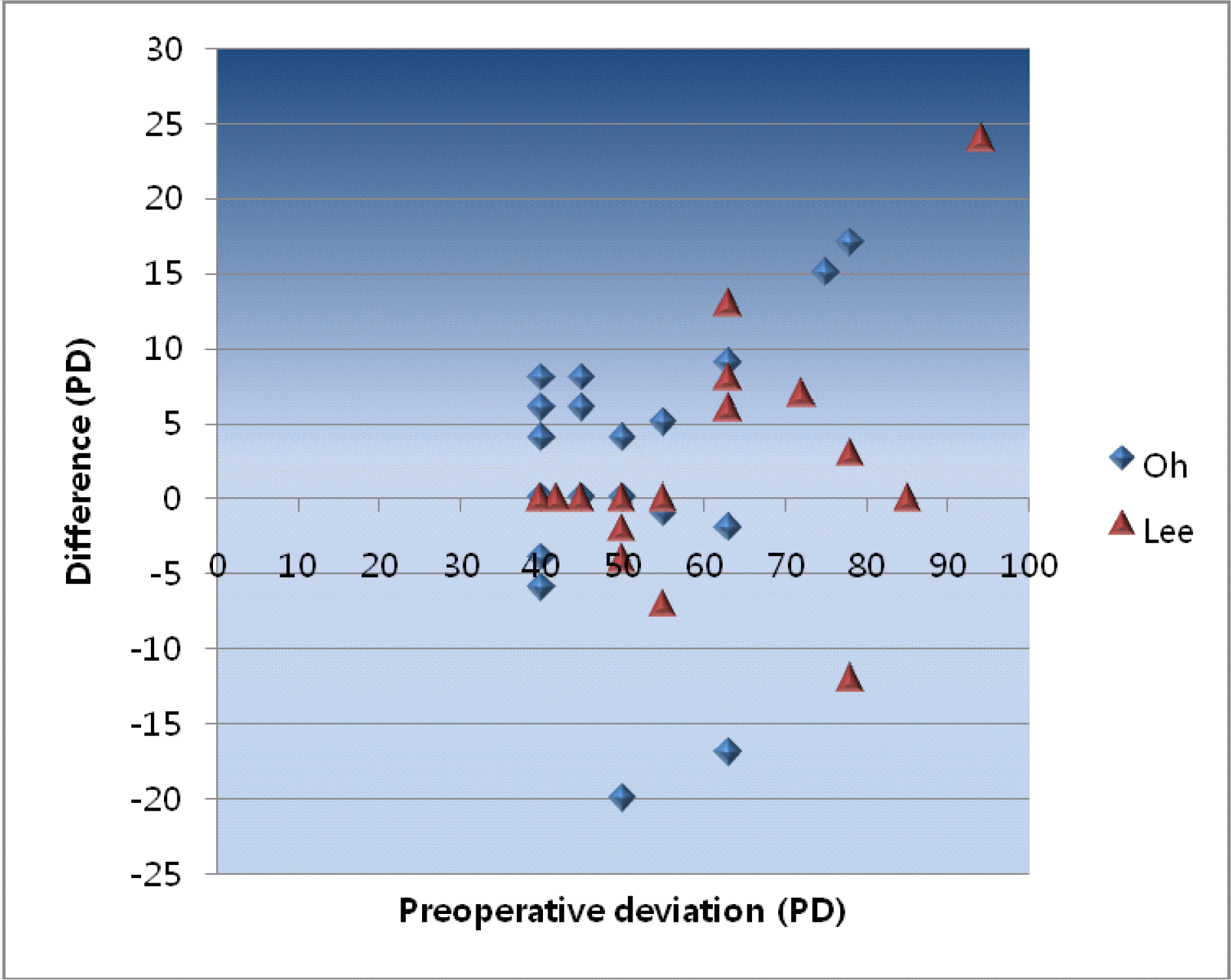
Table 1.
Surgical guidelines
| Deviation (PD*) | Bilateral recession of lateral rectus | Unilateral recession of lateral rectus/ resection of medial rectus | Bilateral resection of medial rectus |
|---|---|---|---|
| 40PD | 8.0∼8.5 mm | 8.0∼8.5 mm/5.0∼5.5 mm | 5.5 mm |
| 45PD | 9.0 mm | 8.5∼9.0 mm/5.5∼6.0 mm | ⋅ |
| 50PD | ⋅ | 9.0 mm/5.5∼6.0 mm | 6.0 mm |
| 55PD | ⋅ | 8.5∼9.5 mm/6.0 mm | ⋅ |
| > 60PD | ⋅ | 9.0∼10.0 mm/6.0∼6.5mm | 6.0 mm |
Table 2.
Demographics of patients with large angle exotropia
| | Oh† | Lee† | Total |
|---|---|---|---|
| Number of patients | 37 | 24 | 61 |
| Age (year) (range) | 29.9 ± 16.3 (3–62) | 38.3 ± 3.4 (7–74) | 33.2 ± 16.8 (3∼74) |
| Sex (male/female) | 17/20 | 13/11 | 30/31 |
| Preoperative deviation (PD*, Mean±SD) | 49.1 ± 10.6 (40–78) | 56.2 ± 15.2 (40–94) | 51.9 ± 13.0 (40∼94) |
| Corrected deviation (PD*, Mean±SD) | 46.8 ± 9.5 (30–72) | 51.6 ± 10.2 (40–84) | 48.7 ± 10.0 (30∼84) |
| Follow-up (months) | 17.8 ± 13.5 (6–48) | 8.8 ± 5.2 (6–30) | 14.3 ± 11.8 (6∼48) |
Table 3.
Discrepancy between preoperatively estimated residual deviation and residual deviation at postoperative 6 weeks in exotropiaexperimental with over 40PD
| Preoperative deviation | Operator | Number of patients | Amount of deviation to correct (PD*) |
Discrepancy between estimated residual and postoperative deviations No. (%) |
||
|---|---|---|---|---|---|---|
| within ±10PD | Overcorrected‡ | Undercorrected§ | ||||
| 40 | Oh† Lee† | 134 | 40 | 13 (100) 4 (100) | 0 (0) 0 (0) | 0 (0) 0 (0) |
| 45 | Oh Lee | 10 4 | 45 | 10 (100) 4 (100) | 0 (0) 0 (0) | 0 (0) 0 (0) |
| 50 | Oh Lee | 3 6 | 50 | 2 (66.7) 6 (100) | 0 (0) 0 (0) | 1 (33.3) 0 (0) |
| 55 | Oh Lee | 3 2 | 50 or 60 | 3 (100) 2 (100) | 0 (0) 0 (0) | 0 (0) 0 (0) |
| ≥ 60 | Oh Lee | 8 8 | 50 or 55 or 60 | 5 (62.5) 5 (62.5) | 2 (25.0) 2 (25.0) | 1 (12.5) 1 (12.5) |
Table 4.
Surgical results according to the deviation angles at postoperative 6weeks, 6months and 1year
| Preoperative deviation |
Success rate No. (%) |
||
|---|---|---|---|
| Postoperative 6weeks | Postoperative 6months | Postoperative 1year | |
| 40∼49PD* | 30/31 (96.8) | 30/31 (96.8) | 18/19 (94.7) |
| 50∼59PD | 12/14 (85.7) | 10/14 (71.4) | 6/10 (60.0) |
| ≥60PD | 7/16 (43.8) | 8/16 (50.0) | 5/11 (45.5) |
| Total | 49/61 (80.3) | 48/61 (78.7) | 29/40 (72.5) |
Table 5.
Surgical success rates at postoperative last visit according to the preoperative deviations
| Preoperative Deviation (PD*) | Operator | Number of patients |
Number of patients according to the surgical results (%) |
||
|---|---|---|---|---|---|
| Corrected‡ | Overcorrected§ | UndercorrectedΠ | |||
| 40∼49 | Oh† | 23 | 22 (95.7) | 0 (0) | 1 (4.3) |
| Lee† | 8 | 8 (100) | 0 (0) | 0 (0) | |
| 50∼59 | Oh | 6 | 4 (66.7) | 0 (0) | 2 (33.3) |
| Lee | 8 | 6 (75.0) | 0 (0) | 2 (25.0) | |
| ≥60 | Oh | 8 | 3 (37.5) | 0 (0) | 5 (62.5) |
| Lee | 8 | 5 (62.5) | 0 (0) | 3 (37.5) | |
 XML Download