



 PDF
 ePub
 Citation
 Print


Abstract
Purpose
To reveal the pattern of change of the prostate-specific antigen (PSA) level in asymptomatic men younger than 45 years whose PSA level was ≥4.00ng/ml.
Materials and Methods
Between January 2003 to October 2007, 105 men (<45-year-old) and 285 men (≥45-year-old) were respectively referred from a health promotion center due to an elevated PSA level (≥4.00 ng/ml). Among them, the men with prostatitis-associated symptoms and pyuria (≥5WBC/HPF) on urinalysis, those taking medication that influence the PSA level or those men with a short follow-up period (<6 months) were excluded. The pattern of change of the PSA level in men younger than 45 years (group 1) was analyzed, and the results were compared with those of men whose age was ≥45 years (group 2).
Results
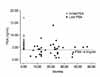
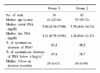
The data from 38 (group 1) and 87 (group 2) men was finally analyzed respectively. In group 1, the median age was 41 (25-44) and the initial PSA level was 5.60ng/ml (4.10-17.00). The PSA levels in 31 men (81.6%) decreased spontaneously during a median follow-up period of 20 months, and the PSA levels in 18 men (47.4%) were spontaneously normalized (<4.00ng/ml), and both of which were significantly higher as compared with those values in group 2 (48.3% and 28.7% respectively). Prostate biopsies were performed in 3 men (group 1), and 33 men (group 2); all of these revealed benign disease.
Figures and Tables
References
1. Smith RA, Cokkinides V, Eyre HJ. American Cancer Society guidelines for the early detection of cancer, 2004. CA Cancer J Clin. 2004. 54:41–52.
2. Grubb RL, Roehl KA, Antenor JA, Catalona WJ. Results of compliance with prostate cancer screening guidelines. J Urol. 2005. 174:668–672.
3. Collins MM, Stafford RS, O'Leary MP, Barry MJ. How common is prostatitis? A national survey of physician visits. J Urol. 1998. 159:1224–1228.
4. Collins MM, Meigs JB, Barry MJ, Walker Corkery E, Giovannucci E, Kawachi I. Prevalence and correlates of prostatitis in the health professionals follow-up study cohort. J Urol. 2002. 167:1363–1366.
5. Pansadoro V, Emiliozzi P, Defidio L, Scarpone P, Sabatini G, Brisciani A, et al. Prostate-specific antigen and prostatitis in men under fifty. Eur Urol. 1996. 30:24–27.
6. Cho IR, Kim GJ, Park SS, Choi HS. Prostate-specific antigen and prostatitis in men under 45 years old. Korean J Urol. 1998. 39:633–637.
7. Lee SO, Cho IR, Lee KC, Kim HS. Elevation of serum prostate specific antigen in subclinical prostatitis: the role of pathology of inflammation. Korean J Urol. 2006. 47:31–36.
8. Irani J, Levillain P, Goujon JM, Bon D, Dore B, Aubert J. Inflammation in benign prostatic hyperplasia: correlation with prostate specific antigen value. J Urol. 1997. 157:1301–1303.
9. Schatteman PH, Hoekx L, Wyndaele JJ, Jeuris W, Van Marck E. Inflammation in prostate biopsies of men without prostatic malignancy or clinical prostatitis: correlation with total serum PSA and PSA density. Eur Urol. 2000. 37:404–412.
10. Potts JM. Prospective identification of National Institutes of Health category IV prostatitis in men with elevated prostate specific antigen. J Urol. 2000. 164:1550–1553.
11. Stancik I, Luftenegger W, Klimpfinger M, Muller MM, Hoeltl W. Effect of NIH-IV prostatitis on free and free-to-total prostate-specific antigen. Eur Urol. 2004. 46:760–764.
12. Terrone C, Poggio M, Bollito E, Cracco CM, Scarpa RM. Asymptomatic prostatitis: a frequent cause of raising PSA. Recenti Prog Med. 2005. 96:365–369.
13. Zisman A, Soffer Y, Siegel YI, Paz A, Lindner A. Postejaculation serum prostate-specific antigen level. Eur Urol. 1997. 32:54–57.
 XML Download