



 PDF
 ePub
 Citation
 Print


Abstract
Purpose
The prognostic factors of renal cell carcinoma(RCC) are well known. However, the knowledge about the behavior of the nodal and metastatic involvement is still lacking. We analyzed the prognostic factors and survival for patients with various statuses of RCCs.
Materials and Methods
We conducted a retrospective review of 1,140 patients who had RCC between 1989 and 2005. The patients with multifocal and/or cystic RCCs, bilateral RCCs, RCCs related to ESRD and von Hippel-Lindau disease or the patients who didn't undergo lymph node dissection were excluded. The patients were divided into 4 groups; the TxN0M0 (473 patients), TxN1-2M0 (31), TxN0M1 (47) and TxN1-2M1 (21) groups. Univariate and multivariate analysis were performed to identify the prognostic factors (age, the mean tumor size, the pT stage, the histological type, the nuclear grade and the presence of symptoms). The five-year cancer-specific survival (CSS) also was calculated.
Results
The five-year CSS for each group was 90.5%, 62.8%, 38.8% and 17.9%, respectively. For the TxN0M0 group, every prognostic factor had a significant impact on survival on univariate analysis. Multivariate analysis subsequently showed that the pT stage, the histological type and the nuclear grade were independent prognostic factors. For the TxN1-2M0 group, the histological type was a significant prognostic factor. Age and the pT stage were independent prognostic factors for the TxN0M1 group and the presence of symptoms was an independent prognostic factor for the TxN1-2M1 group.
Conclusions
The survival was the highest for the TxN0M0 group and it was the lowest for the TxN1-2M1 group. The survival for the TxN1-2M0 group was better than that for the TxN0M1 group. These results obtained by analyzing the prognostic factors and the five-year CSS according to the various nodal and metastatic statuses of RCC patients will provided crucial information to predict clinical progression and the survival outcomes.
REFERENCES
1. Chow WH, Devesa SS, Warren JL, Fraumeni JF Jr. Rising incidence of renal cell cancer in the United States. JAMA. 1999; 281:1628–31.

2. American Cancer Society. Cancer facts & figures 2007. 2007. Atlanta, GA: American Cancer Society.
3. Kim WJ, Chung JI, Hong JH, Kim CS, Jung SI, Yoon DK. Epidemiological study for urologic cancer in Korea (1998-2002). Korean J Urol. 2004; 45:1081–8.
4. Ministry of Health and Welfare. 2002 Annual report of the Korea Central Cancer Registry. 2003.
5. Frank I, Blute ML, Leibovich BC, Cheville JC, Lohse CM, Zinche H. Independent validation of the 2002 American Joint Committee on Cancer primary tumor classification for renal cell carcinoma using a large, single institution cohort. J Urol. 2005; 173:1889–92.
6. Campbell SC, Novick AC, Bukowsik RM. Renal tumor. Wein AJ, Kavoussi LR, Novick AC, Partin AW, Peters CA, editors. editors.Campbell-Walsh urology. 9th ed.Philadelpia: Saunders;2006. p. 1603–7.
7. Green FL, Page DL, Fleming ID, Fritz A, Balch CM, Haller DG, et al. AJCC cancer staging manual. 6th ed.New York: Springer-Verlag;2002. p. 323–8.
8. Tsui KH, Shvarts O, Smith RB, Figlin RA, deKernion JB, Belldegrun A. Prognostic indicators for renal cell carcinoma: a multivariate analysis of 643 patients using the revised 1997 TNM staging criteria. J Urol. 2000; 163:1090–5.
9. Ljungberg B, Alamdari FI, Holmberg G, Granfors T, Duchek M. Radical nephrectomy is still preferable in the treatment of localized renal cell carcinoma. A longterm follow-up study. Eur Urol. 1998; 33:79–85.
10. Mejean A, Oudard S, Thiounn N. Prognostic factors of renal cell carcinoma. J Urol. 2003; 169:821–7.
11. Kim SW, Park WJ, Ha JS, Lee SJ, Lee JY, Lee CB, et al. Prognostic factors in renal cell carcinoma. Korean J Urol. 2002; 43:98–105.
12. Selli C, Hinshaw WM, Woodard BH, Paulson DF. Stratification of risk factors in renal cell carcinoma. Cancer. 1983; 52:899–903.
13. Hofmockel G, Tsatalpas P, Muller H, Dammrich J, Poot M, Maurer-Schultze B, et al. Significance of conventional and new prognostic factors for locally confined renal cell carcinoma. Cancer. 1995; 76:296–306.
14. Fuhrman SA, Lasky LC, Limas C. Prognostic significance of morphologic parameters in renal cell carcinoma. Am J Surg Pathol. 1982; 6:655–63.
15. Medeiros LJ, Gelb AB, Weiss LM. Renal cell carcinoma. Prognostic significance of morphologic parameters in 121 cases. Cancer. 1988; 61:1639–51.
16. Skinner DG, Colvin RB, Vermillion CD, Pfister RC, Leadbetter WF. Diagnosis and management of renal cell carcinoma. A clinical and pathologic study of 309 cases. Cancer. 1971; 28:1165–77.
17. Chang YS, Moon WC, Kim YS. Analysis of prognostic factors in renal cell carcinoma. Korean J Urol. 1994; 35:1065–72.
18. Golimbu M, Joshi P, Sperber A, Tessler A, Al-Askari S, Morales P. Renal cell carcinoma: survival and prognostic factors. Urology. 1986; 27:291–301.
19. Karakiewicz PI, Trinh QD, Bhojani N, Bensalah K, Salomon L, de la Taille A, et al. Renal cell carcinoma with nodal metastases in the absence of distant metastatic disease: prognostic indicators of disease-specific survival. Eur Urol. 2007; 51:1616–24.
20. Bottiger LE. Prognosis in renal cell carcinoma. Cancer. 1970; 26:780–7.
21. Lee CT, Katz J, Fearn PA, Russo P. Mode of presentation of renal cell carcinoma provides prognostic information. Urol Oncol. 2002; 7:135–40.
22. Henson DE, Fielding LP, Grignon DJ, Page DL, Hammond ME, Nash G, et al. College of American Pathologists Conference XXVI on clinical relevance of prognostic markers in solid tumors. Summary. Members of the Cancer Committee. Arch Pathol Lab Med. 1995; 119:1109–12.
23. Taccoen X, Valeri A, Descotes JL, Morin V, Stindel E, Doucet L, et al. Renal cell carcinoma in adults 40 years old or less: young age is an independent prognostic factor for cancer-specific survival. Eur Urol. 2007; 51:980–7.
24. Sanchez-Ortiz RF, Rosser CJ, Madsen LT, Swanson DA, Wood CG. Young age is an independent prognostic factor for survival of sporadic renal cell carcinoma. J Urol. 2004; 171:2160–5.
25. Gillett MD, Cheville JC, Karnes RJ, Lohse CM, Kwon ED, Leibovich BC, et al. Comparison of presentation and outcome for patients 18 to 40 and 60 to 70 years old with solid renal masses. J Urol. 2005; 173:1893–6.
26. Kang JS, Kim JC, Rhew HY. Comparitive analysis of advanced renal cell carcinoma according invasion, metastatic sites and number. Korean J Urol. 2000; 41:725–30.
27. Canfield SE, Kamat AM, Sanchez-Ortiz RF, Detry M, Swanson DA, Wood CG. Renal cell carcinoma with nodal metastasis in the absence of distant metastatic disease (clinical stage TxN1-2M0): the impact of aggressive surgical resection on patient outcome. J Urol. 2006; 175:864–9.
28. Vasselli JR, Yang JC, Linehan WM, White DE, Rosenberg SA, Walther MM. Lack of retroperitoneal lymphadenopathy predicts survival of patients with metastatic renal cell carcinoma. J Urol. 2001; 166:68–72.
29. Pantuck AJ, Zisman A, Belldegrun AS. The changing natural history of renal cell carcinoma. J Urol. 2001; 166:1611–23.
Fig. 1.
Cancer-specific survival according to the lymph node involvement or metastasis (Kaplan-Meier cancer survival curve).
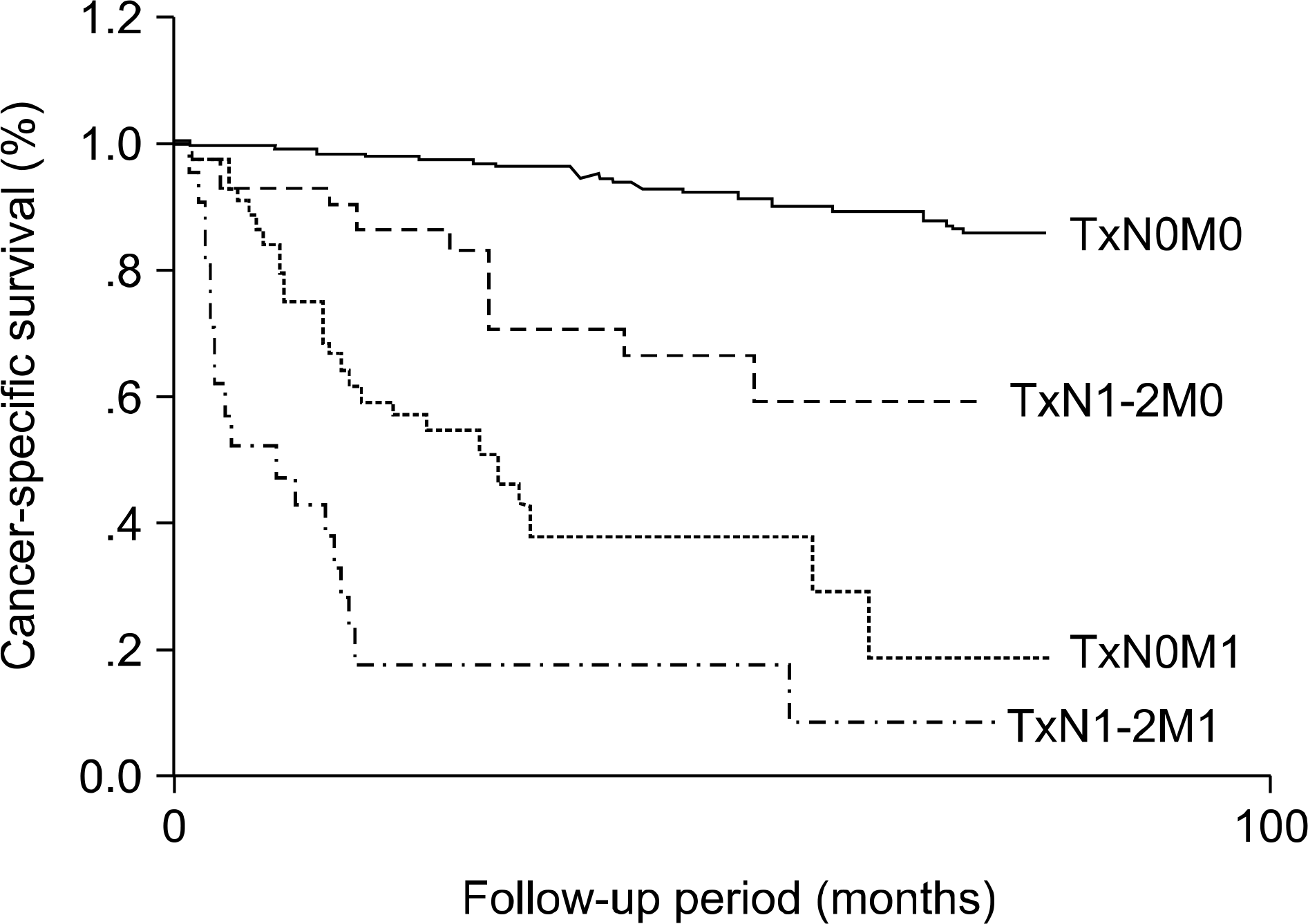
Table 1.
Clinical characteristics
| Group A | Group B | Group C | Group D | p-value | |
|---|---|---|---|---|---|
| No. of patients | 473 | 31 | 47 | 21 | |
| Mean age±SD (years) | 54.1±11.3 | 52.0±17.1 | 55.3±10.9 | 53.2±14.3 | 0.652∗ |
| 0.601† Sex | |||||
| Male (%) | 339 (71.7) | 22 (71.0) | 37 (78.7) | 17 (81.0) | |
| Female (%) | 134 (28.3) | 9 (29.0) | 10 (21.3) | 4 (19.0) | |
| Mean tumor size±SD (cm) | 6.4±3.2 | 8.7±3.7 | 8.8±3.0 | 10.4±3.9 | <0.001∗ |
| <0.001† Pathological T stage (%) | |||||
| pT1a | 130 (27.5) | 4 (12.9) | 0 (0) | 0 (0) | |
| pT1b | 151 (31.9) | 3 (9.7) | 8 (17.0) | 1 (4.8) | |
| pT2 | 86 (18.2) | 5 (15.1) | 13 (27.7) | 4 (19.0) | |
| pT3a | 48 (10.1) | 6 (19.4) | 12 (25.5) | 7 (33.3) | |
| pT3b | 50 (10.6) | 11 (35.5) | 12 (25.5) | 5 (23.8) | |
| pT3c | 3 (0.6) | 0 (0) | 1 (2.1.0) | 2 (9.5) | |
| pT4 | 5 (1.1) | 2 (6.5) | 1 (2.1.0) | 2 (9.5) | |
| <0.001† Histological type (%) | |||||
| Conventional | 366 (82.4) | 14 (60.9) | 37 (84.1) | 11 (55.0) | |
| Papillary | 26 (5.9) | 4 (17.4) | 2 (4.5) | 5 (25.0) | |
| Chromophobe | 36 (8.1) | 0 (0) | 0 (0) | 1 (5.0) | |
| Collecting duct | 0 (0) | 0 (0) | 0 (0) | 1 (5.0) | |
| Unclassified | 16 (3.6) | 5 (21.6) | 5 (10.3) | 2 (10.0) | |
| <0.001† Nuclear grade (%) | |||||
| 1 | 20 (4.5) | 0 (0) | 1 (2.2) | 0 (0) | |
| 2 | 205 (46.2) | 6 (22.2) | 13 (28.3) | 1 (4.8) | |
| 3 | 177 (39.9) | 16 (59.3) | 24 (52.2) | 14 (66.7) | |
| 4 | 42 (9.5) | 5 (18.5) | 8 (17.4) | 6 (28.6) | |
| Mean follow-up±SD (months) | 57.6±38.0 | 49.5±38.7 | 25.1±19.5 | 16.1±20.6 | <0.001∗ |
Table 2.
Five-year cancer-specific survival for the patients with renal cell carcinoma according to lymph node involvement or metastasis
Table 3.
Multivariate analysis of the five-year cancer-specific survival for patients with renal cell carcinoma without involvement of the lymph node or other organs (multivariate Cox regression model)
 XML Download